The wealthiest members of the Millennial generation are on the threshold of their peak earning years, but a Millennial-fueled luxury buying boom that could hit around 2020 as they enter middle age may not play out. Why not? Because luxury isn’t important to them, says affluent consumer expert Pam Danziger. This generation prefers substance over style, and their buying patterns will reflect who they are, not how much money they are capable of spending.
Danziger is president of Unity Marketing, a consulting firm focusing on the buying behavior and motivation of luxury consumers, and the author of two books on the upscale consumer, including Putting the Luxe Back in Luxury. How New Consumer Values Are Redefining the Way We Market Luxury (Paramount Market Publishing, 2011). She says a generational shift is on the horizon, one that heralds a brand-new definition of luxury. Brands and marketers that think luxury buying patterns of the past will prevail are in for a rude awakening.
Danziger spoke with Diane Merlino, editor in chief of Travel Weekly PLUS, about the new realities of the upscale consumer and how they could impact the luxury travel market. This is the second of three installments from their dialogue, edited for clarity and length.
Merlino: How are today's luxury consumers different from the luxury consumer of two or three years ago?
Danziger: Well, they're older. And the older you get, the more you pull in your spending, and it changes direction.
Younger affluents — between 24 and 44 years of age — tend to spend a whole lot of money on luxury goods. They are in an acquisitive life stage. They're having families, they’re buying their move-up home, they're buying new furniture. They're acquiring more professional wardrobes, maybe they’re investing in higher-priced jewelry and buying new, more expensive luxury cars. They are acquiring things; they have a very heady appetite for luxuries.
As you get older, over that 45 mark, you tend to have already acquired most of that stuff. The difference between how much younger affluents and more mature affluents spend is distinctly different.
Prior to the recession, people who were 40 and still had a heady appetite for luxuries are around 45 now, and the  thinking is more like, "Ah, who needs it? Who wants it?" I can just hear my husband now; he looks at my closet and he says, “You absolutely do not need to buy any more clothes ever again.” Sad but true. I've got a closet-full, and how many times a year do I even wear them? So there is no justification for me to go out and buy a new outfit.
And that's really what's happened. We've got an older, more mature consumer.
Merlino: More mature affluent consumers may not be in the acquisition mode any longer but doesn’t the experiential mode increase in importance for this demographic? That’s where travel buying would fit in.
Danziger: Exactly. Older, more mature people are definitely experientially oriented, and they spend and invest in experiences. But they’re going to want to invest in experiences they haven’t had yet. This is not to criticize any of the hotel brands in any way, but there’s not that much difference if you’ve stayed in a Ritz-Carlton or Four Seasons resort in one country or city or another.
The mature affluent consumer is searching for different, meaningful, life-changing experiences. I hear this when I do focus groups. For some young people, that first stay at a Ritz-Carlton Resort is a life-changing experience. For someone 55 it isn't. It’s like, “This again?”
Mature affluents want real travel experiences. Many times they want to get their hands dirty and get dust on their feet. They want to really experience the destinations and the locals. There’s a distinct change in orientation.
Merlino: Pam, you emphasize that marketers who expect the next generation of affluents to restore the luxury market to the patterns of the past are missing the boat.
Danziger: The babies of the baby boomers — the Millennial generation — haven't hit affluence yet, because affluence comes with middle age. But once this generation gets to be about 35, they will be growing in professional status and getting rewarded for their contributions in business. They’ll be accumulating money, and they will have an appetite for luxury.
But to think that this generation is going to define luxury the same way as baby boomers or Gen Xers did is ridiculous. It’s going to get a lot of people into a lot of trouble, because there's a generational shift coming. Many of this younger generation have grown up in very affluent circumstances, so affluence and luxury may not have the appeal for them that it did for people who didn't grow up that way.
I'm thinking of my own family. I grew up in a middle-class family. My father was a white-collar worker, but there was just one income, and there were two children, and I went to public school and so on. It was a very middle-class background. My children grew up in a much more affluent environment, and I don't see any indication that they're striving for that same level of affluence. They're striving much more for personal self-expression, and trading off money for other things when it comes to their career goals and their life goals.
Merlino: You’ve said that growth in the luxury market is destined to slow down, since there are fewer potential luxury customers coming along to build a bridge to the future.
Danziger: A new luxury boom could potentially hit around 2020 when the Millennials start reaching that period of middle age and affluence in their careers. But I’m very skeptical about whether it will play out or not.
We recently did a series of focus groups with young people who were all in professional fields and had very ambitious career goals. They all had advanced academic degrees. When I asked them what luxury meant to them, 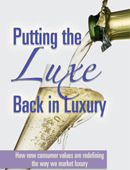 they said, “Luxury is just a marketer’s term. It doesn't mean anything to me.” That was chilling, because what they were really saying is, “This isn't important to me. I'm more interested in other things.”
I asked about watches; these are people who are going to be in boardrooms, and their watches are going to show under their suits. Their status symbol watch wasn’t a Rolex. It was a triathlon watch because that says “I am a triathlete. I need this triathlon watch,” not “I can spend a lot of money on a Rolex.” That’s says something about who I am; it’s internal. It’s not about the shirt or the coat or the watch I wear or the car I drive. These people are putting substance before style.
Merlino: In a nutshell, how is that focus on internal values and self expression by Millennials different from what fueled baby boomer luxury purchases?
Danziger: Baby boomers had a strong focus on style before substance, at least as far as luxury and affluence were concerned, so this generational shift has some very significant implications for marketers.
Brands selling luxury goods, not luxury experiences, will be in the most vulnerable spot in this marketplace. But luxury experiences are vulnerable, too. Think of all the boutique hotels that are out there now. My husband and I won't stay in a Four Seasons or Ritz-Carlton. We like boutiques because we want something different, not the same cookie-cutter thing.
Merlino: Do all of these changes collectively add up to a situation where affluent consumers will become less important to brands and retailers?
Danziger: No. Affluent consumers are always going to be the ones with cash. In fact, through this recession, they've become even more important because the middle class has gotten wiped out. They’re buying power and spending power have really eroded, and I think it's going to erode even more as we go forward. So the affluent are going to become even more important to brands.
NEXT ISSUE: Pam Danziger’s analysis of Unity Marketing’s luxury trend report, Affluent Consumers and their Travel Plans 2013.
ALSO SEE:Today’s Affluent Consumers Are Feeling Decidedly Middle Class