The Entrepreneurial X-Factor
Insights from Maddy Dychtwald on the job creation engine fueled by entrepreneurs:
“There’s an assumption made by mainstream corporate firms that when women leave the corporate workplace to start their own businesses they are creating kitchen-table businesses, just trying to make some money while they’re raising their families. That’s just not the case.
During the height of the recession, while corporate entities were firing people, women-owned businesses were actually hiring people and helping move us out of the recession.
Let me put a caveat on that. It’s true that women-owned businesses were in a hiring mode during the recession at the same time corporate entities were laying people off, but so were other entrepreneurial companies. Entrepreneurial companies, in general, were willing to take the risk. For one thing, when you have a small company your relationship with your employees is really different than in a corporate structure. It’s much more intimate, you feel for them.
I’ll give you an example from my own company. We have an entrepreneurial company (AgeWave, cofounded by Maddy Dychtwald). During the height of the recession, when it was really at its very worst, our company was not doing well. But we did everything we could to save money rather than firing people, because we felt a relationship with the people that we had brought on to work with us.
As it turned out, we didn’t have to fire one person. We did have to change some packages, but we didn’t have to actually fire anyone. They all stuck it out, and we came out the other end doing better than ever, working together to make things successful.
I think that’s a model that women and entrepreneurs are more willing to follow, where in the more structured corporate world there’s a more bureaucratic system and it’s less empathetic. There is less consideration given to the right thing to do and more of a tendency to follow the rules that have always been followed to save money, rather than thinking about the best way everyone can endure.”
We’re on the cusp of an unprecedented economic and social shift, fueled by the growing financial power of women. According to author and researcher Maddy Dychtwald, that’s great news for everybody, including women, men, millennials and generations to come.
Dychtwald is cofounder and senior vice president of Age Wave, a research and consulting firm that focuses on the implications of population aging and counts more than half of the Fortune 500 companies among its clients. She is also the author of three books, including Influence: How Women’s Soaring Economic Power Will Transform Our World for the Better (Hyperion Books, 2010.)
Based on proprietary research and candid interviews, Influence makes a lively case that women’s increasing 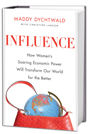 financial power will be wielded in myriad and unexpected ways that will improve our society and culture.
Several chapters examine how women are transforming the business world, both from the inside out and from what Dychtwald describes as the “entrepreneurial exodus” of smart and successful women who are leaving the corporate world to start their own companies in record numbers — 1.5 times the national average for new business launches in the U.S. over the last 15 years.
Dychtwald shared her expertise on some of the far-reaching implications of gender-related and generational demographic trends in an exclusive interview with Travel Weekly PLUS.
You’ve described the emergence of women as an economic force as being the biggest demographic change of our times.
Yes. And that’s not just in the United States; it’s a global trend.
If that’s the case, why aren’t we seeing more discussion or research about it?
There have been different phases of women moving forward, and that’s when attention has focused on a particular issue.
For example, when Susan B. Anthony was trying to get the women’s vote, she got a lot of attention. When the baby boomer women were the first generation en masse to go to college, they got a lot of attention for it. And when they were the first generation to enter the workforce and stay in the workforce — trying to create careers rather than just working jobs — people sat up and took notice because they were the first generation to do it. They were pioneering the space.
Today it’s different because we’re not pioneering the space. We’re retrofitting the space.
Describe what you mean by retrofitting the space.
Retrofitting is like renovating a house rather than building it. When you renovate the house, it generates a different kind of attention from the outside. Actually, you can renovate without the outside world even knowing you’re doing it. You can be making incredible changes, making your life very different in the home you’re living in. That’s what women are doing in the workplace. They aren’t setting out to tear down and rebuild. They’re retrofitting the space.
Can you put some context around this in terms of women moving forward in the work world?
When the baby boomer generation first entered the workforce they were trying to fit into a system that was designed for men. For the most part, women were second-class citizens — if they were even that. Most women were in supporting or subservient positions in the workplace, because the general point of view was that women just weren’t up to the task.
So, baby boomer women worked incredibly hard to both fit in and do well. They put in the long, grueling hours, and they were willing to be the only woman senior executive if they made it up to that level. They were even willing to dress like men in some instances; if you were around back in the 1980s, the style was women wearing pantsuits and ties. The idea was to fit in.
Do you think the focus on fitting in is still true today?
Well, that’s transformed itself pretty dramatically. But the other thing about that time — a negative — is that rather than trying to help one another up the scale of success, women felt very competitive with each other.
They saw that the successful end of the workforce was dominated by white men, with a token woman or two in there. So a lot of women felt, “Well, if you may make it, I may not.” That created a very competitive environment for women. And if they wanted to get a mentor, they usually had to get a guy as a mentor because there just weren’t women in place to do it.
 On top of that, in terms of being supportive, the women who did make it felt that they had come up the hard way, and they expected other women to do the same. That was the prevailing attitude. That also has really changed, even for that generation of women.
Given everything you’ve just said, can you elaborate on what you mean when you say that women today are retrofitting the workspace rather than pioneering it.
For one thing, many women have come into the workforce and introduced new concepts to make it a little bit more user-friendly for women, especially women with families. Out of that we’ve seen the more flexible workplace.
We’ve seen the virtual workplace. We’ve seen job sharing. And we’ve seen some innovations that were used to help women have a life and have a career at the same time. Those were the early precursors to what we see going on now.
What other “retrofitting” trends do you see occurring in the workplace?
It’s still often difficult for women to fit into the mainstream corporate workplace because the expectations for success are still based on many of the same values that were in place back in the 1950s and 1960s.
Instead, very well educated, very savvy and very capable women are deciding, “You know what? I can’t even try to fight that fight. Instead, I’m going to go out and I’m going to do it on my own.” They are the ones who have created the entrepreneurial exodus. They’re the ones — very talented and very well educated — who often leave the workplace and start their own businesses.
Do you have any numbers on the entrepreneurial exodus?
From 2007 to 2012, the number of women-owned businesses in the U.S. increased from 7.8 million to 8.3 million — about 100,000 new businesses per year. Overall, in the past 15 years, the number of U.S. businesses increased by 37%, whereas the number of women-owned businesses increased by 54% — approximately 1.5 times the national average.
Editor’s Note: Information cited is from The State of Women-Owned Businesses Report 2012, commissioned by American Express OPEN.)
Those are really impressive numbers.
The underpinning of these changes is women’s education. It started with the baby boomers, but it’s really cascaded over the last decade. And this is not just in the United States; it’s global. We see women being educated unlike ever before.
In the United States, just last year, 73% of all high school valedictorians were women. And women are graduating from college in higher numbers than men — significantly higher numbers. And they’re going on to graduate school, which is really where the rubber meets the road. That’s where you get the skillset to succeed in the workplace and the toolkit that allows you to be innovative, to think and act outside of the box.
That’s exactly what women entrepreneurs are doing. You’ll see a lot of MBAs turning around and saying, “No, this is not okay with me. I can do this better.”
By the way, the flip side of women exiting the corporate workforce is that corporations are beginning to create innovations to hold onto that talent because they realize they can’t afford to lose it. So there is a positive impact on the corporate side as well.
Next week: The dialogue with Maddy Dychtwald focuses on how women are influencing corporations to change, from the inside out.