The Iran war has led to at least a temporary reshaping of air traffic patterns connecting Europe with Asia and the Oceania region.
Since March, European and Australasian carriers have beefed up their long-haul east-west offerings to capture demand that has materialized because Emirates, Qatar Airways and Etihad have sharply cut back operations.
In April, Emirates flew 34% fewer flights than it did a year ago, according to Cirium data, while Qatar was down 56% and Etihad 19%. The cuts are due to restricted airspace within the Middle East as well as aversion to Gulf transit from the traveling public due to safety concerns.
With those airlines, especially Emirates and Qatar, being massive transporters of travelers between Europe and Asia, especially India, demand has spiked for itineraries that don't touch the Middle East.
British Airways has been aggressive in exploiting the void, replacing much of its Middle Eastern capacity with additional flights to India, including Bangalore, Delhi and Mumbai. It also added an extra daily flight to Nairobi, Kenya, for the summer.
For June through October, British Airways is scheduled to fly 21.9% more flights to India than in 2025, according to Cirium.
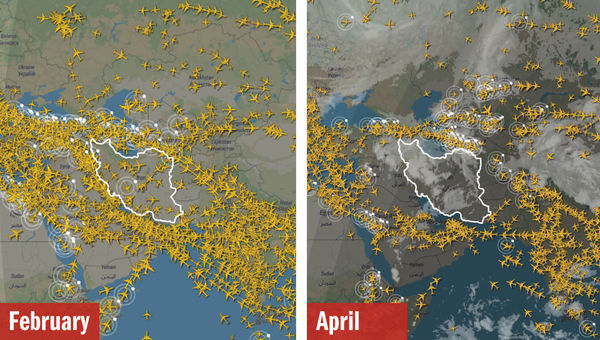
Images of flight traffic show much lighter traffic across the Middle East on an early Tuesday evening in late February compared to one in late April. Photo Credit: AirNavRadar.com
The move "generates replacement revenue" while British Airways' Middle East routes are suspended, said John Grant, senior analyst for flight-data company OAG. It could also "take the pressure off" when Middle East aviation gets back to normal, said Grant, who anticipates a fare war when that happens.
Meanwhile, Air France has placed larger aircraft on flights to eight airports in Thailand, Singapore, India, China and Japan. Air France also added flights to Singapore and Tokyo Haneda in June.
Lufthansa Group carriers, which include Lufthansa, Austrian, Swiss, ITA and Brussels, are taking similar measures. They have temporarily replaced Middle East service with flights to Thailand, India and South Africa as well as destinations in Southern Europe.
Qantas doesn't fly to the Middle East. But in response to a demand surge for European service that avoids a Middle East stopover, Qantas has redeployed aircraft from widebody domestic service and from its U.S. network to bolster service to Paris and Rome.
East Asian carriers have reported demand increases for Europe destinations. For example, Korean Air reported an 18% increase in passenger revenue on its Europe routes in the first quarter, citing the Iran war as the reason.
There are limits
Still, fundamental constraints will prevent airlines from making more sweeping moves to capture the sudden unmet Europe-Asia demand.
Airlines simply don't have lots of spare aircraft sitting around that they can redirect on short notice, Grant said.
Capacity limitations across major European airports, including Amsterdam Schiphol, London Heathrow and Paris Charles de Gaulle are another major sticking point, said John Strickland, director of London-based JLS Consulting.
Adding a flight to Asia will typically mean dropping a flight elsewhere. Strickland said European airlines could add Asia flights "if they were to scrap more of their North Atlantic programs, but that's not likely."
He said Turkish Airlines, already a major player in east-west connections, is positioned to benefit structurally from Middle East turmoil. It's a large airline, well positioned geographically, and its service culture is respected.
Importantly, Istanbul Airport has lots of spare capacity, and Turkish has large order books with Airbus and Boeing.
Strickland said he expects the Gulf carriers to fully recover ultimately.
"These airlines, in the case of Emirates for more than 40 years, have built up such a reputation for quality of service and competitive pricing," he said. "Of course, they will be going out of their way to reassure people."
Grant said Emirates, Qatar and Etihad could even benefit over the long-term. He noted that several British Airways routes to the Middle East have historically been poor performers and predicted that European carriers will not return to the region with the level of capacity they had in the past.