In the early 2000s, when Pittsburgh Airport was a US Airways hub, it offered nonstop flights to more than 100 destinations. But by the time Christina Cassotis took over as CEO of the Allegheny County Airport Authority in early 2015, U.S. Airways had long since pulled the plug on the Steel City.
The result: Pittsburgh had nonstop connections to just 37 airports, and the 2014 passenger traffic figure had dropped below 8 million, less than half the number of travelers the airport had served in 2002.
"We were so dramatically underserved when I got here," Cassotis said. "You could see that passengers had fallen off in key markets because they didn't have access to air service."
However, in the two years since her arrival, Pittsburgh Airport has experienced something of a metamorphosis, buoyed by the low-cost carriers.
Allegiant began serving Pittsburgh in 2015 and now flies nine routes from there.
Frontier came next, in 2016. It now flies from Pittsburgh to Denver, Las Vegas and Orlando.
Then, last month, Spirit announced it would enter Pittsburgh this summer with seven routes.
Today, Pittsburgh offers flights to nearly 70 cities nonstop, with more to come in the summer.
Meanwhile, American, which subsumed US Airways in late 2015, isn't the largest carrier in Pittsburgh any longer. That mantle is held by Southwest, which carried 28% of the airport's passengers over the 12-month period that ended on Nov. 30, according to the most recent data available from the DOT's Bureau of Transportation Statistics.
Indeed, Southwest offers daily service, for at least part of the year, to 15 destinations from Pittsburgh, up from just four in 2005, a year after US Airways began its dehubbing operation.
Pittsburgh is one of several airports across the nation's midsection that have seen air service connectivity crash in the past decade or so as the major U.S. airlines have consolidated, and those that remain have concentrated their hubs.
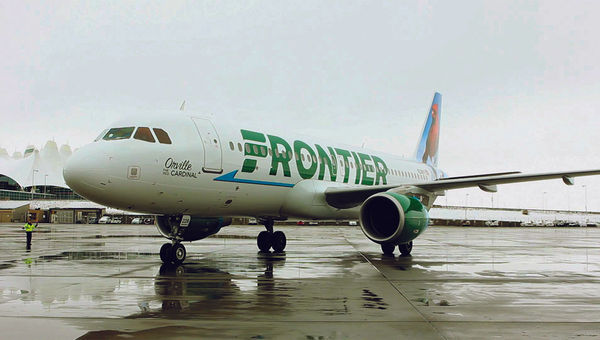
Frontier named an Airbus A320 Orville the Cardinal to honor the carrier’s growth in Ohio. It has 17 routes out of Cincinnati and will soon have 11 routes out of Cleveland. The cardinal is Ohio’s state bird, and Orville Wright was an Ohio native.
In 2014, Cleveland Hopkins Airport became the most recent casualty when United decided to end its hub operation there. Cincinnati/Northern Kentucky Airport suffered a similar fate in 2005, when Delta began dehubbing. Moreover, Delta ended its hub operation in Memphis in 2010, resulting in an approximately 65% drop in that city's air passenger traffic over the next four years.
St. Louis, Milwaukee and Columbus, Ohio, are among the other cities that have seen their airports lose connecting hub status in recent years.
The decision of an airline to close a hub can be damaging to both the economy and the psyche of the affected city, costing the community jobs and tax revenue while depriving residents of the air travel options to which they have become accustomed. But it can also present opportunities.
For competing carriers, those opportunities are obvious. For example, Scott Brockman, CEO of the Memphis-Shelby County Aviation Authority, said that at its peak in 2009, Delta had 240 flights per day out of Memphis. As of late January, it was flying 21. That leaves plenty of potential space for competitors to fill in the gaps.
The void left by legacy carriers at former hubs has long played a key part in Southwest's network expansion strategy, said Carter Ganss, the airline's director of commercial planning.
"We're constantly looking for ways to deliver customer nonstop service with our point-to-point model," he said, referencing Southwest's business approach that relies on direct routes between a wide combination of cities rather than centering operations out of a handful of hubs.
The opportunities that being dehubbed present to airports may be less immediately apparent and are often countered with major challenges, such as figuring out how to replace revenue and how to deal with empty gates and vacant terminals.
Still, as hubs, airports mainly cater to connecting passengers who never set foot outside the terminal. When an airport suddenly becomes a spoke instead, it has the opportunity to turn its focus to the community itself, where rewards come from offering accessible flights and a customer service experience that is focused on hometown flyers.
"Quite frankly, we're in reinvention mode right now," Brockman said. "We're reinventing the airport into something that it hasn't been in 45 years: an origin and destination airport."
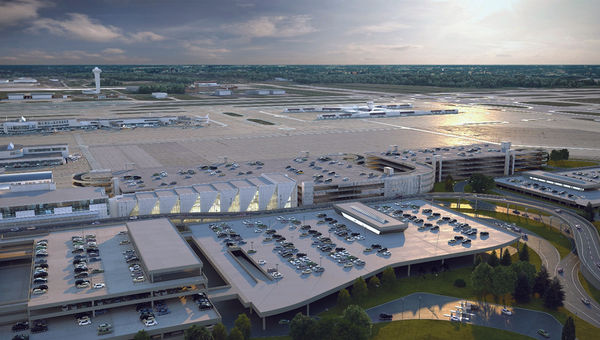
A rendering of the car rental facility that will be built at the former site of terminals 1 and 2 of Cincinnati/Northern Kentucky Airport.
Lower fares
For airports like Memphis and Cincinnati, part of that process involves making flying more affordable.
Despite offering many flights, hubs are often expensive to fly into and out of. One reason for that dynamic is that a single airline can dominate a hub enough to thwart competition. Another reason, Ganss said, is that at a hub operation locals typically occupy just 30% of a given plane.
But even though a one-stop connecting passenger will take twice as many flights on an itinerary as a nonstop passenger, airlines don't typically charge a connecting passenger twice as much. So passengers who are flying direct from the hub airport end up paying a premium to, in effect, subsidize connecting passengers.
During the peak of Cincinnati's hub days in 2005, for example, the average itinerary, adjusted for inflation, cost $464, according to the Bureau of Transportation Statistics. In the third quarter of last year, the average cost was $363.
Similarly, Memphis passengers paid an inflation-adjusted price of $466 for an average itinerary at the end of the Delta hub period in 2010. The price had dropped to $388 by late last year.
Of course, ticket prices don't come down on their own. To make that happen, airports that have ceased to be connecting hubs often offer discounts on fees as well as marketing assistance to attract other airlines. For example, the average fee in Pittsburgh, measured as the cost per enplaned passenger, was $16.73 in 2015, the last year for which the Bureau of Transportation Statistics website shows data. That's down from $18.51 two years earlier.
Cassotis said the figure dropped again last year.
"We continue to lower fees so that the airlines can count on stability," she said.
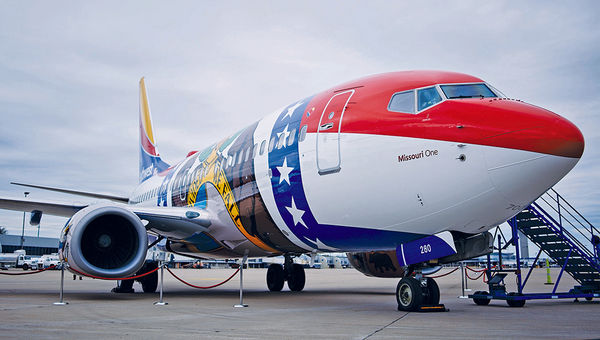
Southwest Airlines’ expansion strategy involves filling the void left by legacy carriers at former hubs. It unveiled the Missouri One in April 2015 in Kansas City, Mo., celebrating 30 years of service in the state.
Carriers, including Allegiant, Frontier and Southwest, are certainly attracted to such bargains. But they're also attracted to the profit potential they find in the many underserved markets that hub carriers leave behind when they exit a city.
Ganss cited as an example Lambert Field in St. Louis, which was a TWA hub until the carrier was folded into American in 2001. When American completed its de-hubbing there in 2007, Southwest flew 24 routes from the airport. Today Southwest is by far Lambert's largest carrier, offering 44 routes and carrying 55% of its passenger traffic. St. Louis is Southwest's fifth-largest base, behind Chicago Midway, Denver, Baltimore and Las Vegas.
Ganss said that because the 35% of Southwest passengers who are making connections is much smaller than the portion of connecting passengers that the legacy airlines service from a hub, it is able to move into dehubbed markets and offer lower fares while still making a profit.
Flying from point A to point B, Ganss said, is simply less costly than flying from point A to point B to point C.
Southwest entered Memphis in 2014 and will make Cincinnati its newest U.S. destination in June when it launches service from the southern Ohio city to Baltimore and Chicago.
However, Southwest won't be the first airline filling Delta's void. Frontier entered the market in 2013 with a total of six flights per week and will have increased that figure to 93 per week with the launch of service to San Diego, New York LaGuardia and Minneapolis in April. At that time, Frontier will fly to 17 destinations from Cincinnati, making the airport its fourth-largest base.
Allegiant began flying to Cincinnati in 2014 with two routes. In the short time since then, Cincinnati has grown into Allegiant's largest origination market, with 15 operating routes and Denver service coming in June.
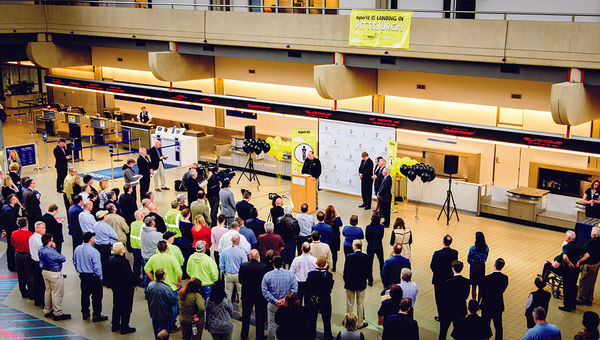
Officials gathered at Pittsburgh Airport in February to celebrate Spirit’s announcement that it would bring service there this summer with seven routes.
Daniel Shurz, the chief commercial officer for Frontier, said that former hub airports often make good hunting grounds for ultralow-cost carriers (ULCC). Frontier entered Cleveland in 2012 and will be serving 11 destinations from there by May. The carrier also has begun service in recent years in Memphis, Pittsburgh and St. Louis.
But Shurz noted that fundamentally what Frontier is looking for is underserved leisure-market city pairs or leisure-market city pairs with expensive fares that it can undercut. On average, tickets in Cincinnati, he said, even when baggage fees are added in, were only slightly more than half the cost of tickets sold by the legacy carriers during the third quarter of last year.
"That's the story around the country," Shurz said.
Allegiant operates under a similar business model, looking for underserviced and overpriced leisure-centric routes. But Lukas Johnson, the carrier's vice president of network and pricing, is more direct than Shurz in discussing the strategic interest the ULCC has in dehubbed airports.
"If there's not a current existing hub carrier in your market and you've lost seats over the last eight years or so, we'll be taking a look," Johnson said.
Along with its recent entries into Cincinnati and Pittsburgh, Allegiant began service in Columbus in 2012, St. Louis in 2014 and Memphis in 2015. In February Allegiant added Cleveland to its network, commencing nine routes with plans to launch a 10th in April.
"By and large, we want to be the all-encompassing, leisure, sun-and-fun airline for these dehubbed airports," Johnson said.
Creating a new experience
Large airports offer the advantage of lots of flights. But as anyone who flies out of one knows, they often come with the disadvantages of heavy traffic, long security lines and lengthy journeys between check-in and the gate.
For dehubbed airports, faced suddenly with the reality that their primary customer is the local traveler rather than a connecting one, a smaller size can be an advantage as they seek to re-engage local travelers, not only with new and less-costly routes but with improved customer service.
To take advantage of the contraction, however, airports have to shift from a focus on moving passengers within their terminals to moving traffic to and from the facility, Brockman said.
They also have to deal with lots of excess space.
Memphis airport, for example, has 83 gates spread over its three concourses.
But at present, just 17 of them are leased. So this year Memphis will close its Concourse B to begin what could be a more than $100 million modernization project.
When the concourse reopens early next decade, passengers will enjoy modern amenities, such as moving walkways and larger gate areas. But they'll also find a more concentrated facility, where gates, retail outlets and restaurants will be more conveniently situated, reflecting the airport's smaller operation.
With the reopening of Concourse B, Memphis will also mothball concourses A and C, Brockman said.
In another step geared to local flyers, Memphis constructed a 4,500-space, $121 million, centrally located parking garage in 2012, which replaced its more distant feeder lots.
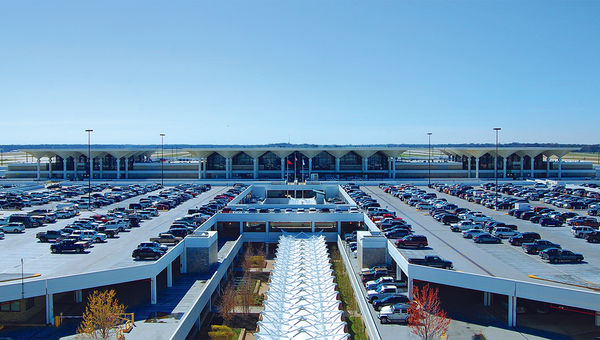
Memphis Airport completed a 4,500-space parking garage in 2012 as part of the process of making the airport more customer-friendly to local travelers with its current status as an origin and destination facility rather than as a connecting hub.
Similar mechanisms are underway in Cincinnati, where passenger traffic was at 6 million in 2015, compared with 23 million a decade earlier.
The airport closed its terminals 1 and 2, respectively, in 2007 and 2012 and last year demolished them to make way for a car rental center that will connect to the lone existing terminal, Terminal 3.
"It's all about making it a great experience for those people coming or going through your front door," Cincinnati airport CEO Candace McGraw said.
Beyond the mechanics of making the airport experience easier and more pleasant, directors of dehubbed airports said it's essential to engage in new ways with the community as flights begin to return and prices come down.
"One of the biggest issues we have is awareness," said Pittsburgh's Cassotis. "Lots of people remember the cuts and start thinking we can't get anywhere, so they don't even look."
Cassotis said her team works closely with the local business community as it seeks out and markets routes. She also emphasized the airport's efforts to create a sense of place inside the terminals themselves.
For example, Pittsburgh airport has its own concert series as well as more than a dozen locally focused art exhibits.
Last November, the airport completed a renovation of its Kidsport play-and-learning center, which features seven interactive exhibits, some of them designed by community partners such as the Carnegie Science Center and the Children's Museum of Pittsburgh.
Such steps are designed to increase the connection between the airport and the Greater Pittsburgh community.
"You may not know, as an outbound traveler, that there is a really cool exhibit at the Carnegie Center," Cassotis said.