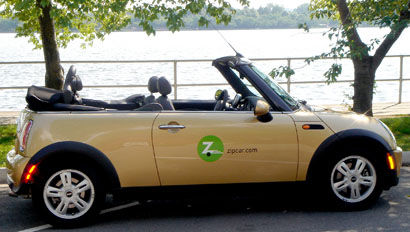
 Last week’s proposed $500 million acquisition of Zipcar by Avis Budget Group signaled that the car-sharing portion of the car rental business is rapidly maturing from an experimental niche to a proven market segment.
Avis Budget, the No. 3 U.S. car rental company behind Enterprise and Hertz, said last week that it will pay $12.25 a share for Zipcar, a 49% premium over Zipcar’s closing price on Dec. 31, the last trading day before the announcement.
The acquisition is slated to close by the end of March, and Avis Budget predicted that the combined companies will save as much as $70 million in annual operating expenses compared with their current combined costs.
Zipcar, which was founded in 1999 and went public in April 2011, has more than 760,000 members. It operates in 20 cities and on more than 300 college campuses in North America and the U.K.
“By combining with Zipcar, we will significantly increase our growth potential, both in the United States and internationally, and will position our company to better serve a greater variety of consumer and commercial transportation needs,” Avis Budget CEO Ronald Nelson said in a statement. “We see car sharing as highly complementary to traditional car rental.”
The U.S. car-sharing segment also includes the Enterprise CarShare unit, the Hertz On Demand division and Daimler AG’s Car2Go unit. In all, the segment generates about $400 million a year in revenue, according to Avis Budget.
Unlike traditional car rental companies, car-sharing services have members that, in Zipcar’s case, can pay either an annual fee for more occasional use or a monthly fee for regular use, with gas and insurance inclusive.
For example, in Los Angeles, Zipcar offers two plans: a $60 annual fee that lets drivers rent cars for as little as $8.75 an hour or $72 a day; and a $50 monthly membership fee that includes eight hours of prepaid driving plus a 10% discount on regular hourly rates beyond that threshold.
Members can make an online reservation, swipe their membership card over a car-window sensor for access and drive away.
Car sharing has gained popularity in the past few years. The Frost & Sullivan research firm estimated in 2010 that North American car-sharing revenue would surge more than tenfold, to $3.3 billion, by 2016, from $253 million in 2009.
And Frost & Sullivan predicted that the number of car-sharing members in North America would more than double between 2012 and 2016, to better than 4 million.
According to the trade publication Auto Rental News, overall annual U.S. car rental revenue during the past five years grew 10%, to $23.6 billion.
Zipcar acquired Seattle-based Flexcar in 2007, and in 2010 it bought U.K.-based Streetcar Ltd. to expand its London presence. The company saw its annual revenue more than double between 2008 and 2011, to $241.6 million.
For the first three quarters of 2012, Zipcar’s revenue increased 16%, to $208.2 million, while the company realized a net income of $850,000, compared with an $11 million loss for the same period a year earlier.
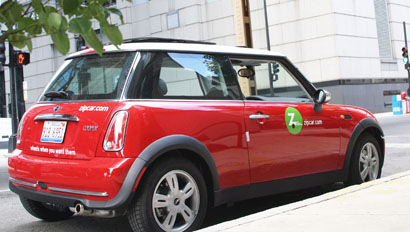 That kind of growth has drawn larger players into the field.
Enterprise started a pilot car-sharing program in 2007 and launched a unit called WeCar by Enterprise the following year. Last May, Enterprise paid an undisclosed price for car-sharing service Mint Cars On-Demand and subsequently combined the company with its WeCar and PhillyCarShare units to create its Enterprise CarShare.
Meanwhile, Hertz debuted its Connect by Hertz car-sharing service in New York, London and Paris in late 2008. It has since grown its operations to more than 80 U.S. cities and universities from about 50 in 2011.
Mercedes-Benz parent Daimler AG has jumped into the Europe market, launching its Car2Go service in Germany in 2008. That division has nine outlets in the North America as well as nine more overseas.
Still, concerns over meeting that expected growth rate and Zipcar’s challenges turning a profit have caused the company’s shares to plunge since going public. While Zipcar generated net income for 2012, the company lost more than $40 million between 2008 and 2011.
As a result, Zipcar, whose April 2011 IPO share price was $30, closed on the last trading day before the Avis Budget announcement at $8.24.
As for Avis Budget, the company bid aggressively against Hertz in 2011 for Dollar Thrifty. Later that year, it dropped out of that bidding to acquire Avis Europe for about $1 billion.
Hertz, which in November completed its acquisition of Dollar Thrifty, now controls about 26% of the U.S. market, while Avis Budget, inclusive of Zipcar, has about a 20% market share, according to Auto Rental News. Enterprise has about 49% of the U.S. market.
Follow Danny King on Twitter @dktravelweekly.