NEW YORK — Hilton and Hyatt are among the U.S. hotel brands that are saying goodbye to traditional, formal reception desks to make room for individual, pod-style desks that hotel executives said offer an easier and smoother guest experience.
In recently renovated hotels, the reception desk is removed in favor of as many as four shorter reception tables, or pods, each of which are staffed with hotel attendants to offer personalized assistance. These pods also enable guests to more privately complete functions such as paying bills and filing complaints.
During a panel discussion at the New York University International Hospitality Industry Investment Conference here, Vito Lotta, Hilton Worldwide's senior director of design, said Hilton Hotels debuted a pod-style front desk in April 2011 at Hilton McLean Tyson's Corner near Washington.
The new design has been well received by guests and employees, he said.
 Because of the popularity of the Tyson's Corner design, pod-style desks have been added to the Hilton Barcelona, which reopened in May after a six-month redesign. In coming months, pods will also be incorporated into Hilton properties in Milan; Rotterdam, Netherlands; Glasgow, Scotland; and Batumi, Georgia, according to Dave Horton, global head of Hilton Hotels & Resorts.
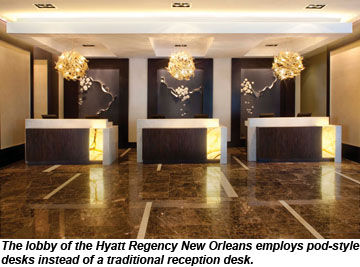
Hyatt is also quickly embracing this trend. Michael Miller, vice president of architecture and design of Hyatt, told the panel audience that the company had moved to pods during the redesign of the Hyatt Regency New Orleans. When Miller led the redesign of the hotel, which was completed in late 2011, he said, he included the pods to create an interactive and modern guest experience.
The trend parallels the growing popularity of select-service hotels with self-check-in kiosks, where technology advancements are enabling hoteliers to maintain service standards while cutting labor costs by giving guests the ability to perform functions that previously required hotel staff.
Another panel member at the NYU conference was Ralph Newman, COO of WTS International, which designs hotel spas. He said the pod design enhances staff-customer relations, whether guests are checking in or going for a spa treatment.
"It facilitates ease in staff walking from behind the desk and personally greeting guests," Newman said after the conference. "We divided our long, traditional spa desk in the middle to facilitate a more personalized, stepping-around greeting."
In an email to Travel Weekly, Horton said the new layouts help to speed up the check-in process while enabling easy access for staff to perform back-of-house duties.
In addition to fostering a more interactive greeting experience, he said, the pod styles enable hotels to incorporate up-to-date technology to help enhance the customer's experience, eventually leading brands such as Hilton to routinely offer independent guest check-in as well as hosted check-in.
"The core purpose of this area is to check in, and we hope to make the experience as stress-free, private and quick as possible," Horton said.
"This design sets the stage for our team members to be welcoming hosts and ensure a refreshing check-in experience that is both calming and welcoming," Horton said.
CORRECTION: Hilton would offer independent check-in in addition to hosted check-in. An earlier version of this article incorrectly implied that hotel brands such as Hilton would move to completely independent check-in.