FAUX SNOW
Faced with increasingly unpredictable and warmer weather, ski resort operators are turning to snowmaking systems to prolong seasons on their mountains, even as skier and snowboarder visits have remained flat.
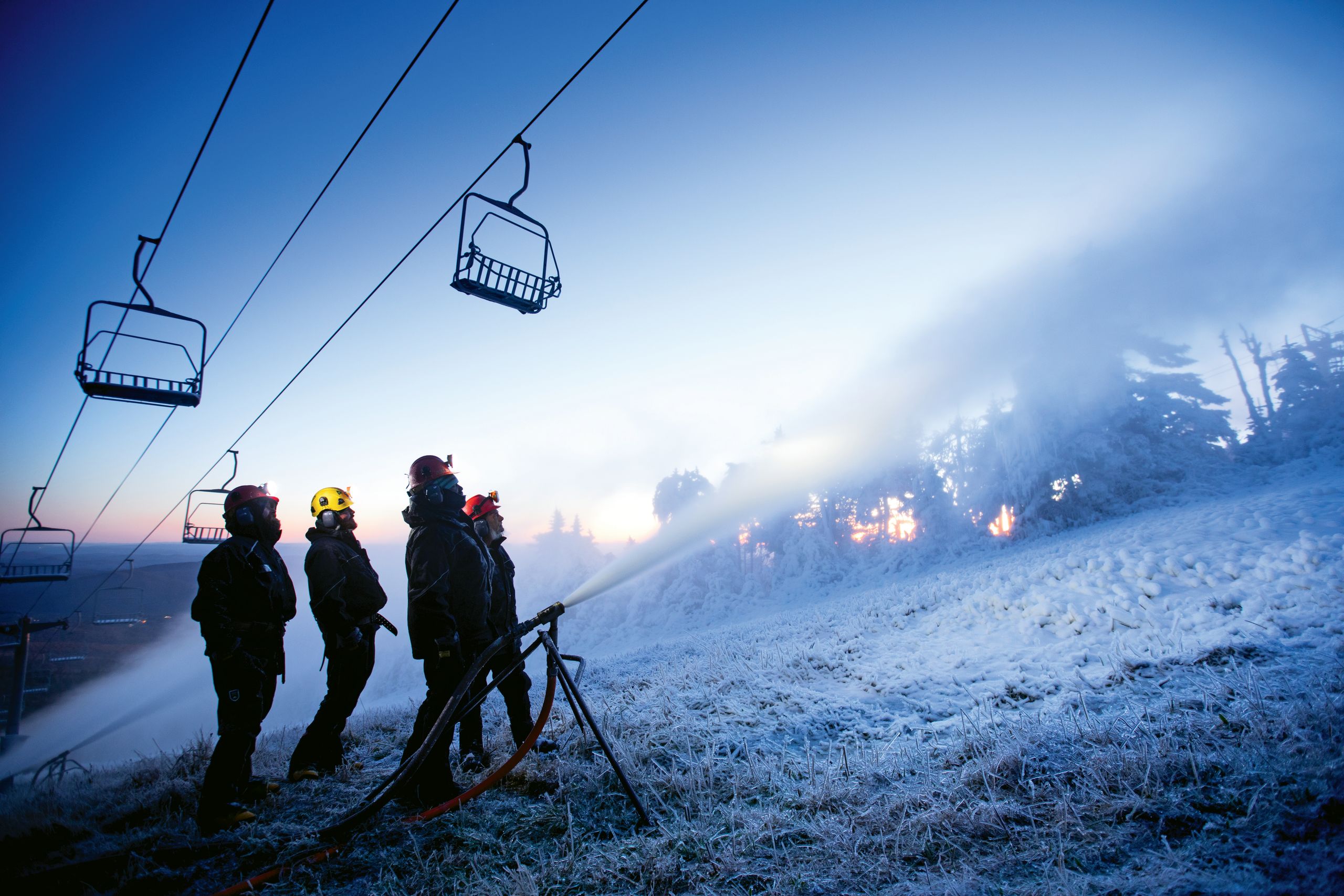

For most of the history of snowmaking technology, the ski industry has viewed it as a plan B effort: filling in bare spots on an occasional warm, dry day in the mountains, especially late in the season. But global warming has changed that view. Increasingly, snowmaking is becoming a ubiquitous component of the ski experience at U.S. resorts large and small.
In announcing its first capital improvement budget since its founding last year, Alterra Mountain Co. made sure to earmark a sizeable part of that budget for snowmaking equipment designed to pick up where Mother Nature leaves off — or has already left off.
Alterra declined to say exactly how much of the $555 million it has budgeted for its dozen North American resorts within the next five years will be dedicated to upgrading the snowmaking systems at Colorado’s Winter Park and Quebec’s Tremblant and replacing the snowmaking system at West Virginia’s Snowshoe.
But the equipment is costly, and the company left no doubt about how crucial snowmaking is to its bottom line.
“The ability to make sure we’ve got a timely start to our seasons and ensure they last long enough, and to take some control over the snow quality, is central to the resorts’ viability,” said Alterra CEO Rusty Gregory. “And you can supplement natural snow with snowmaking to fill in the bare spots wind can create and make sure you have late-season snow.”
Nor is Alterra unique in that regard.
The total number of skiers in the U.S. has changed little in the past two decades. That fact, combined with signs that global weather patterns are beginning to eat away at the edges of the typical four-month ski season, has left resort owners with little choice but to continue to boost their investment in snowmaking operations.
Specifically, Northeastern and Midwestern drive-market resorts are under more pressure than ever to ensure snow coverage in time for the Thanksgiving holiday, while larger Rocky Mountain and Western U.S. resorts look to stretch the season well into spring, rendering snowmaking more of a necessity than a luxury.
Trevor Crist, CEO of travel technology company Inntopia, said the perception of snowmaking has changed dramatically in recent years.
“It used to be that snowmaking was nice to have at a resort, and often indicated that [a resort’s natural] snow isn’t that good,” Crist said. “Now the perception is different. It doesn’t matter if you’re a Western or Eastern resort. You have to have snowmaking.”
As of today, snowmaking machines can cover about 22% of the acreage at U.S. ski resorts, according to the 2016-17 Kottke National End of Season Survey released by the National Ski Areas Association (NSAA). Regionally, that number can range from more than 70% in the Midwest and Northeast to 13% in the Rockies. It covers less than 1% in the Pacific Northwest.
Jeff Temple, director of mountain operations at Vermont’s Killington, said, “We don’t see the natural snowfall you see out West. It takes a tremendous amount of planning.”
Killington’s system includes 88 miles of piping, and the resort estimates that it makes some 2,200 acre-feet of snow per year.
For an individual resort, snowmaking represents a multimillion-dollar investment in equipment, not to mention the labor, water and power required to keep the systems running.
Smaller resorts within driving distance of major cities in the Northeast or Midwest can have as much as $2 million invested in snowmaking, including water-pumping systems, air compressors, hydrants and electrical power systems.
Joe VanderKelen, president of SMI Snow Makers, said the machines alone range in price from $2,000 to $50,000, and the smaller resorts will spend another $25,000 to $30,000 a year on associated costs for water, energy and labor.
For a larger Rocky Mountain-area resort, VanderKelen said, the investment in equipment alone can reach $100 million, and annual operating costs can exceed $2 million.
VanderKelen’s clients include ski resort owners Vail Resorts, Alterra and Powdr. His company has, he asserts, a “majority market share” of snowmaking equipment in North America.
In all, 89% of U.S. resorts have some sort of snowmaking capability, according to a joint report by the nonprofit Protect Our Winters (POW) and the Natural Resources Defense Council.
A look at recent weather patterns indicates that those investment numbers in snowmaking will continue to rise. According to NASA’s Goddard Institute for Space Studies, the last 17 years represent 17 of the 18 warmest years on record in terms of global surface temperatures, while every year since 1980 has been warmer than the average temperature between 1951 and 1980.
As a result, the POW report estimated that with 23 million Americans spending a collective $12.2 billion on winter sports each year, the impact of global warming has cost U.S. winter resorts an estimated $1.07 billion in the past decade, mostly because of lower turnout due to a lack of snow.
Moreover, the difference between high-snow and low-snow years can translate into $1.7 billion in annual spending on lift tickets, lodging, restaurants, bars, grocery stores and gas stations.
What’s more, weather and temperature fluctuations have grown so extreme that snowmaking equipment can not always keep up.
The study reported: “Resort towns at elevations in the transition zone are especially vulnerable to global warming because incremental warming increases the number of rainy, rather than snowy, days. Minimum temperatures are rising at a faster rate than maximum temperatures, undermining the efficiency of snowmaking.”
In fact, the report predicts that by the end of the century, seasonal snowfall could fall by as much as 30% in the Northeast and by as much as 55% in the Cascades and Sierra Nevada.
“One year, it snows like hell in California, and the next year, it doesn’t,” said VanderKelen, who estimated that revenue at his company, which was founded by his parents in 1974, has doubled in the past decade. “But in general, glaciers are receding, snow lines are moving up and natural snowfall is maybe not as prevalent as it was.”
As deep as the climate-change impact is on North American resorts, global warming might be reshaping ski mountains even faster in Europe, where many of the resorts are built on glaciers. Crist said that while visiting Switzerland’s Crans-Montana, he spotted a sign stating that a chairlift would be moved away from a section of the mountain where snow has disappeared.
Whatever the cause, recent seasons have often been of the feast-or-famine variety at many U.S. ski resorts. Back East, Vermont’s Stowe Mountain received just 146 inches two seasons ago, then more than doubled that total to 330 inches last year, according to Vail’s online report Onthesnow.com.
Last season, California’s Mammoth Mountain was almost bone dry until getting the snowiest month in its 75-year history in January and finishing the year with a whopping 536-inch total. Meanwhile, after a handful of years with fairly steady snowfalls of between 215 inches and 313 inches, this season has left the Rockies relatively barren, with Vail recording just 130 inches of cumulative snowfall as of late last month.
“You just never know,” said Gregory, who started working at Mammoth as a ski-lift operator four decades ago and eventually became its CEO before being tapped to run Alterra in February. “Last year, we closed down [Mammoth] Aug. 6. And that was to fix the place.”
Weather patterns and snowmaking requirements are just some of the issues ski resort operators have grappled with, even as the number of ski and snowboarding visits has remained little changed in the past couple of decades.
While the 54.8 million single-day skier or snowboarder visits in the 2016-17 season marked a three-year high, that total still represented a decline from 2010-11’s record 60.5 million visitors and was about equal to the average number of visits between 1992 and 1995, according to the NSAA.
The capital costs necessitated by fluctuating snowfall patterns have helped hasten the demise of many smaller resorts in North America. At the same time, consolidation in the industry continues apace. At the end of last season, the number of U.S. ski areas had dropped to 481, from more than 700 in the mid-1980s, according to the NSAA.
Meanwhile, the larger resort companies continue to grow and accumulate more financial resources that can be invested in snowmaking systems on more mountains. Since 2012, Vail Resorts has cemented its position as the world’s largest ski resort operator by acquiring Utah’s Park City, British Columbia’s Whistler Blackcomb and Vermont’s Stowe as well as Minnesota’s Afton Alps and Michigan’s Mount Brighton.
Vail Resorts, which declined to comment for this article, said in its most recent quarterly report last month that it had earmarked $150 million for capital improvements this year, including snowmaking upgrades at Park City, Lake Tahoe’s Heavenly and Vail in Colorado.
Meanwhile, Powdr, whose holdings include Killington, Oregon’s Mount Bachelor and Colorado’s Copper Mountain, bought Colorado’s Eldora Mountain Resort in 2016.
Most notable on the consolidation front, though, is Alterra, which was formed last year after KSL Capital Partners, owner of Squaw Valley Alpine Meadows in California, partnered with Aspen Skiing Co. owner Henry Crown and Co. to buy Intrawest Resorts and its half-dozen ski mountains for about $1.5 billion. Alterra followed that with the acquisition of Mammoth Resorts, while Utah’s Deer Valley Resort was added later.
“Scale becomes more critical because snowmaking is capital-intensive,” Inntopia’s Crist said. “It’s one of the many pressures that a lot of smaller, independent resorts are going to continue to face.”
Fortunately for those surviving resorts and companies, snowmaking has come a long way from its early days in the 1930s, when ice was either shaved or chopped to create artificial snow. In the past couple of decades, far more sophisticated technology has become substantially more efficient, introducing the process of spraying, stacking and sweeping enough snow to cover ski trails with 12- to 18-inch layers.
Even so, some of the basics have remained the same: One cubic foot of water will produce about twice that volume in snow, and colder, drier conditions are better for snowmaking than warmer, wetter conditions (snow makers use the term “wet bulb” to describe a numeric standard that reflects both air temperature and relative humidity).
So while snowmaking is not possible at 30 degrees Fahrenheit with 90% relative humidity, it is possible at 37 degrees and 20% humidity. At 50% relative humidity, a snowmaker operating in 18 degrees can turn water into snow at about five times the rate as it can when it’s 34 degrees.
That said, the process of snowmaking, which involves breaking water into particles that are then frozen with compressed air and sprayed onto a pile or a trail, has become more efficient, with improved snow machine nozzles and superior automation that can rapidly start or stop snowmaking in response to ambient conditions.
As a result, VanderKelen said, an old snow gun that required 150 horsepower can be replaced by a similarly productive device that operates on 10 horsepower.
Additionally, snowmaking systems are being configured not only to make snow with less energy, but to make it lighter and drier and thus more attractive to skiers. The exception is for ski races: Temple said that when Killington prepared to host the Audi FIS Women’s Ski World Cup last November, it sprayed water over the top of the snow to create a sheet of ice, creating, as he put it, “basically a hockey rink.”
Resort operators are also becoming more adept at “curing” man-made snow. In this case, a snowmaker makes a pile — or a “whale” in snowmaking parlance — that will sit for eight to 10 hours to develop a consistent level of moisture throughout before being pushed onto the ski trails.
“When you typically think of man-made snow,” Crist said, “you think of really icy snow that’s basically granular ice, and in early snowmaking, that was the case. The technology now has enabled the snowmaking to be a lot more like natural snow, with less moisture content and more air content per snowflake.”
With those kinds of improvements in mind, resort operators are trying to remain optimistic that the combination of natural snow and snowmaking will enable them to maintain full seasons for the foreseeable future.
“You have to have a certain amount of acre-feet down by the Christmas holidays to have the mountain connected,” said Killington’s Temple. “Our brand at Killington is the first to open in the East and the last to close.”
Gregory added: “Any impact associated with climate change is probably an oversimplification. Weather, in general, changes. And the faster we can react to that and give the guest a dependable experience, the better we are.”
Following its first full season of ownership, Alterra Mountain Co. will waste little time cementing its status as one of the country’s two largest owners of ski resorts.
The company last month said it will make $130 million in capital improvements for the upcoming ski season and will spend $555 million on upgrades during the next five years as it takes on Vail Resorts for North American ski resort supremacy.
Among other improvements, Alterra will replace the Zephyr Express Quad chairlift at Colorado’s Winter Park Resort with a gondola to boost uphill capacity and cut wait times. At California’s Mammoth Mountain, the company will upgrade and expand the resort’s Canyon Lodge and will add summer-activity facilities at Mammoth’s Main Lodge, including North America’s longest top-to-bottom zipline.
Colorado’s Steamboat will receive an overhaul of its Bear River Restaurant. The Snow Bowl chairlift at Vermont’s Stratton will be replaced with a high-speed, detachable quad lift. Other improvements include the replacement of the Lowell Thomas chairlift at Quebec’s Tremblant and base-area upgrades at Southern California’s Big Bear Mountain Resort. Winter Park, Tremblant and West Virginia’s Snowshoe will also receive snowmaking improvements.
Rusty Gregory, Alterra’s CEO and former longtime head of Mammoth, said, “A lot of what we’re doing is to appropriately capitalize what’s now a very large company so that we can invest in the ideas of the management of each one of the resorts. Those are projects they’ve wanted to do for some time.”
Alterra was formed last July when Squaw Valley and Alpine Meadows owner KSL Capital Partners, along with Aspen Skiing Co. owner Henry Crown and Co., acquired Intrawest Resorts and Mammoth Resorts. Utah’s Deer Valley was acquired in August.
In February, Alterra announced the Ikon Pass multiresort product for the 2018-19 ski season. The pass, which went on sale last month amid a TV ad blitz, lets users ski at as many as 26 North American resorts that are either owned by Alterra or are affiliate partners with the Ikon Pass.
The company owns 11 North American ski resorts as well as British Columbia’s CMH Heli-Skiing & Summer Adventures.
— D.K.
(Photo by Jack Affleck)