 Hotel companies, which for years have been looking for new ways to lure Internet shoppers away from online travel agencies and directly to their booking sites, will gain a new competitive tool with technology being developed for Google and metasearch sites like Kayak.com.
Although Google has for the most part declined to talk publicly about its growing emphasis on travel search, which includes its purchase of the airline flight pricing software maker ITA, central reservation system operator Pegasus confirmed this week it is working with Google to include hotel pricing and direct links to hotel booking sites alongside OTA listings on its new Google Maps hotel search function. And the company next week will announce a similar tool for metasearch sites.
Douglas Quinby, senior director of research for PhoCusWright, said the new technology “will have huge implications for hotels in regards to search engine marketing.”
“But I am not sure it means that once this is all up and running that hotels can start to ignore online travel agencies,” he said.
Still, he and other who have been watching development of Google’s entrance to the travel space said it may help level the playing field a bit for hotels, which are constantly looking for ways to reduce their reliance on OTAs and their high commissions.
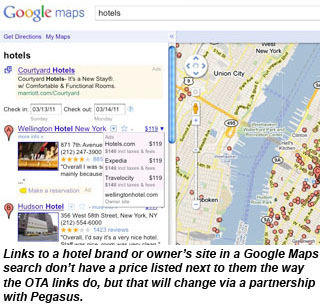
Under Google’s new hotel search function, if a user types in “New York hotels” on Google Maps it will bring up a map with pins for hotel locations. Alongside it is a list of hotels with the lowest prices. If a user clicks on the arrow next to the price, a pull- down box appears that shows the prices for that hotel on the various OTAs.
Currently, there is also a link to the hotel brand or owner’s site, but not a price.
That will change, according to Dave Sjolander, vice president of product management for distribution services for Pegasus. Although he said Google has asked that he not disclose any details about when the direct hotel listings will launch, he acknowledged Pegasus has talking to Google about this for some time. “They have actually had this program in development for maybe six months or so,” he said.
Sjolander said Pegasus will be working to bring the hotels that are part of their central reservation system on board with Google. He said the company may also help third-party hotel customers connect to Google.
Additionally, he said, Pegasus this week will be announcing a similar service that enables hotels to list their prices and website links alongside the OTAs on metasearch sites like Kayak.com.
“It’s a very good thing for hotels, and it’s very important for them to participate,” Sjolander said.
He said the emergence of more details of the program in the last few weeks is also likely a relief to many hoteliers, who had been hearing rumblings about Google getting into the hotel-search business but were unclear if that meant Google would be trying to compete in the OTA and booking space.
“Google has come out in the last few weeks and stated emphatically that they are not going to sell hotel rooms,” Sjolander said.
“The way I see this, it’s a lot like meta-search, like Kayak and others,” he said. “To me, Google has sort of brought metasearch into the basic search process. So I think it gives Google a way to capture advertising and placement revenues.
“They may not know yet where this will go in terms of bidding or positioning on the drop-down; I think that will evolve over time. For now what is most important is that hotels are participating and playing in this field and are not being relegated to the sidelines.”
Quinby said hotels and OTAs should pay close attention to the new technology, but he said he doesn’t see it dramatically changing the competitive landscape between hotels and OTAs.
He cited PhoCusWright research that shows that when travelers buy online, 38% use OTAs and 23% purchase direct from hotel and airline Web sites.
“So there is the possibility that this could even the odds a bit between hotels and OTAs, but I’m not so sure,” he said, noting that the technology is still in the early stages and that online travel shoppers visit an average of three-and-half sites before buying.
“I don’t think it’s a game changer that is suddenly going to flip those percentages around.”