 There is a certain segment of the traveling public for whom a destination's desirability is directly proportionate to how taboo it is. The more controversial its politics, the longer it has been closed to the outside world, the deeper their curiosity and appetite.
So, for all the industry's fretting over the negative impact of State Department travel warnings and sensational reports about political or social tumult, an emerging niche market is actually seeking places that are getting bad press.
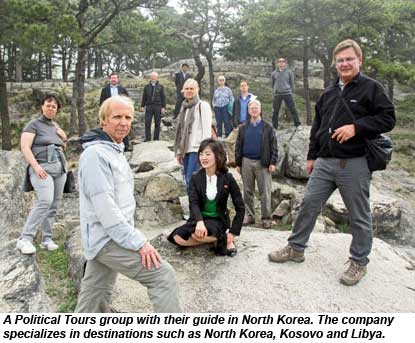
"There are a lot of people out there who are interested in news and current affairs and who would like travel that is more challenging," said Nicholas Wood, director of Political Tours, a company he founded in 2009 that takes clients to "more challenging" destinations like North Korea, Kosovo and Libya.
Wood was stationed in the Balkans as a reporter for 10 years, most recently as a New York Times correspondent for the region from 2003 to 2008. When friends or family would visit, he would offer them a tour from a journalist's point of view, incorporating information about the news and current events unfolding there. Both he and his guests overwhelmingly enjoyed the experience.
That ultimately spurred the idea of taking people to places all over the world and presenting those destinations through an informed, political lens.
Political Tours started off with just a handful of itineraries. The company operated seven last year, and it's up to 11 in 2013, with about a third of its client base coming from the U.S.
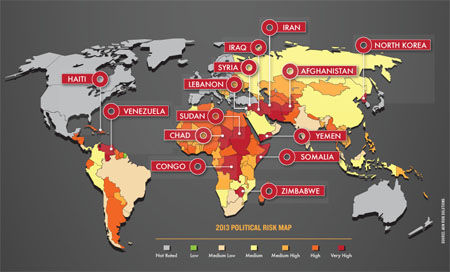 While Wood's Political Tours is clearly focused on a niche product, travel companies across the spectrum say they are seeing growing demand for destinations that are more politically relevant or controversial or that have been closed off to the outside world. Places such as Myanmar, Cuba and Colombia are often cited as being among the most sought-after destinations in 2013, in large part because in the recent past, travelers couldn't go to those places. (Click here or on the image for a larger view of Aon Risk Solutions' 2013 Political Risk Map.)
For example, tour operators that have been able to survive the bureaucratic morass involved in obtaining people-to-people licensing from the U.S. government to operate tours to Cuba are seeing a huge demand for travel to that country, which has essentially been off limits to U.S. citizens since the Cuban Missile Crisis in February 1962.
"For 50 years ... Americans have been told, 'You can't go,'" said Tom Popper, president of Insight Cuba. "As humans, we often want to do the things we can't do."
Cuba, he said, is "the forbidden fruit of travel. It's the only destination that the U.S. prohibits Americans from traveling to without special permission."
In a rush to meet the pent-up demand for travel to Cuba, three additional travel companies were recently approved to launch federally licensed, people-to-people educational travel to Cuba this summer: Central Holidays, the Globus Family of Brands and Michigan-based Other Cuban Journeys.
Red tape and risk
Bringing travelers to places such as Cuba, Myanmar or North Korea is definitely a more complicated ordeal than sending them to more established tourism destinations with much less political drama surrounding them.
To obtain the people-to-people license for Cuba, for example, operators must go through a laborious application process with the U.S. Department of Treasury's Office of Foreign Assets Control (OFAC).
"It did take us a long time to get the license through OFAC," said Pam Hoffee, vice president of product and operations for Globus. "The application took almost a year and a half."
 And after all that, Globus' license is good for only one year. Three months prior to its expiration next spring, Globus can begin applying for a renewal, which will either be good for one or two more years.
Hoffee said Globus' Cuba program, which launched earlier this month, has already proved very successful.
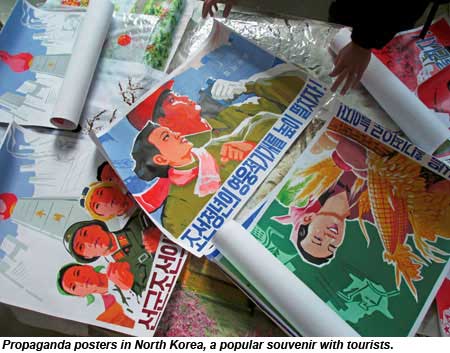
Other "off-limits" locales can be just as arduous, if not more so, to arrange travel to. Among the more difficult destinations is North Korea, which made its way into the news last month when Korean-American tourist and tour operator Kenneth Bae was sentenced to 15 years of hard labor after being arrested there in November.
The arrest and sentencing not only reminded Americans of the challenges in traveling to countries with authoritarian regimes or political unrest; they also cast a light on the potential for severe personal risk.
But the handful of operators that offer tours to North Korea all said they would continue operating their tours as normal and that travelers who still want to visit should feel safe to do so.
"There is no added danger in traveling to North Korea," Simon Cockerell of Koryo Tours wrote in an email. "It isn't a dangerous place for tourists at all, as the thousands of people who have been there with us over the last two decades will concur."
Koryo Tours is a British-run company based in Beijing that specializes in travel to North Korea. Cockerell said that in the 20 years he has been providing tours to North Korea, he has never had a tourist or tour leader arrested, taken for questioning or expelled from the country.
Troy Collings, managing director for North Korea for Beijing-based Young Pioneer Tours, wrote in an email that Bae "broke local laws ... [and] was sentenced according to local laws that he in his position should have been familiar with."
Collings said that travelers heading to North Korea should not be concerned about Bae's sentencing.
"You have to intentionally go out of your way to get into trouble," he said. "We advise people on how to behave, and they would have to go to extreme lengths to get themselves arrested."
Nevertheless, there is a U.S. State Department-issued travel warning to North Korea stating that "U.S. citizens crossing into North Korea, even accidentally, have been subject to arbitrary arrest and long-term detention."
Since January 2009, four U.S. citizens have been arrested for entering North Korea illegally, and two U.S. citizens who entered on valid North Korea visas were arrested on other charges, the State Department reported.
Collings admitted that doing business in North Korea is no simple task.
"Without personal contacts and connections, business in [North] Korea is impossible," he wrote.
The payoff, however, has been a doubling of business each year since Young Pioneer Tours was founded by a group of expats living in China five years ago.
 North Korea "is the last country of its kind in the world," Collings said. "People also want to see that which others believe can't be seen. In truth, it is very easy to visit the DPRK [Democratic People's Republic of Korea], and they welcome all visitors except journalists and South Koreans. Yet people's view is that it is a closed country."
While tour operators and travelers continue to push the envelope of where they want to and are willing to go, this kind of travel requires a constant evaluation and re-evaluation of risk. None of the operators interviewed for this report, for example, take travelers to Afghanistan, Iraq or Iran.
And those that take travelers to places where the political and social situation is in constant flux, such as Egypt, monitor U.S. State Department travel advisories and get on-the-ground information through media reports and ground operators.
"When a customer comes in and is going to book, we always advise whether there's a travel warning in place," said Scott Avera, vice president of product development at General Tours World Traveler.
Getting political
A number of responsibilities fall to the travel company that takes people to controversial places, among them presenting that country's policies to its clients. As with all tours, the operator has to take care of logistics. But in addition, it has be to ready to answer difficult questions that inevitably arise, trying to remain objective and providing travelers with responsible information and experiences.
Each operator deals with it differently. Some, like Political Tours, address the issues head-on.
"We don't have a political bias," Wood said. But he hires, among others, local academics or journalists to guide his groups, people who can also answer questions travelers might have about politics, economics or other current events. He also seeks to bring in experts on different topics relevant to the current political situation in the destination to speak with the group.
Especially in places with polarizing politics, such as Israel, he said, but also more generally, "we have input from so many different angles. You need as diverse perspectives as possible."
 Other tour operators try to avoid getting too involved in the politics.
"Our trip is not a political statement," Globus' Hoffee said of the company's new Cuba offering. She noted that Globus is focused on presenting the Cuba program through an educational and cultural lens more than through a political one.
Nevertheless, Globus, too, attempts to address some of the issues between Cuba and the U.S. by having a Cuban-American speak to guests in Miami, at the start of the Cuba itineraries, to provide a Cuban-American perspective on travel to Cuba.
But whether or not operators directly address the issues, most acknowledge that in highly politicized places, issues will come up as travelers interact with locals or talk with their tour guides.
Anyone who has ever traveled to a politically charged destination has probably experienced a tour guide's take on local politics. Some guides are perhaps better than others at discussing the situation objectively, which is all part of experiencing the current events unfolding there. Whether it's contentious government actions or contested elections, a faltering economy or pervasive poverty, when people travel, they see these issues up front and personal, and thus they're bound to come up.
Moreover, people who go to places known more for their politics than for their pristine beaches are likely going because they're curious and want to know more.
Shannon Stowell, president of the Adventure Travel Trade Association (ATTA), said such clients "tend to be highly curious and educated. They're very interested in the destination and what's going on."
The ATTA's members come from 83 countries, representing a wide variety of emerging destinations.
Stowell said that people who travel to politically charged places are "going to get under the surface of this destination."
The ATTA recently absorbed into its organization the American Tourism Society (ATS), a group founded in 1986 by Alex Harris of General Tours World Traveler. ATS was a pioneer in political travel, taking Americans behind the Iron Curtain to Russia and Eastern Europe and, later, exploring other emerging destinations that had previously been off-limits to Americans.
In keeping with that tradition, Stowell said that among today's ATTA members, Cuba, Myanmar and Colombia are the discussed emerging destinations.
But today's world of international globetrotters is far different from the travel landscape the ATS was spearheading in the 1980s. Today, more travelers are crisscrossing the globe and consequently looking for the next unturned stone.
"The general public, as time goes, they've just become more and more well-traveled, and the demand is higher for something new and something they haven't done before; these 'new' destinations like Cuba that have been closed off," said Bill Robison, director of product development for International Expeditions.
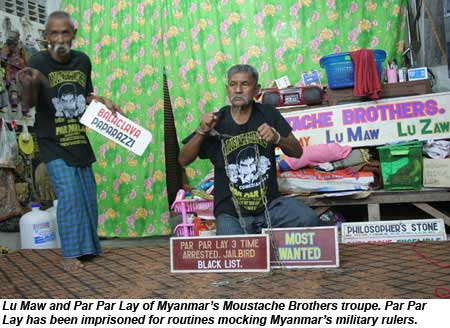
 But as more people flock to these places, the issue of sustainable and responsible tourism to destinations that are not just new to tourism but are often still rife with political, economic and social problems becomes ever more dire.
Operators are cautious, for example, not to have their products come off as exploitative or voyeuristic.
"We're there to look at world affairs," Wood said. "In some cases, that might be a place that's been affected by conflict." What it boils down to he said, is Political Tours does not want to attract "war junkies, if you like."
In March, the ATTA released a new "value statement," a prerequisite for membership in the organization. It includes such things as the United Nations World Tourism Organization's Global Code of Ethics for Tourism; a commitment to the protection of children from the harmful effects of tourism; and responsible tourism standards set forth by the Global Sustainable Tourism Council.
Because many of these places have been closed off to tourism, the introduction of visitors presents a wealth of opportunities, but it also presents a whole host of dangers. And if tourism isn't developed sustainably in these places, that which made them alluring to begin with could quickly be destroyed.
"Even places like Laos, even they're becoming a little touristy," Robison said. "Tourism kind of spoils what was special about the place in the first place."
But that can be avoided if done properly.
Insight Cuba's Popper recalled a conversation with someone in the Cuban tourism industry during a conference in Cancun, comparing Cuba's nascent tourism market to Cancun's arguably overdeveloped tourism market.
"Cubans may not be experts in tourism, but we don't want to replicate [Cancun]," Popper said. "We want balanced growth."
In an increasingly interconnected world, virgin markets for U.S. travelers are getting harder to come by.
Robison said, "I joke that we're going to start investing in Mars tourism."
But if it's the political, cultural or economic issues du jour that are of interest to people, not the fact that the destination has been closed off or off-limits, then the opportunities for political tourism are vast and can stretch from new world to old, from developed to developing nations.
While Political Tours, for example, offers tours to North Korea and Libya, it also has a "London and the Financial Crisis" tour, and it offered a U.S. elections tour last year that followed the presidential campaigns.
"What we do is much more like taking someone through a documentary," Wood said. "You've got slices of real life, then you have meetings with journalists and experts."
Ultimately, it's not just about going to places in the news but also about having a meaningful cultural exchange within the destination.
"There's a movement globally called the citizen ambassadorship," Popper said. "The governments might not get along, but the people do; that's the premise behind it. The awesome byproduct of all this is that our passion for travel conforms with this. For the American traveler to experience that is life-changing."
Follow Michelle Baran on Twitter @mbtravelweekly.