Charlie Leocha learned his lesson the hard way: Don't show up at a train station in Italy armed with only a U.S.-issued credit card.
The self-service kiosks outside the station often accept payments only from the kind of computer-chip-embedded credit cards that are common in Europe but rare in the U.S., a fact that can come as a rude awakening for an American traveler. Even ruder if it's an early-morning train and the station's ticket windows aren't open yet.
"Almost any automatic machine now requires a chip-and-PIN card," said Leocha, director of the Washington-based nonprofit Consumer Travel Alliance and a regular traveler to Europe. "The line's a half-hour long [to buy a ticket at the ticket window], so it becomes a giant pain in the wazoo."
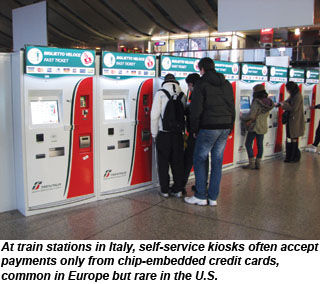 Things are likely to get even more painful in the wazoo department for U.S. travelers headed overseas. That's particularly true in Western Europe, as European Union countries move exclusively to chip card payments and away from cards with the magnetic stripe technology commonly used in America.
The magnetic stripe was first added to a handful of credit cards in the 1950s, but the technology didn't become commonplace until two decades later.
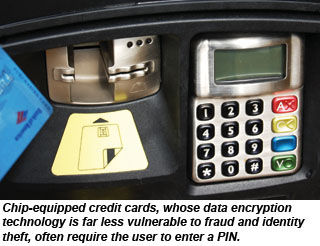
Chip cards, often referred to as "smart cards," "chip-and-PIN cards" or "EMV" cards (an acronym for the Europay, MasterCard and Visa standard), differ from magnetic stripe cards because these smart cards transmit encrypted data stored in the card's computer chip to an electronic payment processing device.
In addition, smart cards, like debit cards in the U.S. and elsewhere, often require the user to enter a PIN code during the transaction after inserting the card into the processing device.
Finally, the portable, wireless, battery-powered smart-card readers that are becoming prevalent throughout Europe significantly enhance the cardholder's security.
For example, in U.S. restaurants, a diner's card is generally taken from the table to a central card reader, which means that it is out of the cardholder's possession and generally out of sight until the waiter swipes and returns it. In contrast, a European waiter equipped with a portable reader can conduct the transaction right at the table without the card leaving the cardholder's view.
Such features make the chip cards far less vulnerable to credit-card fraud and identity theft than magnetic stripe cards, which was a key reason they were adopted in some Western European countries as far back as the early 1990s. In fact, credit-card fraud losses in France fell 50% in 1993, the year after chip cards were introduced in that country, Consumer Reports reported earlier this year.
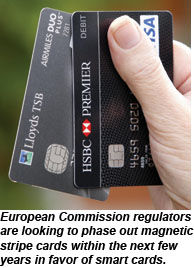
With that in mind, European Commission regulators are looking to phase out the magnetic stripe card within the next few years. Last year, the European Central Bank recommended requiring the 32 countries that make up the Single Euro Payments Area to issue only smart cards, beginning in 2012. Additionally, the European Payments Council required that by the end of last year, all SEPA point-of-sale terminals and ATMs were to be capable of processing chip-card payments. Any that are not will be deemed noncompliant.
Slow to change their stripes
Whether such a phase-in has become a major issue or a minor one for American tourists abroad depends on the traveler and his or her spending habits.
Carlson Wagonlit Travel spokeswoman Michelle Surkamp said the issue wasn't a concern for the travel management company or its business customers. And a number of travel agents interviewed by Travel Weekly said they had not been hearing complaints from U.S. travelers who had been unable to purchase an item abroad because their magnetic stripe card was rejected. A major reason for the lack of problems is that many of the agents put together prepaid tour packages.
"We just haven't heard direct reports of major issues," said John Pittman, ASTA's vice president of industry and consumer affairs. Pittman said he has made three trips to Scandinavian countries over the past 10 years and never ran into a problem. "They just go, 'Oh, you're American.' They check your passport, and then they accept your card."
Still, Leocha said, many automated bus and tram ticketing machines in Germany and Denmark only take chip cards, leaving a U.S. credit card holder stranded when confronted with a driver or conductor who doesn't accept or carry cash.
 Leocha travels to Western Europe about three times a year, most recently in August. And beyond transportation issues, he said, with magnetic stripe cards becoming more and more outdated, many restaurants in Italy will reject the more fraud-vulnerable cards even if there's a magnetic card-swiping machine on site.
"Everyone's used to the chip-and-PIN," Leocha said. "They're just not trained and educated [to process a magnetic stripe card]. Restaurants will say that your magnetic stripe isn't working, and you might be sitting on a $500 bill. It's a creeping problem."
Moreover, the problem could creep further as the U.S. recovers from its most recent recession and Americans begin spending more abroad over the next few years. Travelers from the U.S. spent $103 billion overseas last year, up from $99.1 billion in 2009, according to the U.S. Department of Commerce, while Americans trailed only the Germans when it came to international travel spending, according to the United Nations World Tourism Organization.
Still, when it comes to adoption of the chip-and-PIN cards, the U.S. finds itself years, if not decades, behind Western Europe. And despite the difficulties experienced by American consumers traveling abroad, groups with a stake in the U.S. travel industry have not pushed for more rapid domestic adoption of chip cards.
"We have not had a large number of our card members in the U.S. requesting cards with chips," said American Express spokeswoman Marina Hoffmann Norville. "For our U.S. customers that travel overseas, merchants are able to take cards without chip and PIN. The reason for the U.S. cards being rejected is typically a training issue with the clerks."
Meanwhile, Bank of America, the largest U.S. bank, is taking a wait-and-see approach when it comes to the idea of distributing chip cards to U.S. customers planning to travel abroad. Company spokeswoman Betty Riess said the company was "evaluating the technology" but declined to say if or when a chip-enabled card would be available to customers.
Some other banks have started to take a more proactive approach to serving their wealthier globetrotting customers by experimenting with the distribution of chip cards. Wells Fargo in April announced a pilot program with its Visa Smart Card, which includes both a magnetic stripe and an EMV chip. That card was sent to 15,000 bank customers who had been identified as international travelers. While the company has not disclosed specifics about broadening the program, Wells Fargo spokeswoman Lisa Westermann said, "We will likely roll it out sooner rather than later" because the pilot program was deemed a success.
That same week in April, JPMorgan Chase announced a program in which EMV technology would be included on its JP Morgan Palladium credit card. The bank started distributing a second card with smart-card capabilities, the JP Morgan Select Visa Signature card, in June.
Also in June, U.S. Bank began issuing Visa cards that might be used with both chip-card readers and contactless payment terminals, in addition to magnetic stripe systems. The bank claimed the rollout made it the first U.S. issuer to offer cards with so-called "dual interface." U.S. Bank distributed the cards to more than 20,000 of its FlexPerks Visa cardholders in June and said at the time that it would expand the distribution to other cardholders over the next year.
Meanwhile, in the U.S., credit card fraud is continuing to grow, forcing some institutions to take a closer look at speeding up the adoption of chip card payment processing domestically.
In a report last year, the financial research firm Aite Group estimated that about $8.6 billion worth of credit-card purchases in the U.S. are fraudulent each year, which amounts to 0.4% of the $2.1 trillion in annual U.S. credit card volume.
While that percentage might not seem large in itself, Consumer Reports reported in June that in 2009, about one in four U.S. credit-card customers had reported at least one incident of card fraud in the previous five years. Consumer Reports based that report on a study conducted by the payment-system supplier ACI Worldwide. Last year, ACI said, that number rose to one in three.
With that in mind, Visa in August became the first of the three major U.S. payment networks to enact a program designed to encourage so-called acquirers, or merchant banks, to set up systems that will enable their commercial customers to accept smart-card payments. Visa, which in February set up a smart-card-processing program for international customers, is requiring all of its U.S. merchant banks to have systems in place that support smart-card transactions by April 1, 2012.
In announcing the initiative, Visa credited the proliferation of smart cards and the use of mobile phones as payment devices for spurring the program.
"As ... mobile payments and other chip-based emerging technologies are poised to take off in the coming years, we are taking steps today to create a commercial framework that will support growth opportunities and create value for all participants in the payment chain," Jim McCarthy, global head of product at Visa Inc., said in an Aug. 9 statement.
 Slow adoption of smart-card technology in the U.S. could also become a growing issue for overseas-based travelers visiting the U.S. International travelers spent $103.5 billion in this country last year, up 9.9% from a year earlier, according to the UNWTO.
Neither MasterCard nor American Express have announced plans for programs involving chip-card payment processing systems, although Amex does offer them to its U.K. customers. Both U.S. Travel Association spokeswoman Cathy Keefe and American Hotel & Lodging Association CEO Jim McInerney told Travel Weekly their groups had not yet addressed the issue.
With both credit-card fraud numbers and the use of chip cards overseas on the rise, however, advocates for smart-card adoption in the U.S. have taken an increasingly proactive stance. The New Jersey-based nonprofit Smart Card Alliance, founded in 2000, has grown to more than 170 members including, oddly enough, American Express, Bank of America and MasterCard International. This week, the alliance is hosting an EMV webinar for U.S. banks and merchants.
Mobile payment systems
While the prospect of less fraud and easier spending here by overseas tourists has apparently not been enough to drive the U.S. financial industry to take the plunge into chip-card adoption anytime soon, the potential of making payments via mobile phones might do the trick, according to Theodore Iacobuzio, vice president of MasterCard's Global Insights division.
Findings by technology research firm Gartner support that assertion. In a July report, Gartner predicted that global payments made with smartphones will surge 76% this year, to $86.1 billion, while the average amount of money spent by a mobile-payment user will rise 27%, to $610.
Meanwhile, companies such as Samsung are developing mobile phones that can store a user's smart-card information and can be used as a payment device by merely being waved in front of a vendor's smart-card processor.
All of which could help make digital identification systems a primary method of payment in the U.S. by the end of the decade.
"Merchants didn't want it, and the issuers didn't want it bad enough," MasterCard's Iacobuzio wrote in a July 21 blog post titled "Is the U.S. Finally Ready for EMV?" "But mobile, in this as in other areas, may change everything."