
A new era of cruise entertainment
Cruise lines are deploying cutting-edge technology to elevate onboard shows, creating immersive experiences and finding ways to get the most use out of their theater spaces.
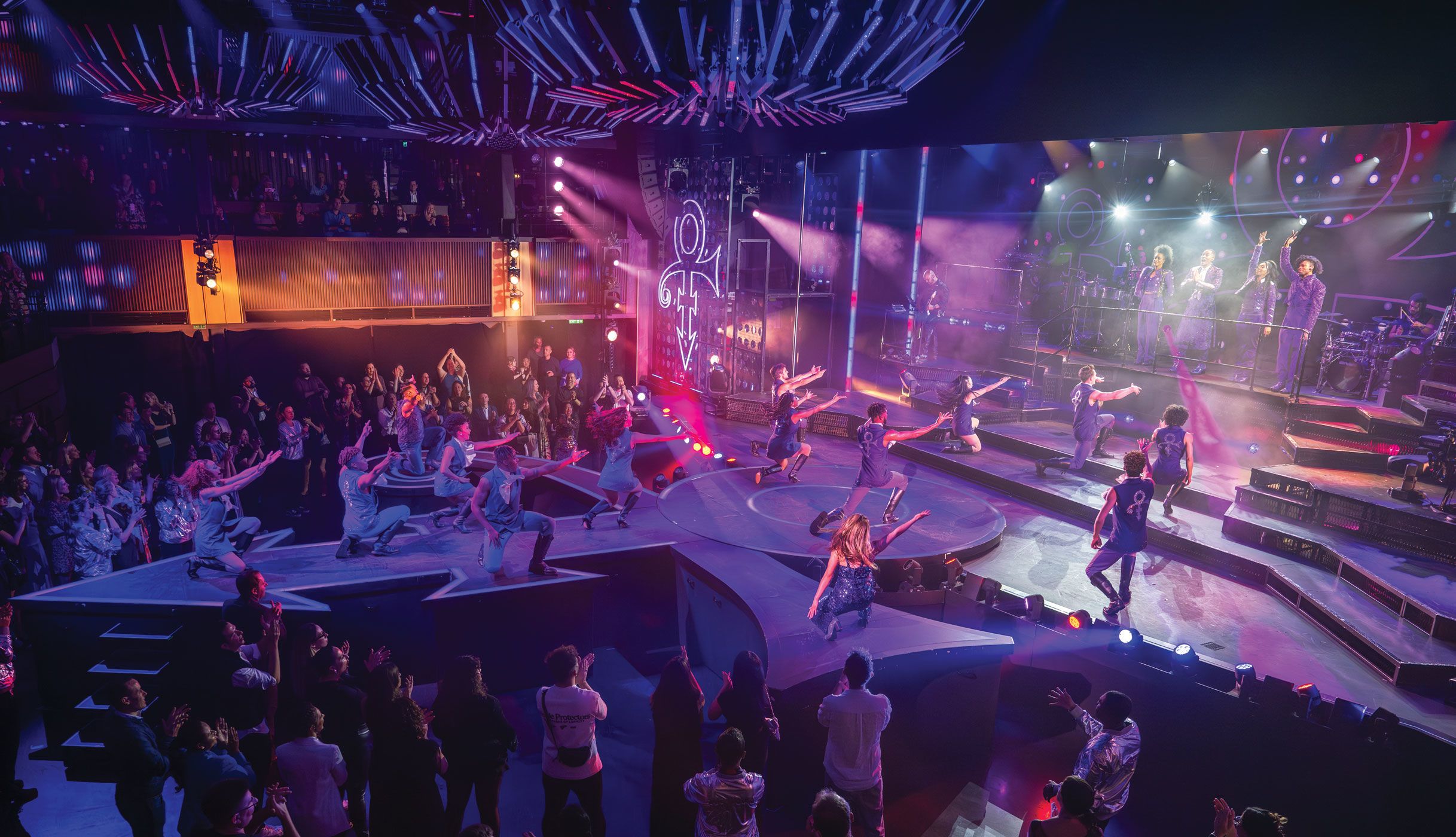

When a group of travel advisors and media journeyed earlier this year to Norwegian Cruise Line Holdings’ entertainment headquarters in Tampa, the big buzz was one of Norwegian Cruise Line’s most anticipated main-stage shows: “Revolution: A Celebration of Prince.”
To mount an ambitious production like “Revolution,” a bunch of moving pieces must come together: the right cast, creative costumes, funky music, props. And quite literally, moving pieces of set design.
In a studio, where a practice stage had been custom-built for “Revolution” performers, director Patricia Wilcox painstakingly explained the staging concept for the theater on the Norwegian Aqua that would make “Revolution” so, well, revolutionary.

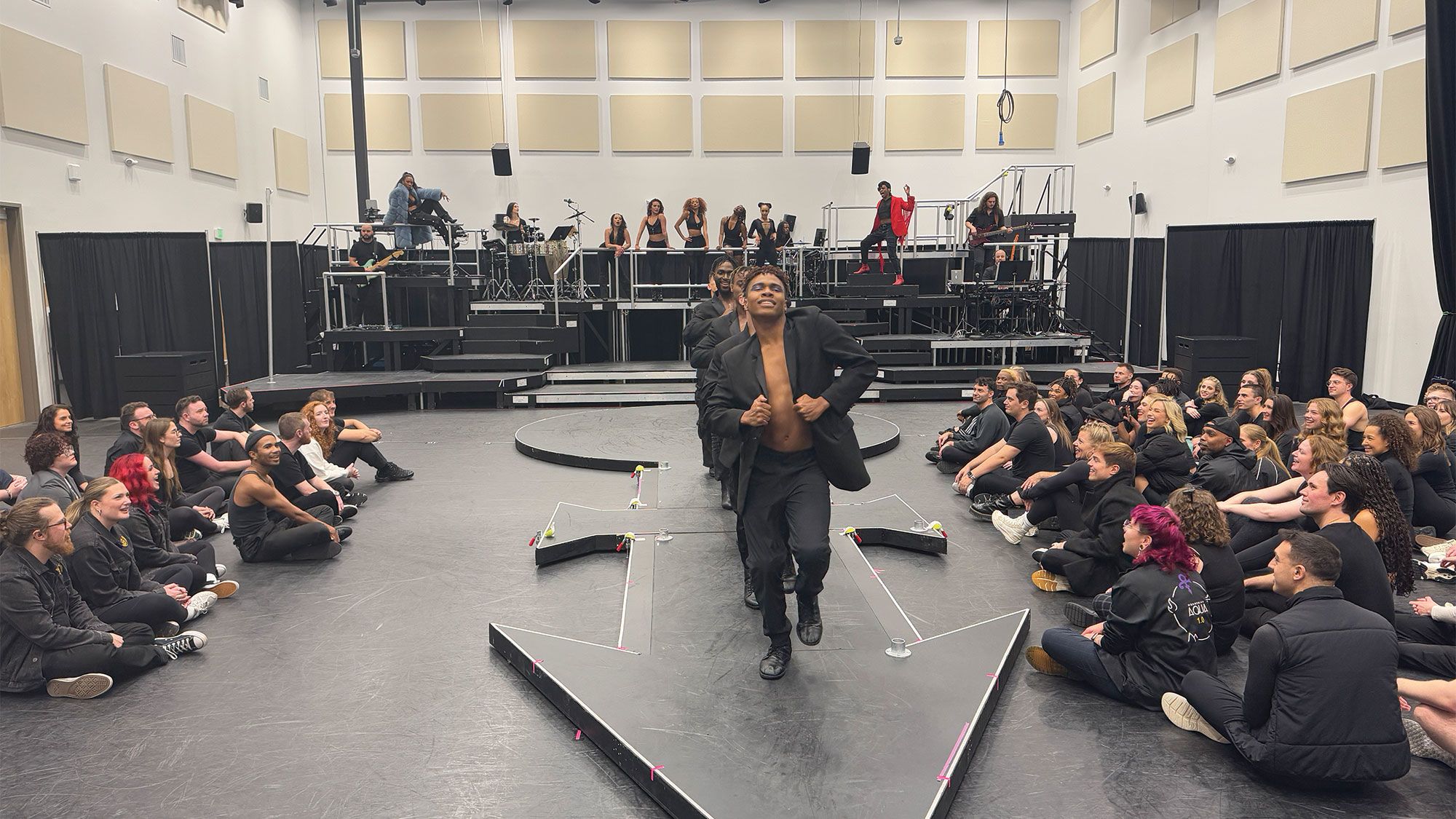
Performers work on “Revolution” at the line’s entertainment headquarters in Tampa. (Photo by Rebecca Tobin)
Performers work on “Revolution” at the line’s entertainment headquarters in Tampa. (Photo by Rebecca Tobin)
First of all, the orchestra-level theater seats in the Aqua Theater & Club can retract, leaving only balcony seating — the rest of the guests stand, concert-style, around three platforms interspersed throughout the floor.
“Our platforms out here will be 3 feet, 8 inches tall,” Wilcox said, pointing at the 8-inch-high practice set pieces. “You’re going to see these pieces move three times in the show.” As the set pieces and the performers on them are moved during the show — eventually locking into place in the design of Prince’s famous symbol — assistants will direct the standing members of the audience to move with them, creating a surprising dynamic element and involving guests as participants in the performance.
“We wanted to create an immersive piece of theater,” Wilcox said.
And that’s not all. The same performers who were cast to belt out Prince’s most famous songs have also been taught to trapeze and bungee for an acrobatic stage show called “Elements: The World Expanded,” which uses a rigging system to enable aerial performances.
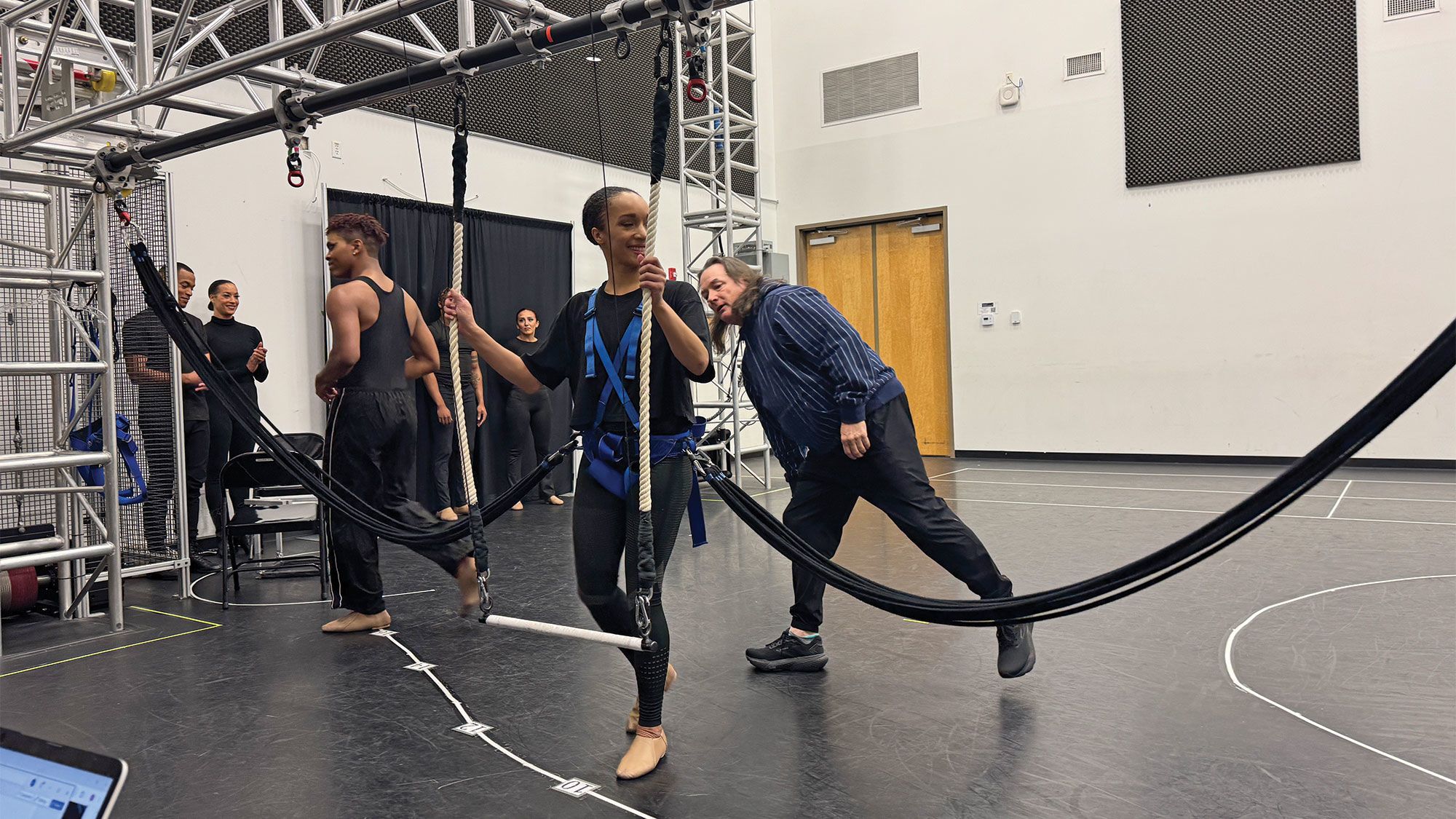
A demonstration of NCL’s “Elements: The World Expanded” shows the rigging system that lifts performers into the air. (Photo by Rebecca Tobin)
A demonstration of NCL’s “Elements: The World Expanded” shows the rigging system that lifts performers into the air. (Photo by Rebecca Tobin)
But the Aqua Theater is not the only venue at sea where money and technology are being deployed with creativity to pull audiences deeper into the show atmosphere.
At entertainment giant RWS Global, which counts Holland America Line, MSC Cruises and Azamara among its clients, Ryan Fitzgerald, the executive vice president of sea production, called it an “arms race” among the biggest cruise lines.

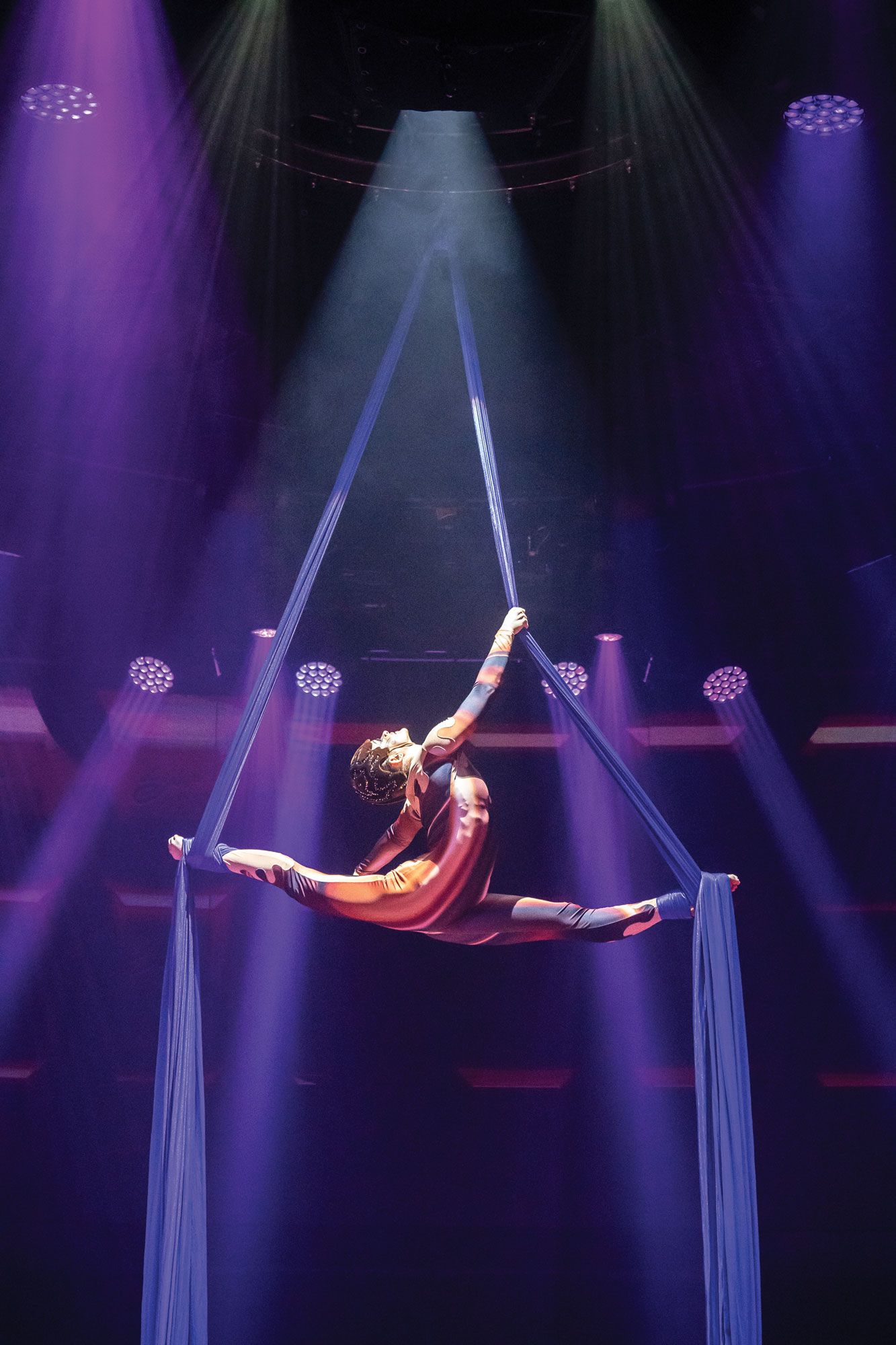
An aerial performer during an MSC Cruises production. (Courtesy of MSC Cruises)
An aerial performer during an MSC Cruises production. (Courtesy of MSC Cruises)
“You really design the show knowing the space it’s going to go into and the technical capabilities it will have, and in this day and age there’s certainly an arms race to do that next thing that no one has ever been able to do,” Fitzgerald said.
“It was drones a couple of years ago,” he said, “and now I think automation’s advanced so much, with nano-winches and flight capabilities, that you’re seeing … stage movements you haven’t seen before, performers flying this way and that.”
One prime example is Royal Caribbean International’s production of “The Wizard of Oz” on the Icon of the Seas, where Dorothy’s tornado-tossed bed flies and Miss Gulch pedals her bike above the stage.
Fitzgerald also used the term “immersion,” whether it was bringing performers into the audience to interact with guests or pairing entertainment with food and beverage, as RWS did for the Bright Lights Society club on Cunard Line’s Queen Anne.
And beyond flying beds and moveable set pieces, lines also employ physical elements like wind, water and sound to move guest emotions.
For Norwegian’s “Elements: The World Expanded,” the closer to the stage guests sit, the more they’re “feeling things,” said Bryan White, NCL’s vice president of entertainment production. For example, guests seated on the floor will have performers entering and exiting the stage around them, and those near the stage will feel water — and everyone will feel wind — during certain parts of the performance.
White said this would give guests more choices in how they want to experience the show, but it also means that they “can come back to these shows multiple times and have a completely different experience.”

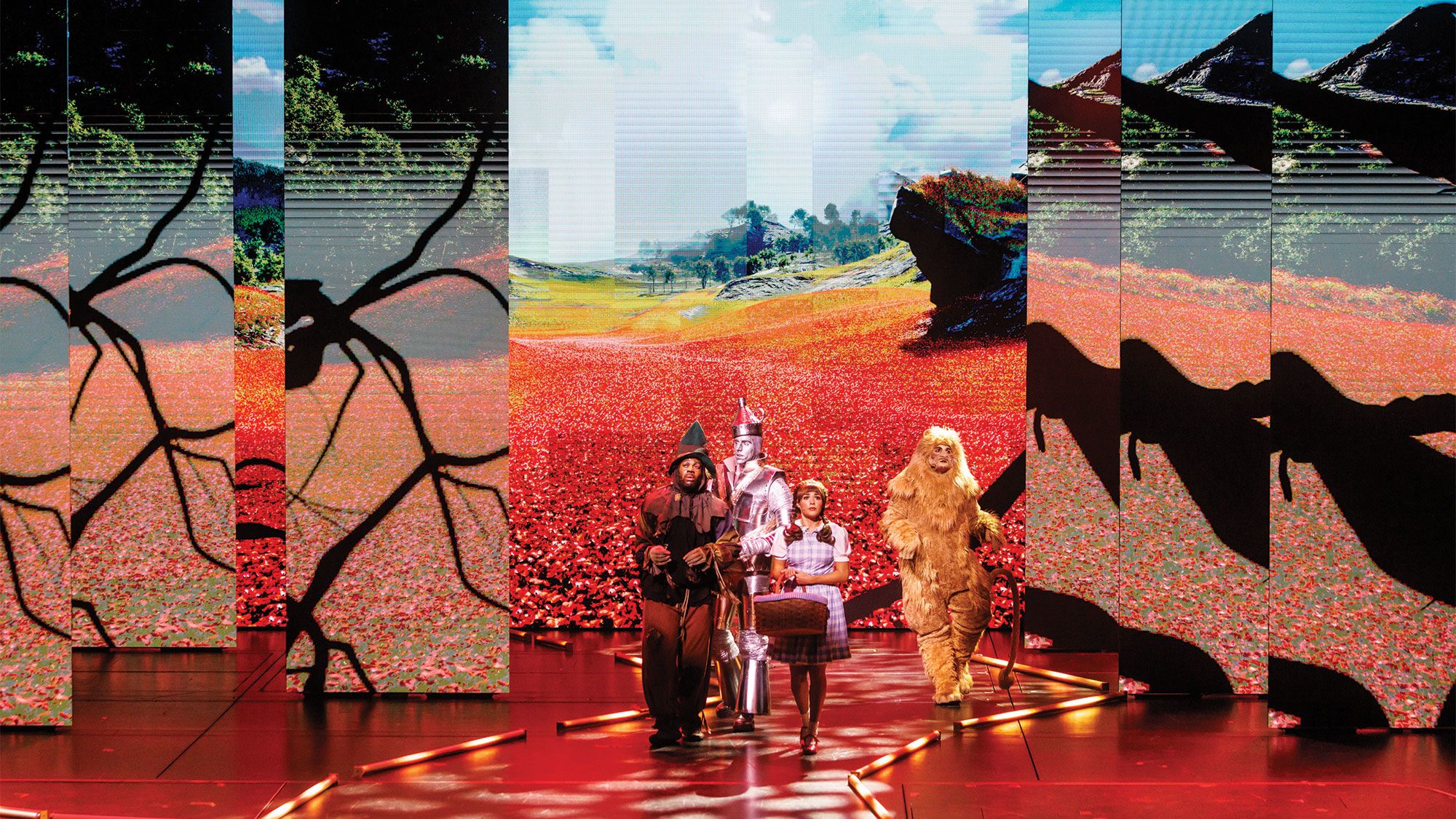
Icon of the Seas features the first rendition of “The Wizard of Oz” at sea, with performers soaring above the audience, a revolutionary set design and never-before-seen stage effects. (Photo by SBW-Photo)
Icon of the Seas features the first rendition of “The Wizard of Oz” at sea, with performers soaring above the audience, a revolutionary set design and never-before-seen stage effects. (Photo by SBW-Photo)
From ‘immersive’ ...
“Entertainment is becoming so much more immersive,” said JP Christensen, the senior director of Royal Caribbean Productions. “That is definitely something we’re seeing, and something we’ve been leaning heavily into for years … where we really use the entire venue to really take you to a place in time. Or to immerse you in an environment by using projection that is in the round or in a half-round, to really put you in that place.”
Christensen hearkened back to technology developed for Royal’s Quantum-class Two70 lounges about a dozen years ago, with robotics that could move big-screen panels in ways that made the robots and panels part of the show.
“That was definitely our first time really trying to push the boundaries of what we could do in a space: How can we change how we use the space, in terms of making all the entrances happen from underneath or above?” he said. “So all the actors either enter from the air, through hatches in the ceiling, or they come up through what we call actors lifts, so that they suddenly appear in this venue, that they’re surrounded by the audience.”
Today, Royal has evolved to using robotics in venues like the Icon of the Seas’ AquaDome to move set pieces and lights or follow performers.
“That’s our biggest challenge: How do we up ourselves?” Christensen said.
“I think Icon is a beautiful example of that,” he said of the entertainment on that ship. “There’s some surprise moments in ‘Wizard of Oz’ where the audience would never expect to feel the wind of the tornado. You know, those little things go a long way to transport them.”
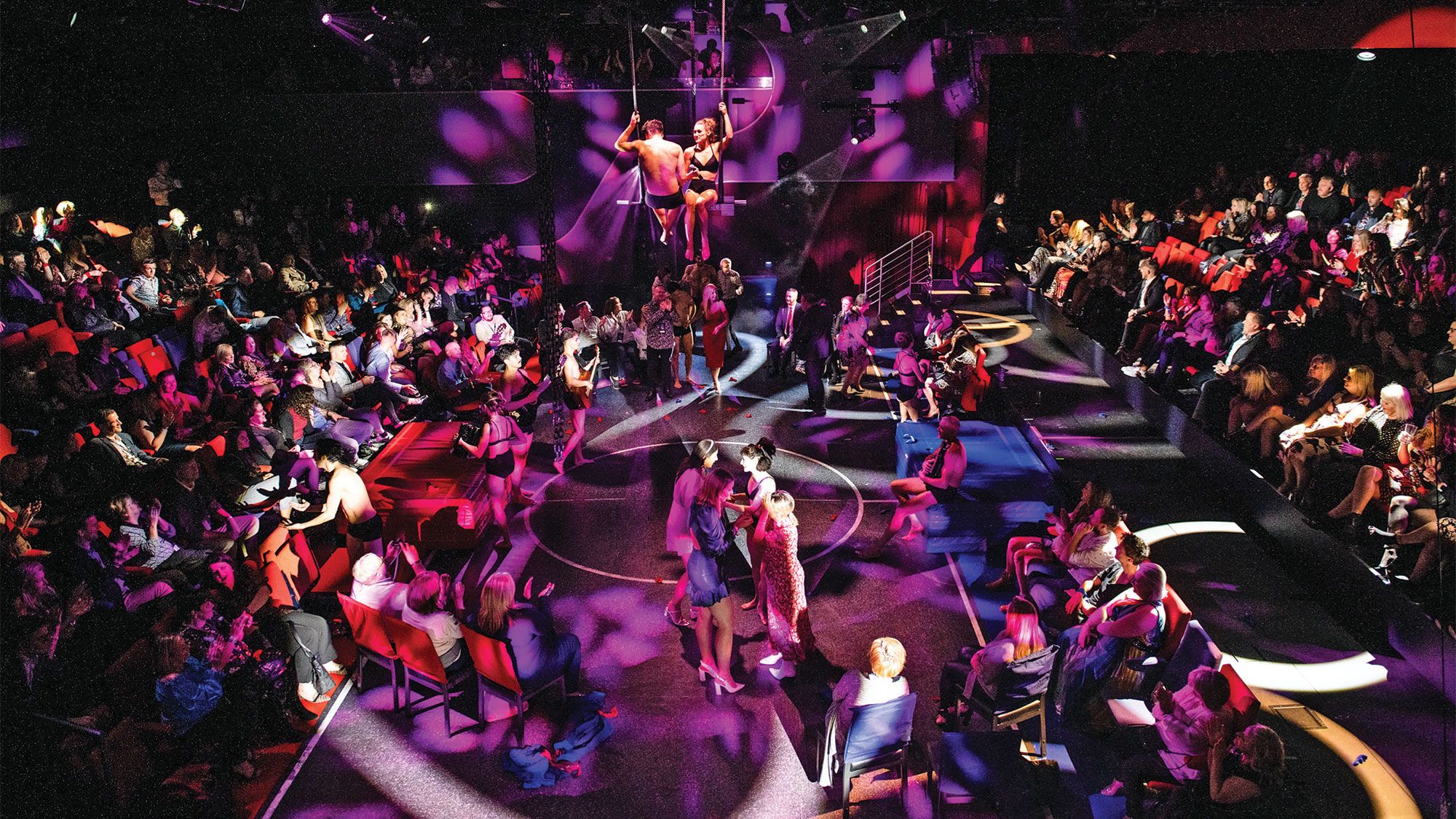
Virgin’s Red Room theater in its “alley” configuration, where two banks of seats are set up on either side of a long stage. (Courtesy of Virgin Voyages)
Virgin’s Red Room theater in its “alley” configuration, where two banks of seats are set up on either side of a long stage. (Courtesy of Virgin Voyages)
... to ‘transformative’...
At Virgin Voyages, vice president of entertainment Richard Kilmain said that the line specifically went “transformative” in the design of the Red Room, its main-stage theater.
“Any company that is building a theater on a ship is spending millions of dollars, right?” he said. “A theater is outfitted with lots of equipment. There could be stages that have platforms built into them, or turntables, performer flying apparatuses, LED screens, all kinds of lighting equipment, sound equipment.
“And so part of our thinking was, look, if we’re going to invest all of this money in a theater, what if it could do other things for us that traditionally you just can’t do?”
For Virgin, that meant that its Red Room theater can be configured like a traditional proscenium theater, but it can also morph into an “alley stage,” two banks of seating facing each other with a stage in between, similar to a fashion-show catwalk.
Virgin can also retract all the seats in the Red Room, giving it the option to reconfigure the theater into a large space for fitness or dance classes. It’s another important feature for theaters as lines look to transform spaces to fit different roles. After all, why let a room that takes up a substantial footprint on the ship — and, by the way, has excellent audiovisual capabilities and, usually, a bar — sit empty?
Examples abound throughout the brands: Take the theaters in Holland America Line’s newest ships, which feature two-story, panoramic LED panels and host lectures during the day and production shows at night.
That was the thinking at Virgin, anyway. “How do we, when I say ‘make the space work harder for us,’ how do we get more programming in for our sailors?” Kilmain said.
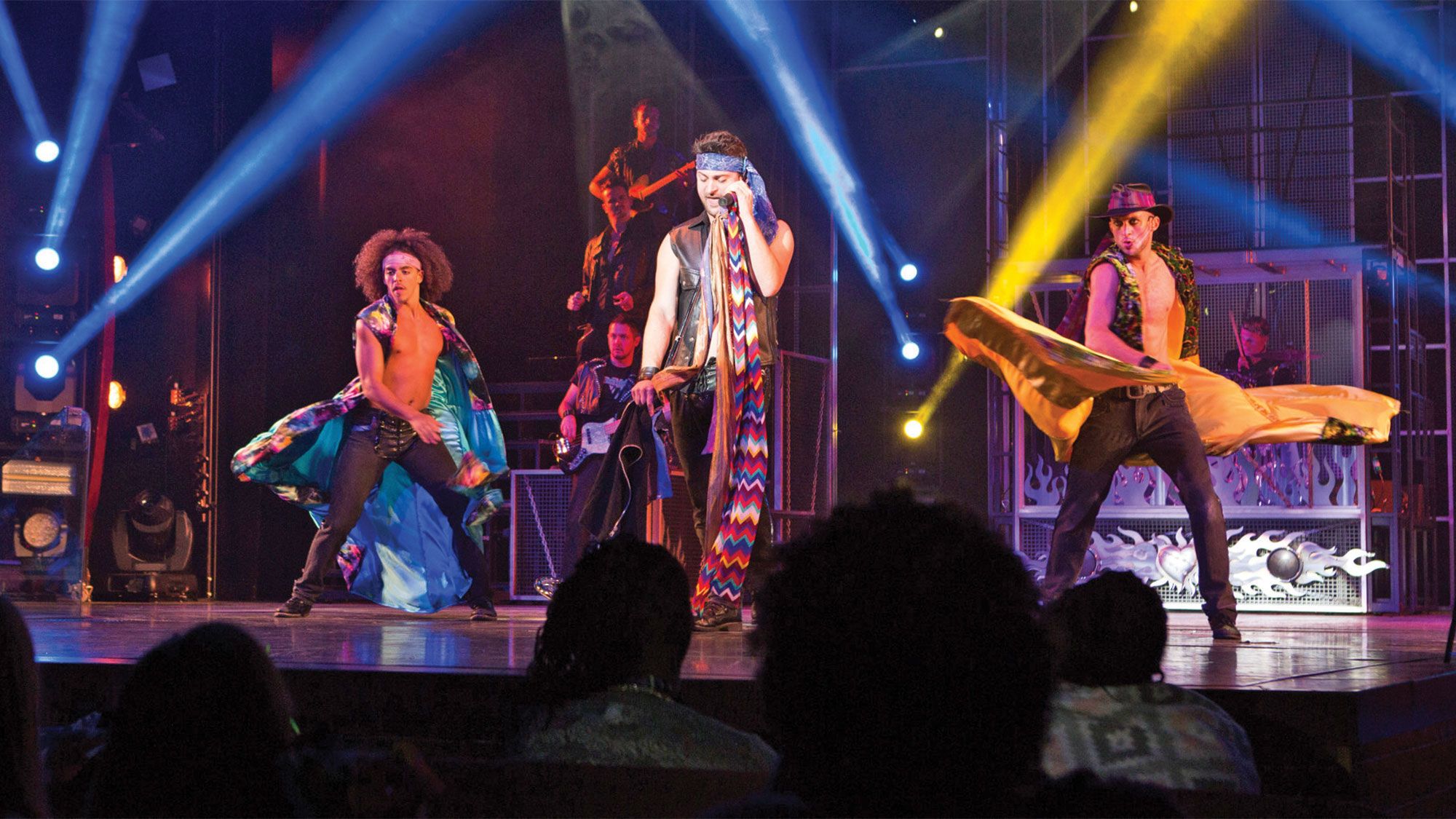
Carnival Cruise Line’s “America Rocks!” show. (Courtesy of Carnival Cruise Line)
Carnival Cruise Line’s “America Rocks!” show. (Courtesy of Carnival Cruise Line)
... to ‘intimate’
That question can logically extend to almost every corner of today’s new ships, which are constructed with new technology and all-day entertainment in mind.
On the newest vessels from Carnival Cruise Line, the atrium is set up to host production shows and aerialists. The line “is not limiting our entertainment to the theater,” said president Christine Duffy.
“In the past, ships had very large theaters that, between the early dinner and the late dinner, could accommodate the two cycles of shows,” Duffy said. “But I think now it’s really activating entertainment in multiple places and entertainment that’s different.”
Duffy also said that activations throughout the ship foster a more “intimate” environment.
And for lines with smaller tonnage — those without megaship-size stages — the focus is also on intimate productions, RWS’ Fitzgerald said. A show package bound next year for Azamara’s Cabaret Lounges, for example, was designed by RWS with the idea of connecting with guests throughout the show, he said, making them feel as though they are a part of the production.
Beyond that aforementioned arms race, he said, is “lines working on maximizing what they have technologically but then also really creating a true connection with a guest that’s meaningful, impactful, that creates memories, enriches people, builds relationships.”
Teri West contributed to this report.
The brand-name of the game
The theater configuration and special effects may be even more important when you consider the investment some lines make to secure the rights to brand-name entertainment.
Of course, brand partnerships aren’t new: For Norwegian Cruise Line, an early example is a partnership with Blue Man Group, and Celebrity Cruises forged a collaboration with Cirque du Soleil in 2004.
But the appeal of brand-name entertainment appears to only be getting stronger. On Royal Caribbean alone, the playbill includes “The Wizard of Oz,” “Mamma Mia” and soon, “Back to the Future: The Musical.” MSC Cruises has “Dirty Dancing in Concert” and “Queen Symphonic,” a medley of Queen songs. That British rock band appears to be having a moment: Royal Caribbean’s Queen tribute show is called “We Will Rock You.”
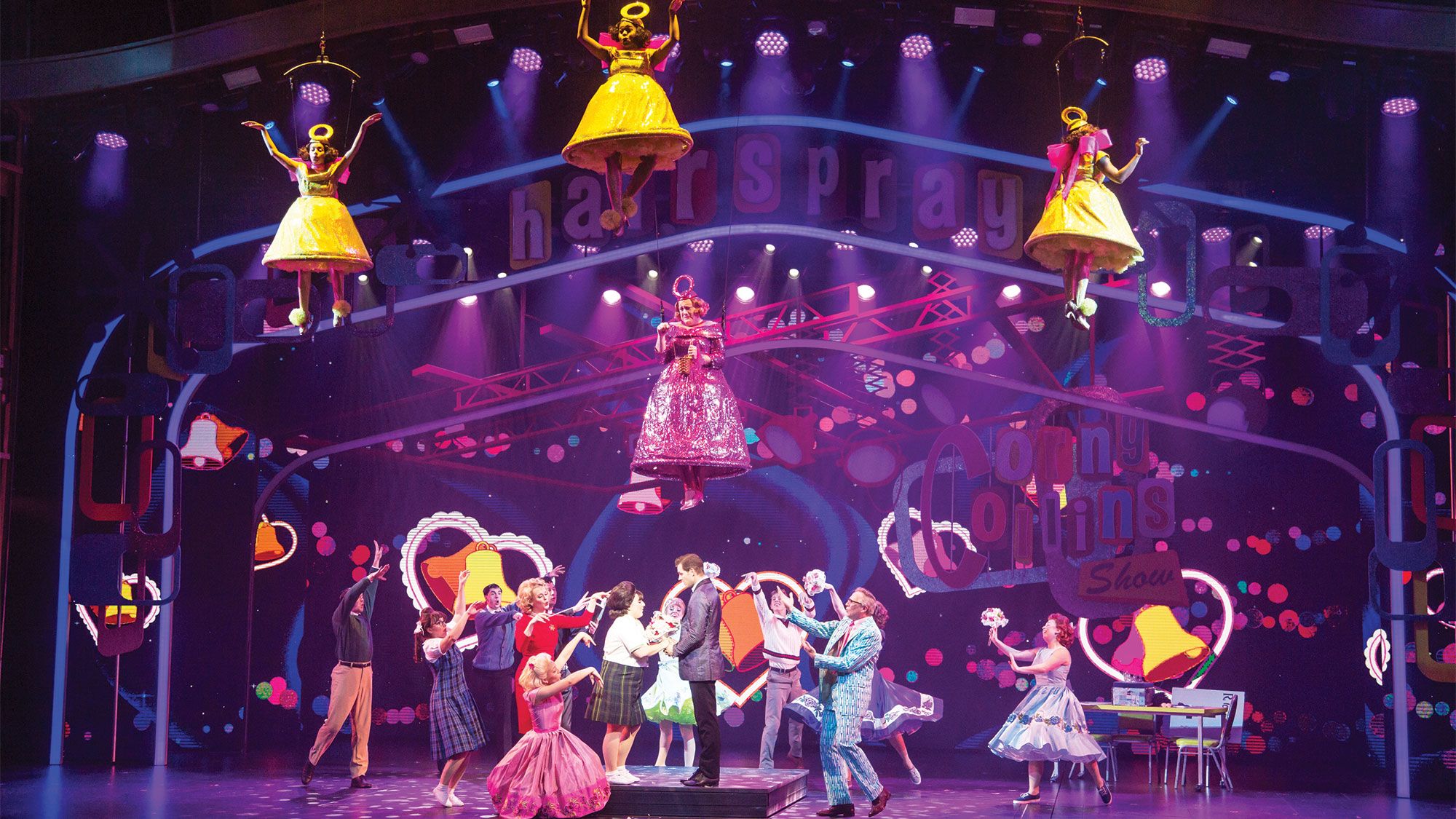
Performers hang in the air in Royal Caribbean’s production of “Hairspray.” (Photo by SBW-Photo)
Performers hang in the air in Royal Caribbean’s production of “Hairspray.” (Photo by SBW-Photo)
And cruise lines seem to always be looking for ways to up the ante: Cunard is bringing a Broadway or West End performer on each of the Queen Elizabeth’s Caribbean sailings this winter, including two-time Tony Award winner Sutton Foster.
At Royal Caribbean, putting together a Broadway-style production like “Back to the Future,” which will premiere this summer on the Star of the Seas, is about an 18-month process, said senior director of Royal Caribbean Productions JP Christensen. And if the production is a replica of what a guest might see in the West End or on Broadway, the props, staging, costumes and choreography has to be precise.
And the relationship with the licensing group or partner is ongoing.
“That takes a lot of back and forth and really working with that partner to make sure that we have all ducks in a row, and then we continue that relationship on,” Christensen said. For “Cats,” for example, the line has for years held a relationship with Really Useful Group, which produces, licenses and promotes Andrew Lloyd Webber shows and music.
And Norwegian, of course, now has “Revolution: A Celebration of Prince.” According to director Patricia Wilcox and Bryan White, NCL’s vice president of entertainment production, the line spent seven years dreaming up the concept, pitching it to the decision-makers at Prince’s estate and then workshopping the show and putting it into production.
It had to negotiate with several entities, including Prince Legacy, a partnership that is a part of the family estate, and Universal Music, which owns the license to the live stage music rights for the songs. And it had to make sure the show itself was approved; representatives from the Prince estate came to watch the cast and gave pointers about the “musicality” of the show, White said during a preview of the show in Tampa.
“They’ve been a really, I’ll say, easy partner to work with,” White said of the estate. “We shared a lot with them up front to say, ‘Here’s the direction we’re going, here’s the design team we’re going to be working with, here’s the basic overall concept’ … and we got feedback at that stage.”
One note the Prince team had for NCL was around the color of purple it was using in the logo, White said.
“It’s actually a little more pink than it is purple,” he said. “Again, something that outside of that world no one would really know; a small detail, but really meaningful to them, because he was very specific about that color and about that representation.”