
Tanzania in the spotlight
Peter Greenberg’s “The Royal Tour: Tanzania” offers a complex and holistic look at the East African nation. And he’s never had a guide quite like Samia Suluhu Hassan.
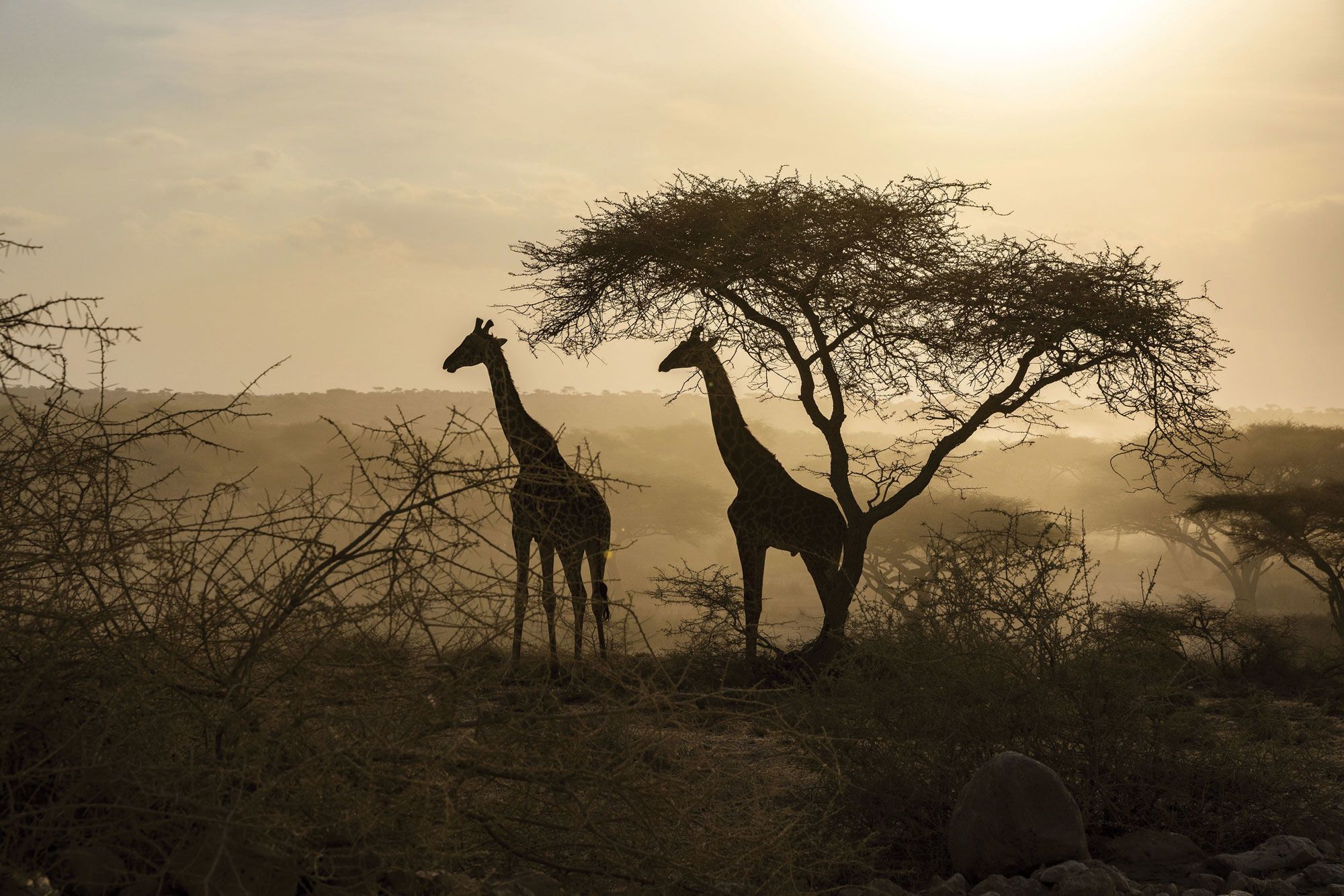

Peter Greenberg’s occasional PBS series, “The Royal Tour,” features heads of state acting as Greenberg’s tour guides to their countries. The shows include well-known tourist highlights but also connect the leaders’ personal stories to that of their nations, providing a more intimate view of the destination.
In the past, kings, presidents and prime ministers have acted as Greenberg’s co-hosts, but he’s never had a leader-guide quite like Samia Suluhu Hassan, the president of Tanzania and featured leader/tour guide in “The Royal Tour: Tanzania,” premiering this week on PBS (check local listings for times).

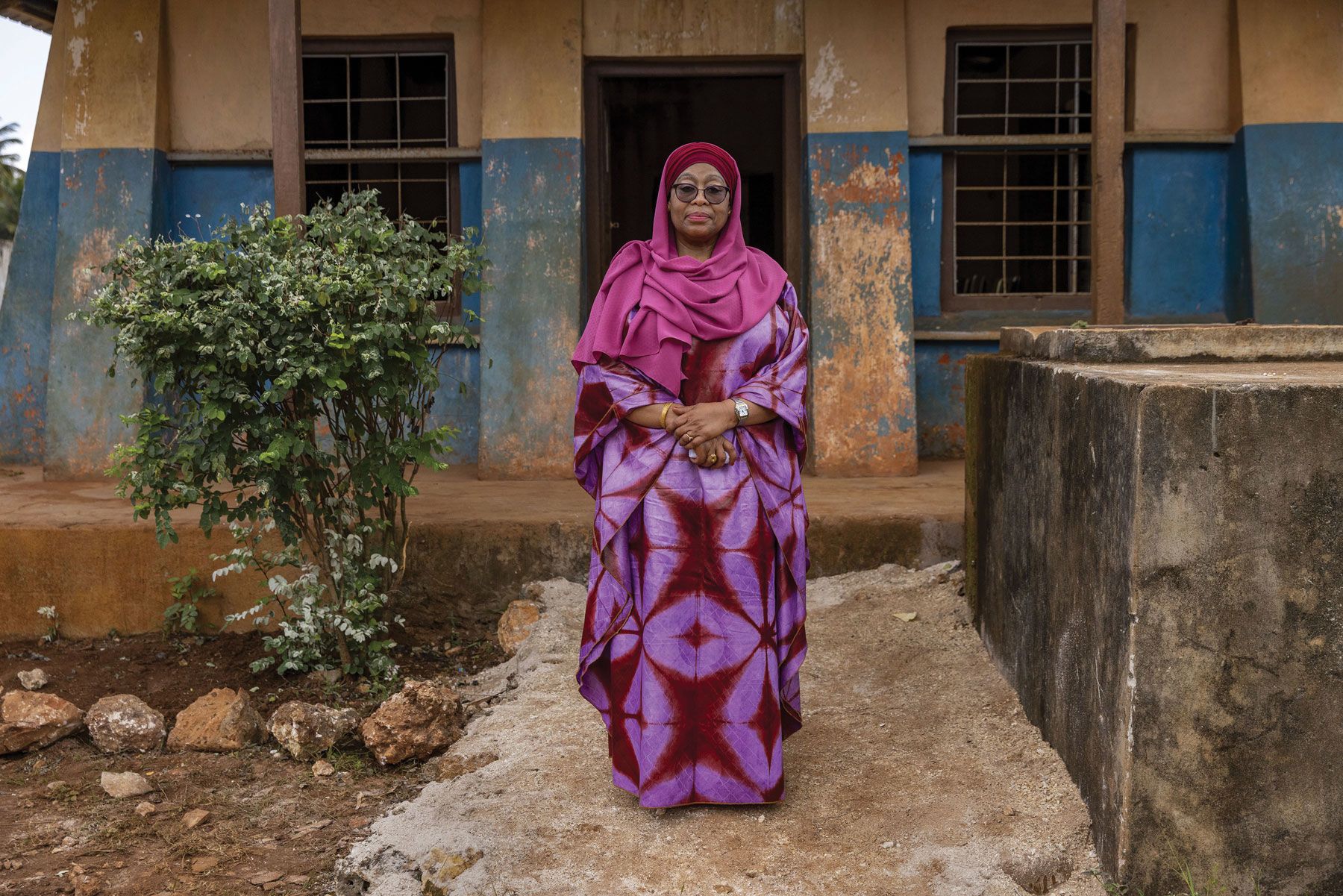
Tanzania president Samia Suluhu Hassan in her native Zanzibar. (Photo by Karen Ballard)
Tanzania president Samia Suluhu Hassan in her native Zanzibar. (Photo by Karen Ballard)
Hassan — or “Mama Samia,” as she’s widely known within Tanzania — came to office following the death of the previous president, John Magufuli, a Covid-denier who may have died of the disease. When he had chosen Hassan as his running mate, it was widely assumed he put her on the ticket to help him secure the votes of women, Muslims and residents of Zanzibar, the archipelago just off the coast of the East African country, where she was born and rose in politics.
Magufuli, after he was elected, had kept Hassan on the sidelines, but after she was inaugurated as president and became the first Muslim woman of color to lead an African country, she wasted no time making it clear that things would be different: One of her first acts was to get publicly vaccinated and to urge citizens to do the same. (Magufuli had insisted there was no Covid in Tanzania.)
The country, about the size of France and Germany combined, comprises more than 120 tribes, including some that have a strong patriarchal social structure and don’t believe a woman should occupy the top spot. “You have to accomplish twice as much as a male to be recognized,” she tells Greenberg during the program.
I accompanied Hassan and Greenberg for a few days of the shooting last September and had an opportunity to observe, up-close, her interactions with everyday Tanzanians, the film crew and Greenberg. She inspired affection in them all.
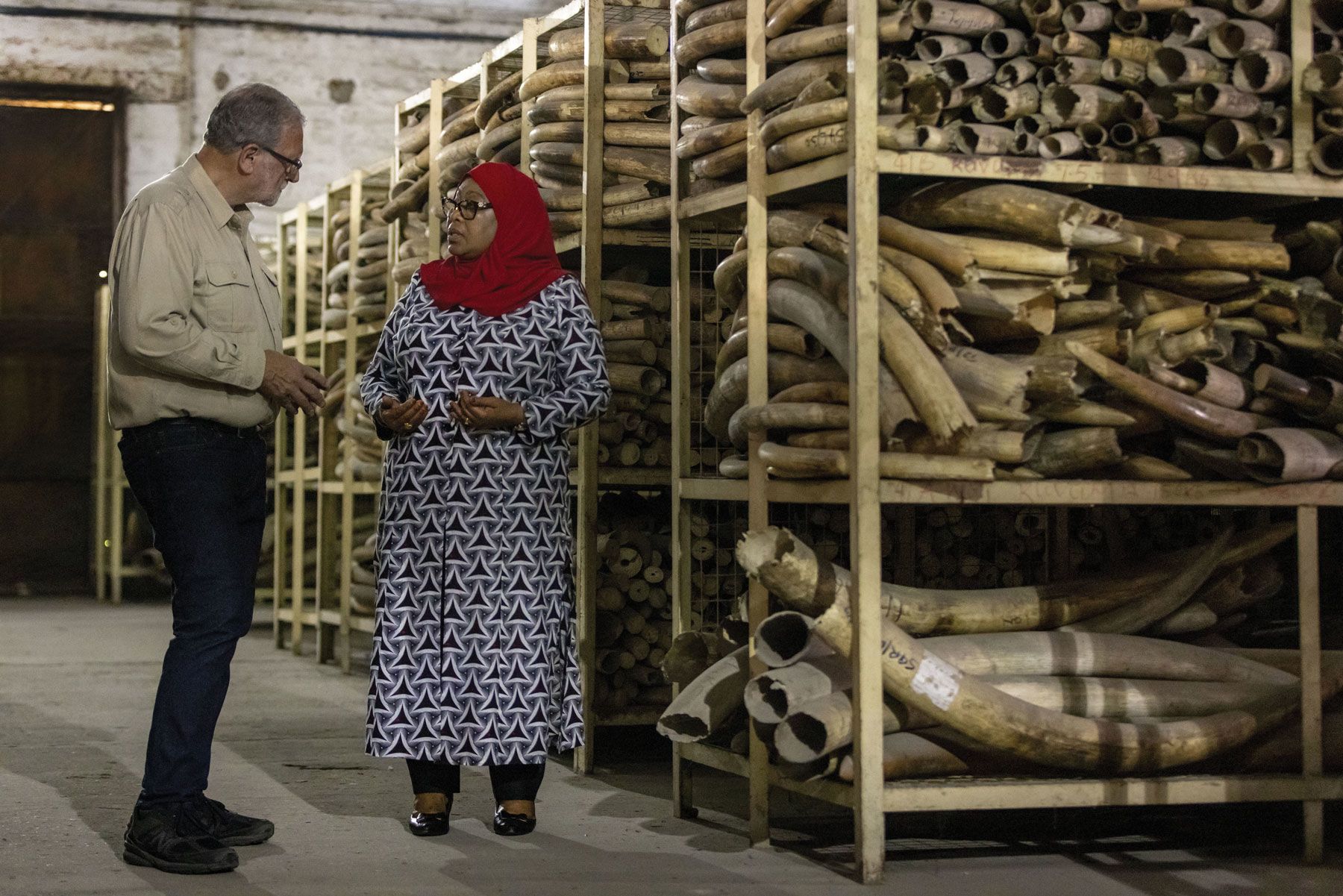
Hassan speaks to Peter Greenberg about the country’s progress against poaching in a secret warehouse that holds more than 49,000 elephant tusks confiscated from poachers. (Photo by Karen Ballard)
Hassan speaks to Peter Greenberg about the country’s progress against poaching in a secret warehouse that holds more than 49,000 elephant tusks confiscated from poachers. (Photo by Karen Ballard)
Many Americans associate Tanzania with safaris and, perhaps, Mount Kilimanjaro, but the first half of “The Royal Tour” explores parts of Tanzania that expand viewers’ understanding of the country. It begins in Dar es Salaam, the country’s de facto capital, which is undergoing rapid development, with skyscrapers and major infrastructure projects in various stages of development.
But then it moves to a Unesco World Heritage Site, the still-bustling settlement of Stone Town, on the Zanzibar island of Unguja.
The contrast is striking; unlike Dar es Salaam, with its wide, often car-clogged avenues, Stone Town is a warren of narrow streets and alleys with a pronounced Arab and Indian influence. Many of the extraordinary, ornately carved doors on residences one passes, however, are a reminder of Stone Town’s sordid past: It was the site of the largest slave and ivory market in East Africa, and its unique character, though charming today, was defined and created by wealthy slavers.
Elsewhere on the island, Hassan brings Greenberg and viewers to the modest home she grew up in near the beach village of Kizimkazi as well as to the mosque and school she attended.
Explaining how her village shaped her and her approach to government, she says that it was there that she first learned about her rights as a woman, including the right to be educated (she eventually received a postgraduate diploma in economics from the University of Manchester). They look in on a class in the primary school she had attended and where her father had been head teacher; she tells the pupils that any of them can grow up to be president.
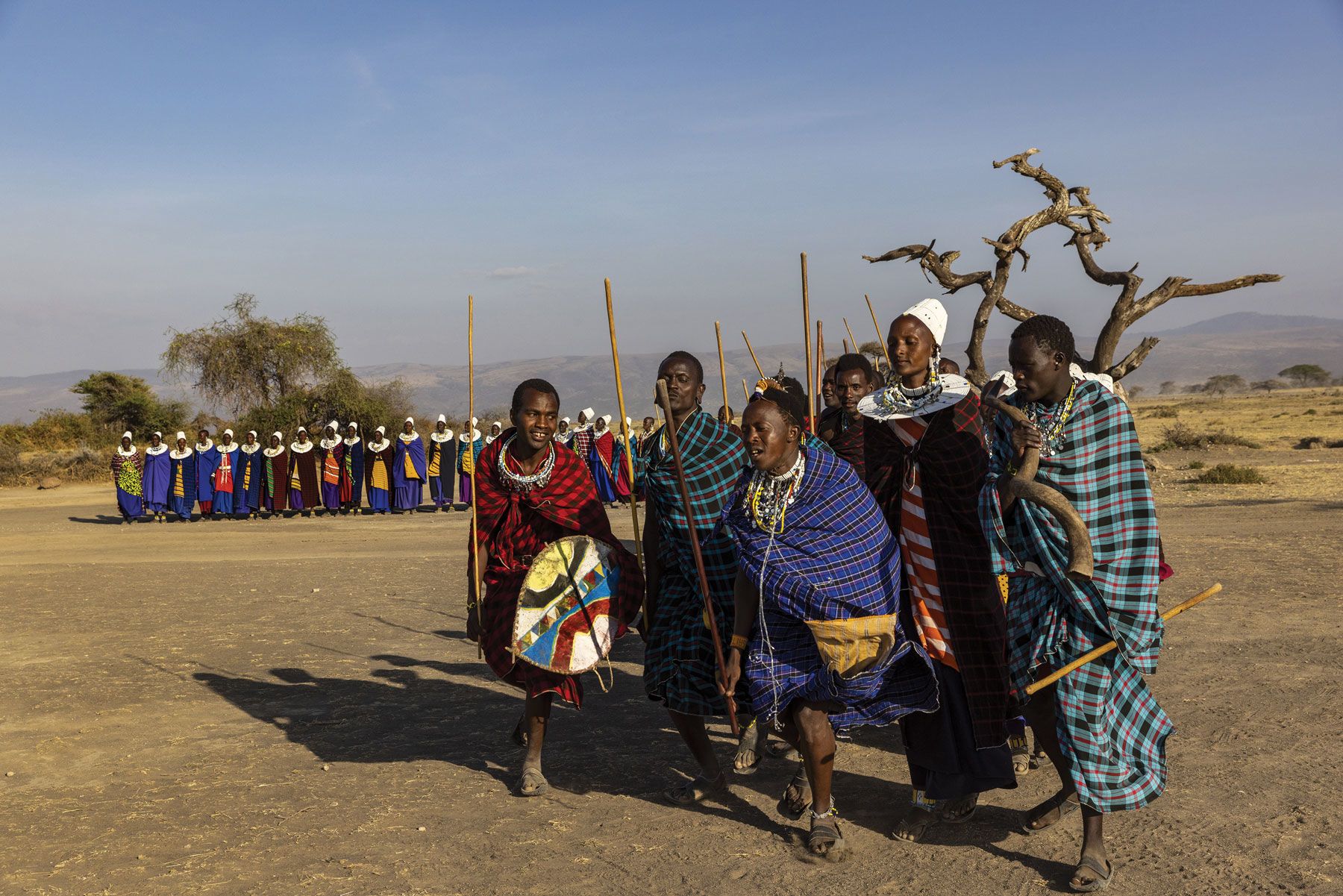
Members of the Masai tribe in Serengeti National Park perform for the president. (Photo by Karen Ballard)
Members of the Masai tribe in Serengeti National Park perform for the president. (Photo by Karen Ballard)
At a beach on the Zanzibari island of Pemba, the president of Zanzibar, Hussein Mwinyi, leads Greenberg to a boat for “a surprise” while Hassan remains on land. Their offshore destination is the Manta Resort, an ecolodge with a difference: Its bedroom is a submarine, sunk into a blue hole within a coral reef. Fish look in from every direction.

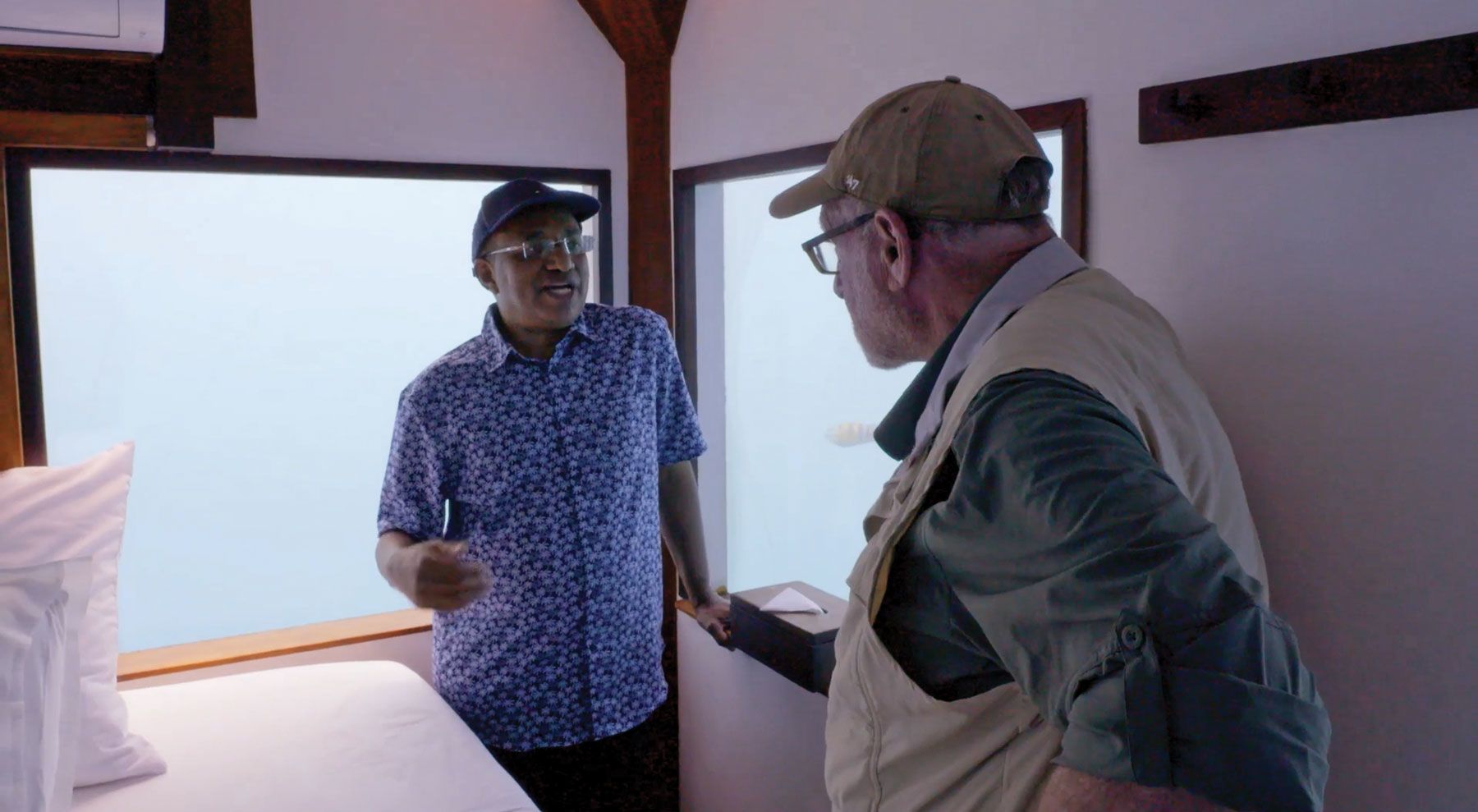
Zanzibar president Hussein Mwinyi and Greenberg in an underwater hotel room at the Manta Resort. (Courtesy Peter Greenberg Worldwide)
Zanzibar president Hussein Mwinyi and Greenberg in an underwater hotel room at the Manta Resort. (Courtesy Peter Greenberg Worldwide)
The next stop is not something that tourists can visit — in fact, its location is secret. It’s a warehouse filled with more than 49,000 elephant tusks that have been confiscated by the government from poachers. It’s an emotional segment, interspersed with disturbing still shots of elephants that had been killed and mutilated. But it also serves to underscore how serious the country is about its antipoaching efforts. Some 2,300 poachers have been arrested in the past six years, and, Hassan tells Greenberg, poaching has been reduced by 90%.
The next scene, while beautifully shot, also has a sobering side. The pair circle above the peak of Mount Kilimanjaro from an airplane. Those whose mental picture of the mountain includes a large glacier covering much of its summit will be in for a shock: Due to climate change, the snow has shrunk to cover only a small portion of the mountaintop.
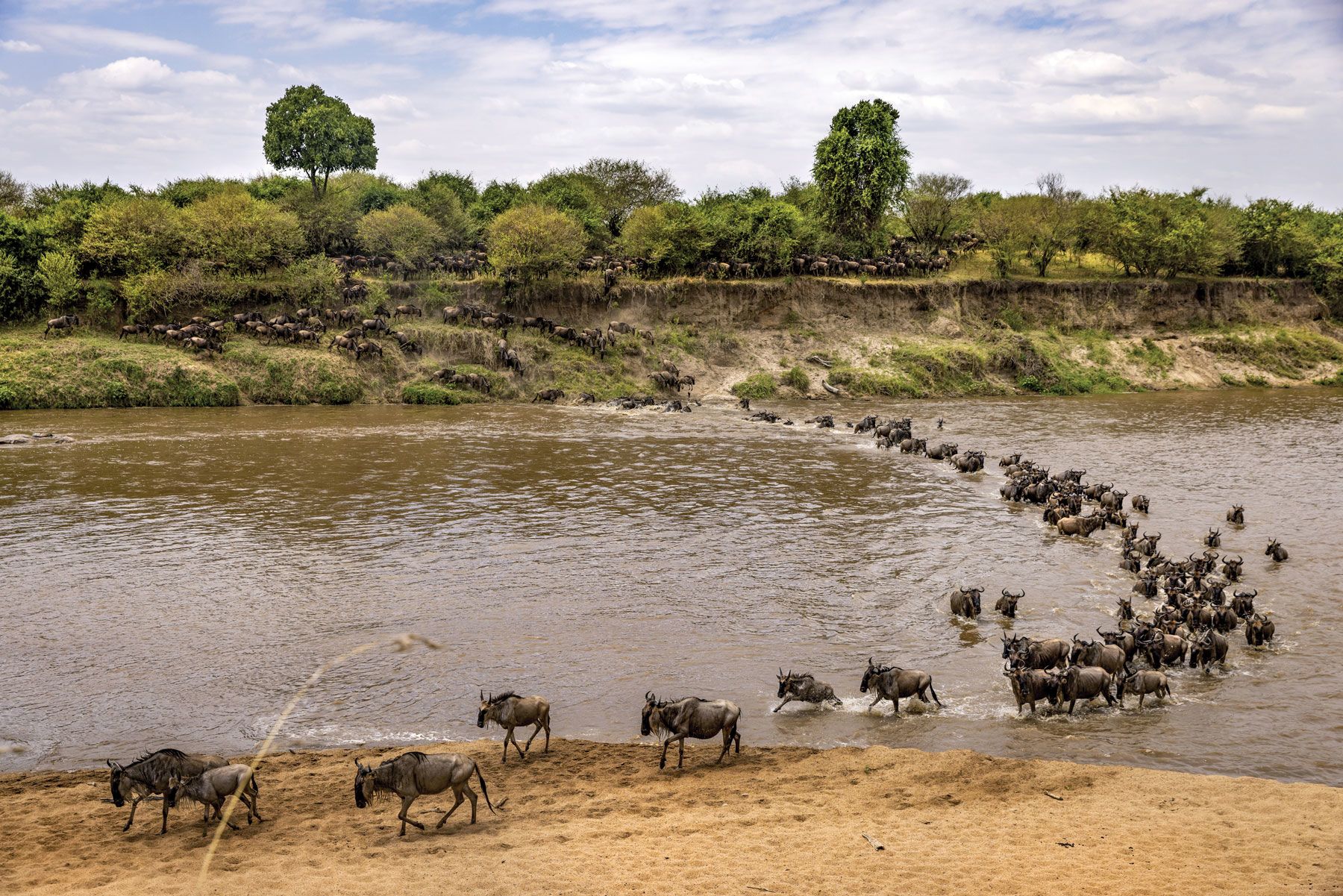
Thousands of wildebeests cross the Mara River in the Serengeti during their annual migration. (Photo by Karen Ballard)
Thousands of wildebeests cross the Mara River in the Serengeti during their annual migration. (Photo by Karen Ballard)
From the highest point in Africa, the tour moves to one of the lowest — and another look at a Tanzanian site that, alas, is not available to visitors: the country’s tanzanite mines. The blue gemstone, first identified in 1967, is found only in Tanzania, and only in one area that is less than four square miles. The stones themselves are mined three miles below the surface. They’re rarer (though less expensive) than diamonds, and it’s expected that the mine will be exhausted in 20 years.

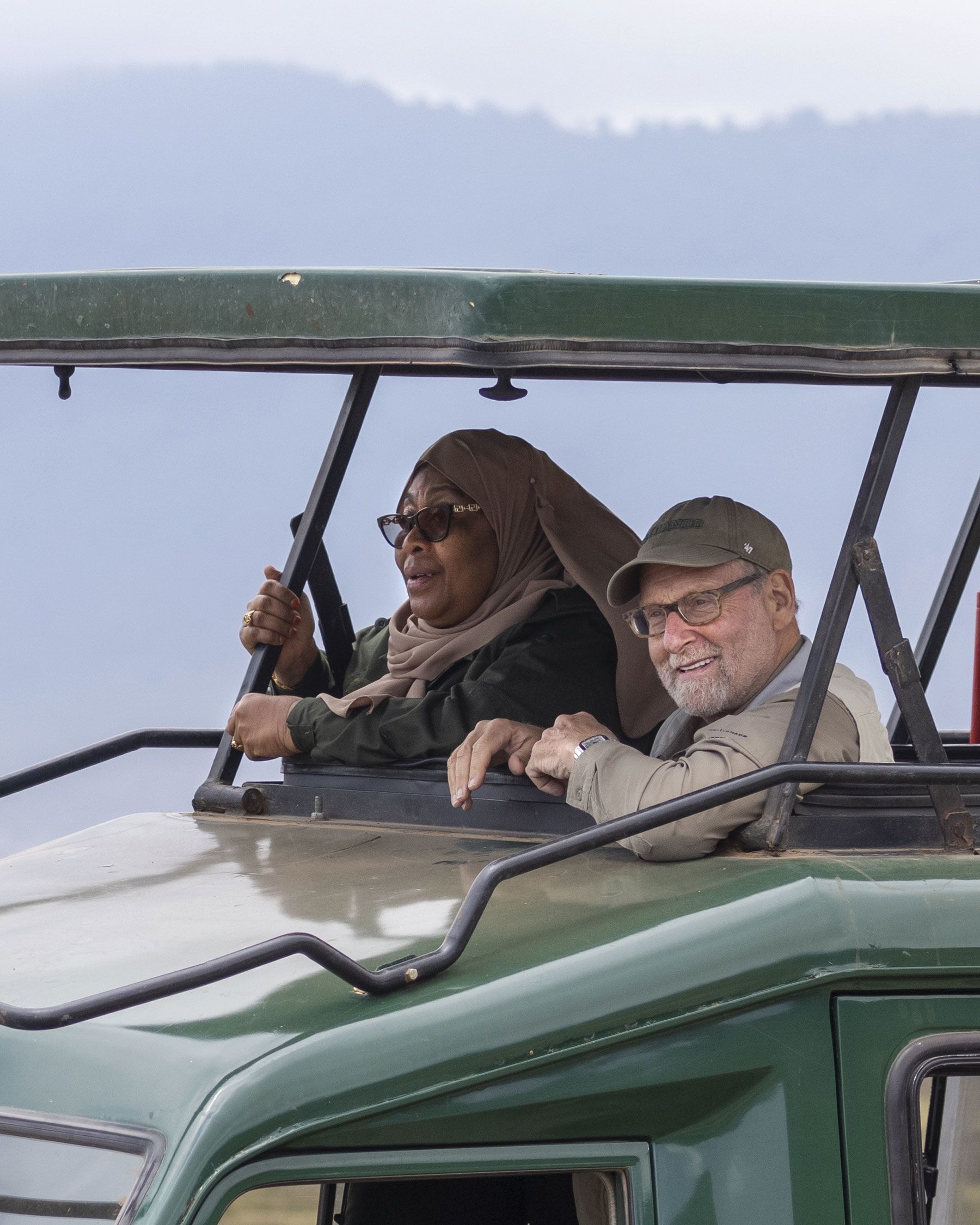
Hassan and Greenberg search for the Big Five in Ngorongoro Crater. (Photo by Karen Ballard)
Hassan and Greenberg search for the Big Five in Ngorongoro Crater. (Photo by Karen Ballard)
The show closes with images of Tanzania that will feel familiar to most people as Greenberg and Hassan visit the popular safari areas of Ngorongoro Crater and Serengeti National Park. Greenberg says his goal in Ngorongoro is to see the Big Five: elephant, lion, leopard, rhino and Cape buffalo.
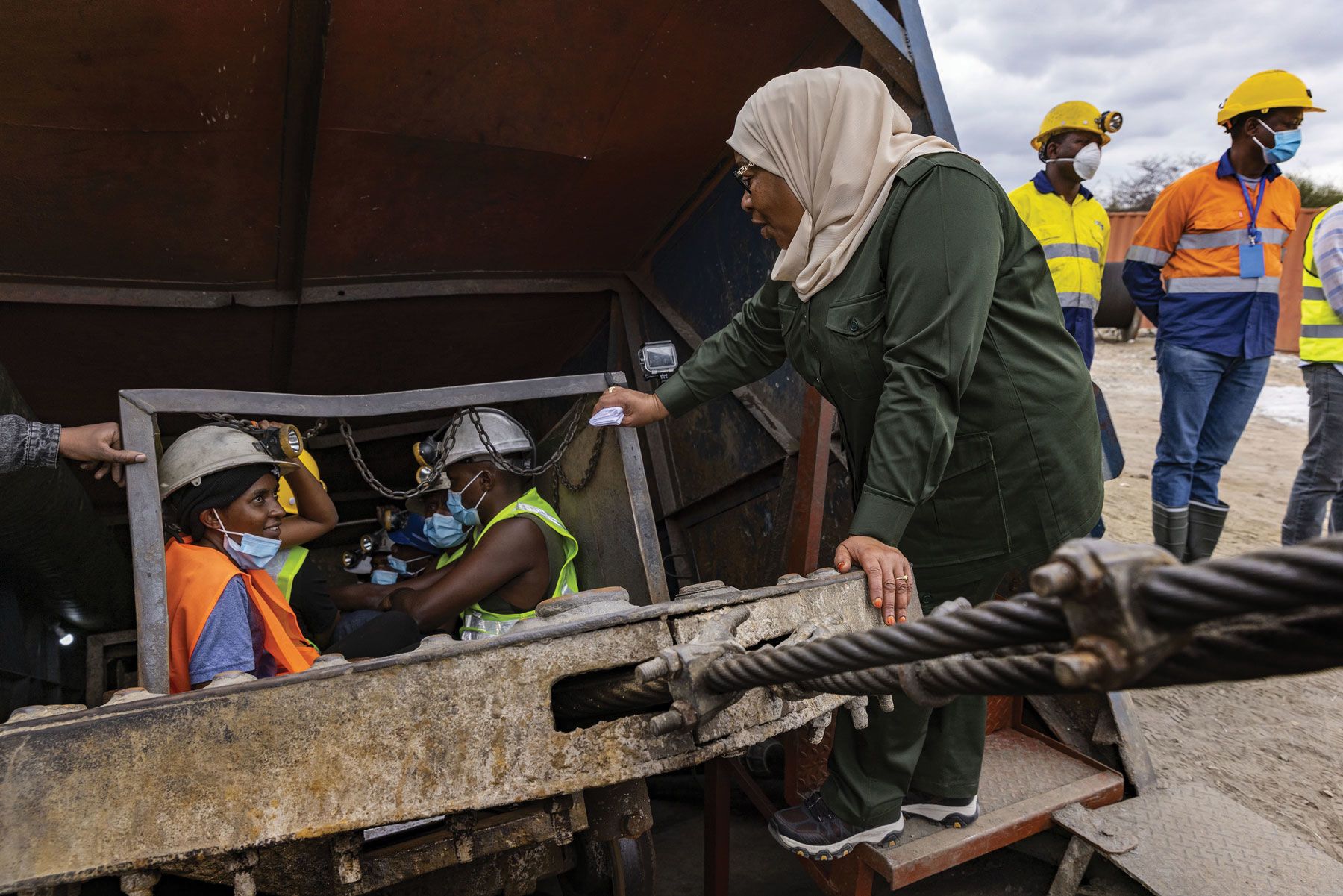
Hassan speaks with miners about to descend three miles below the Earth’s surface in search of tanzanite, a rare gem found only in Tanzania. (Photo by Karen Ballard)
Hassan speaks with miners about to descend three miles below the Earth’s surface in search of tanzanite, a rare gem found only in Tanzania. (Photo by Karen Ballard)
The crater, whose intact rim is 11 miles wide, has the highest density of large predators on Earth. It’s home to 25,000 large animals and more than 500 bird species (including ostriches and flamingos). After finding hippos, warthogs, giraffes, zebras and antelope, Greenberg’s Big Five wish is finally granted. Elephants weren’t hard to find, but the pair also spotted one of only 5,000 black rhinos left on Earth (the species has been slaughtered by poachers interested only in their horns), a solitary leopard and a pride of lions within sight of a buffalo herd.
Hassan and Greenberg catch up with the wildebeest migration in Serengeti, viewing it in part from a hot air balloon, and also visit a Masai village, where Greenberg tries his best to join in a dance with young men leaping straight up, repeatedly and rapidly.
What makes the “Royal Tour” series different from most tourism-related programing is that, aside from presenting an informal and personal side of a leader, it presents a 360-degree view of a country. Poaching, climate-change, slavery and endangered species are not, in most instances, topics that tourist boards want to dwell upon, but they’re important to get a full understanding of Tanzania.
By the end of the presentation, it’s likely that viewers’ interest in visiting the country will be higher than before they had watched it. Even Tanzania’s familiar aspects are enhanced because everything is shown from the personal perspective of the country’s leader.
Although the show premieres this week, most PBS stations will be airing it several times in the coming months. If you have clients who are considering a trip to East Africa, you may want to share with them local viewing times.
Tanzania’s pioneering president wants to change perceptions of her country
During the shooting of “The Royal Tour: Tanzania,” Travel Weekly editor in chief Arnie Weissmann had the opportunity to sit down with Tanzania president Samia Suluhu Hassan for an interview. Here’s a portion of their conversation:
Arnie Weissmann: How has the pandemic impacted tourism arrivals in Tanzania?
President Samia Suluhu Hassan: Tourism contributed about 4% of the country’s GDP in 2019. Since then, it has gone down to 1%. We’re trying to revive the sector. We’ve been seeing the beginnings of a revival, but it hasn’t come back to normal. We don’t predict it will return to normal levels until 2025.
One thing that has resulted from the pandemic is that people want to go outdoors more, into the fresh air. We believe that may bring a good number of tourists here.
We want more tourists. And we’d like them to be vaccinated. [Note: In addition to a vaccination requirement, all visitors are tested for Covid at the airport upon arrival.]

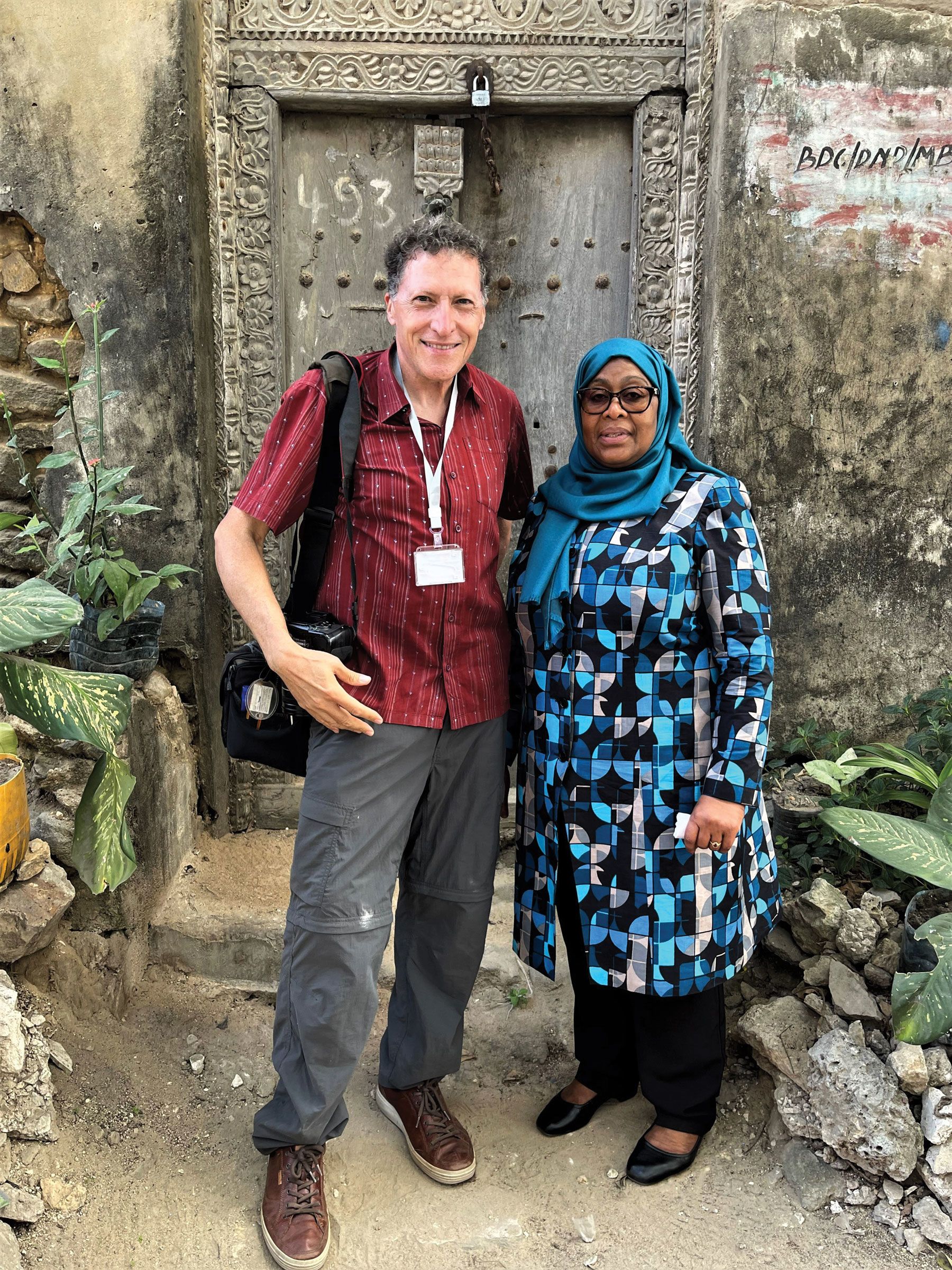
Arnie Weissmann and Tanzania president Samia Suluhu Hassan. (Photo by Karen Ballard)
Arnie Weissmann and Tanzania president Samia Suluhu Hassan. (Photo by Karen Ballard)
Weissmann: What are your expectations for “The Royal Tour”?
Hassan: When you say “Tanzania” to the outside world, most people don’t even know where it is. We have so many attractions that tourists would enjoy that aren’t known to the world. We have political stability and security here, something that is also not widely known to the world.
I get annoyed with some media, which may focus on something negative that once happened and keep showing it over and over, leading some people to think Tanzania is a chaotic country. But it’s not true. We wanted to do “The Royal Tour” so that the world can have a chance to know where is Tanzania, what is in Tanzania, who Tanzanians are and what they can expect when they come here.
Weissmann: How important is the American market to Tanzania tourism?
Hassan: It’s very important, but like others, most Americans don’t really know Tanzania. Once they know what’s available, they will come; they’ll begin to ask travel agents and tour operators.
Weissmann: Many Americans are aware that poaching is a problem that many African countries face. You say you have been successful in reducing it in Tanzania. What’s your approach?
Hassan: We work with the villagers. We’ve had a massive education program, showing them films, and they tell us where the poachers are operating and work with game rangers and the police. We also have support from Americans and the British, who supply us with technology to track the animals, especially the elephants. Poaching came down slowly at first, but now we’ve reduced it to a small percentage of what it was.
Weissmann: There is a controversial plan to put a cable car up a portion of Mount Kilimanjaro, along what is now a very popular climbing route. It’s thought this may increase pressure on other routes. What’s the status of that project?
Hassan: It is under consideration. There are environmental issues and technical issues. I would like to see a cable car there. Many people would like to go up there without climbing. I have seen it work in many other places.
Weissmann: Can a country that is still a developing country make sustainability a priority?
Hassan: The beauty of Tanzania is in its forests, its lakes, its coastline. Protecting our environment is our priority. Forty-four percent of our country is in national parks.
Weissmann: Many places that have such a large portion of their countries protected in national parks find that these areas can come under pressure from farmers encroaching on reserves. Is that a problem here? If so, how do you address it?
Hassan: We’ve had problems. We started an education campaign on conservation. We found that the problem is that, every year, the farmers want more land. Every year, more and more. So, our approach is to work with them to increase the yield on the land they have rather than just giving them more land.
Weissmann: Some of the places that you’ve gone on “The Royal Tour” are not particularly well-known. What are some other less well-known attractions you’d like potential visitors to know about?
Hassan: Near the city of Mbeya, one can see one of the largest meteorites ever found, sticking out of the ground. And there are hot springs in a few places, the Amboni caves and Kikuletwa Hot Springs. And, there are the Kondoa Irangi rock paintings [a Unesco World Heritage Site].
Weissmann: You’ve been in office for less than a year. What’s your vision? What do you hope to have accomplished by the time you’re up for re-election in 2025?
Hassan: In the short term, a broad Covid recovery. That will take time. The economy is now growing at about 4%. By 2025, I hope it will be 7% to 8%.
My hope is not only for economic growth but also for human growth, growth out of poverty, to have clean water, to have children go to school. That’s my vision.
 Built with Shorthand