
Wet & Wild
Summer is peak safari season in East Africa, but wondrous wildlife encounters can occur year-round.
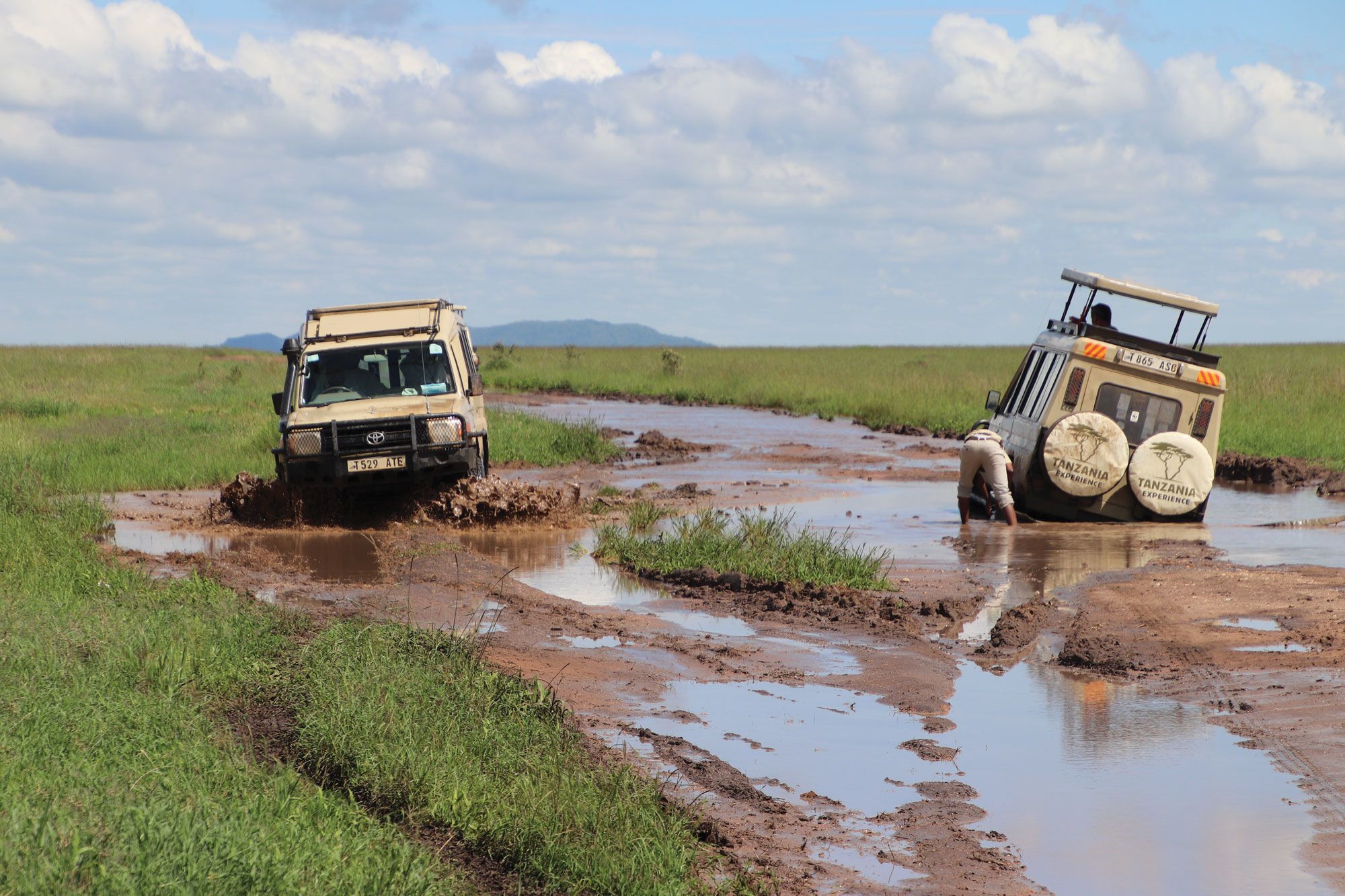

His parents named him Godbless, but had I been in our safari guide’s shoes — his mud-caked shoes, sinking ever deeper into the adobe-colored earth under the late-morning Tanzania sun — I can tell you I wouldn’t have had blessings on my mind as all four wheels of our Land Cruiser spun futilely upon what constitutes a road in the Serengeti.
We were at the tail end of our early-December media trip to Tanzania, and while we had been occasionally inconvenienced by wet weather throughout our weeklong safari, this time it seemed the rain — or rather, the claylike mud left in the aftermath of rain — might truly put a damper on our day.
Help arrived after a few minutes, from our lodge as well as from passersby working for competing safari operators. (Godbless told us that in situations like this, it’s understood that guides should lend a hand to one another regardless of company affiliation, especially if they’d like that favor repaid sometime.)
A half-dozen or so guides placed some wooden planks under our tires, then tied one end of a girthy, natural-fiber rope around our bumper, the other around another Land Cruiser’s. Someone on each end gave the thumbs-up. Engines revved. The rope snapped as our vehicle sank what felt like an inch or two deeper. (We had been instructed to remain seated. I wanted to help, honest.)
Amid all his efforts to free us, Godbless seemed to be in good spirits, and similarly, our group was also taking the setback in stride: raiding the stash of onboard snacks, making small talk, sneaking a bathroom break behind the vehicle once passersby were a reasonable distance away. “Hakuna matata,” Godbless said, instantly planting in my head the “Lion King” song espousing a “problem-free philosophy.”
Eventually it was decided we would continue that morning’s safari aboard another vehicle from our lodge, while others worked to free our sunken Land Cruiser. The whole episode lasted probably an hour. Maybe 90 minutes? I wasn’t sure; I had been keeping myself occupied in the back seat by deleting photos from my camera. Every day thus far had produced dozens of shots I was happy with, and I knew I needed to free up space on my memory card for the photo-ops to follow. After all, rain or shine, this was the Serengeti.
Seasons to taste
We were in Tanzania during East Africa’s rainy season — or one of them, at least. Because it coincides with schools’ summer breaks in the Northern Hemisphere, the period from late June through mid-September continues to be the most popular time for safaris in East Africa. But also, for those envisioning the perfect, once-in-a-lifetime safari experience, the last thing they would want is rain, and East Africa can generally be counted on to be dry during those months.
But safari operators say that those who insist on visiting during that period miss out on the myriad advantages of going on safari at other times of year.
“I had this conversation with a travel agent, and they asked when is the perfect time to go,” said Sherwin Banda, president of African Travel. “And I said, ‘Today.’”
Indeed, that viewpoint has led Banda and other safari operators to mostly eschew terms such as “offseason” in favor of more descriptive phrases such as “short-rain season” (in East Africa, November to mid-December) or “long-rain season,” aka “green season” (April and May). And even those terms might fall short of setting Western visitors’ weather expectations.

‘In the green season, it feels like just you and the wildlife.’
“People have a perception of rain based on the climatic conditions of the U.S.,” Banda said. “The rains don’t happen that way in Africa. So a short rain would be a downpour for 10 to 15 minutes. Then the clouds open and it’s bright sunshine, and the sunshine periods actually outlast the rainy periods.”
Justin Stevens, general manager of the Four Seasons Safari Lodge in the Serengeti, concurred.
“At the end of the day, the rainy season isn’t like the rains you get in North America or Europe, where it can just kind of rain all day long and be miserable and cold,” he said. “It’s generally showers; the rain will come, and then it goes away. So it’ll be maybe overcast, maybe threatening rain, but it’s still nice. It may or may not rain, and [even] if it’s a long one, it’s three or four hours, and then it breaks away and stars come out or sunshine comes out, and the day goes on.”
The grass is greener
Several operators conceded that northern summer months offer optimal wildlife-viewing in one important way: With savannas turning from green to shades of brown under the hotter temperatures, the shorter, drier grasses can make it easier to spot animals. But operators also said there are upsides to wildlife-viewing in greener seasons.
“East Africa can be a very dry part of the world, so it can be dusty and brown and bare,” said James Haigh, director of sales and marketing for the Elewana Collection, which hosted my December safari. “Imagine taking a photograph of a beautiful male lion against a dusty brown or tan field versus taking a photo of a fat and happy lion against a lush, green field.”
Suzanne Teng, Africa product manager for Abercrombie & Kent, mentioned another photographic opportunity presented by the rain.

‘A lot of amazing photography can take place in the offseason.’
“I’ve actually seen a few lodges in East Africa — Singita comes to mind — that have done a lot of advertising for their green season; they really play up the thunderstorms that sweep across the Serengeti,” she said, adding that the advertisements make use of “a lot of amazing photography that can take place, especially when rains stop or they’re starting, or [when there are] thunderstorms and lightning. So a lot of times, photographers really like those offseasons.”
Migration myths
A key safari draw is the great wildebeest migration, when millions of the creatures and other species make their way from the Serengeti to Kenya’s Masai Mara and attempt to cross the Mara River in search of food and water — and if successful, avoiding the waiting jaws of crocodiles.
And while no safari operator would argue the allure of witnessing that spectacle, they noted that the Mara crossing, which occurs in the summer months, is just one period in a yearlong cycle.
“The migration is in Kenya for about two-and-a-half to three months each year,” Haigh said. “Well, it exists the rest of that year; it doesn’t disappear. People often ask me, ‘When is the migration?’ There’s 2.5 million wildebeest; they don’t disappear at the end of September.”
Instead, visitors in the nonsummer months have an opportunity to witness different stages of the wildebeests’ journey, such as winter’s calving season, when the migration makes its way around the western part of the Ngorongoro Conservation Area and the southern part of the Serengeti.
“You have tons of babies running around; they’re healthy,” Stevens said. “I always refer to the rainy season as ‘life season’ because you’ve got flowers, you’ve got color, you’ve got healthy animals. It’s not dusty and arid and dry. It’s an abundance of life, everything from the smallest insect to the biggest elephant.”
Privacy and pricing
And along with that abundance of life comes other advantages for those willing to brave the rain.
“The lion population, the resident antelope population, the elephants and the giraffe stay put in the Masai Mara, whether or not the wildebeests are passing through,” Teng said, adding that the lack of peak-season visitor numbers presents an opportunity for “a more private experience. … They can have amazing game-viewing, and it’s just more exclusive because it feels more private.”
And that exclusivity doesn’t come with a premium; often, it’s quite the opposite. For example, 2020 rack rates for A&K’s 12-day Kenya & Tanzania Wildlife Safari started from $8,795 for its May 19 departure, versus starting rates of $10,795 to $12,995 at other times of the year. Rates for Elewana’s eight-day Classic Tanzania SkySafari range from $6,680 in green season (March 30 to May 29) to $7,556 during high season (June 30 to Oct. 28 and Dec. 17 to 31). For Ker & Downey, East Africa rates range from $1,000 to $2,000 per person, per day in high season (June to October and December to January), versus $800 to $1,300 in low season (February to May and in November).
Indeed, several operators said that it was common for rates in lower-demand time periods to be about 30% or even 40% below high-season rates.
Referring to another off-peak period, Banda said, “I was just in Tanzania in November with our entire sales team, and I have to tell you I absolutely loved it. … There are fewer people out on the savanna, which means that it feels like just you and the wildlife.”
“When you come to Africa,” Elewana’s Haigh said, “you want a little bit of it all to yourself.”
Serengeti standoff
Things weren’t quite that quiet the day after our Serengeti setback, as we spotted probably a dozen or so vehicles on our morning drive, the last drive of our weeklong Tanzania trip. A pair of male lions had been spotted having a post-meal rest — fat and happy lions set against a backdrop of a lush, green field, just as Haigh put it — and understandably, everyone was eager to catch a glimpse.
But that photo-op would prove to be just the opening act. Their meal, it turns out, was Cape buffalo, and a few minutes after our arrival on the scene, a herd of said species appeared in the distance. The lions retreated a bit, huddling near our group of Land Cruisers as the buffaloes approached the remains of their fallen companion.
The pair, vastly outnumbered, seemed like they might be in danger of some payback. But from the other side of the road, a group of female lions began approaching, leading to a standoff wherein the buffaloes would chase off a lion, only for that lion to rally her pride and eventually see the buffaloes retreat.
The tension abated, the pride then sought refuge from the late-morning sun not underneath a tree but in the shade of safari vehicles parked nearby. During my Kenya safari in June 2017, lions had proved mostly elusive, but here now in the Serengeti they were just a few yards away.
The previous day’s muddy mishap seemed a distant memory. And this time, it wasn’t “Hakuna Matata” going through my head but another tune, from the 1982 pop album “Toto IV.” I scrolled through the shots on my camera, frame after frame of blue skies and green savannas and golden cats, and I blessed the rains down in Africa.
 Built with Shorthand