
Serving up food on the fly
Food and beverage operations in airports have to deal with tight security, small kitchens and fluctuating customer numbers — and that’s all before harried diners are seated.


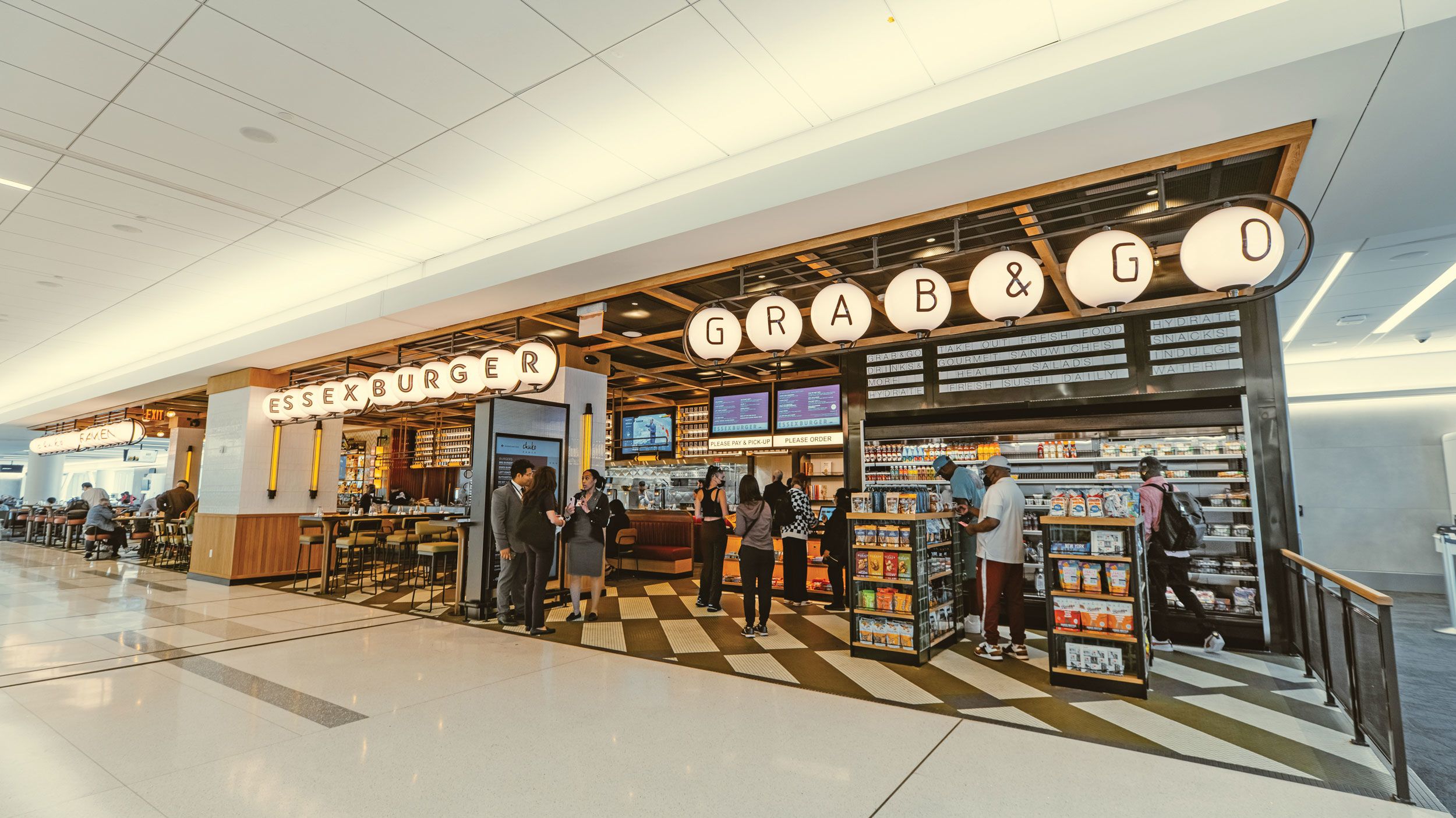
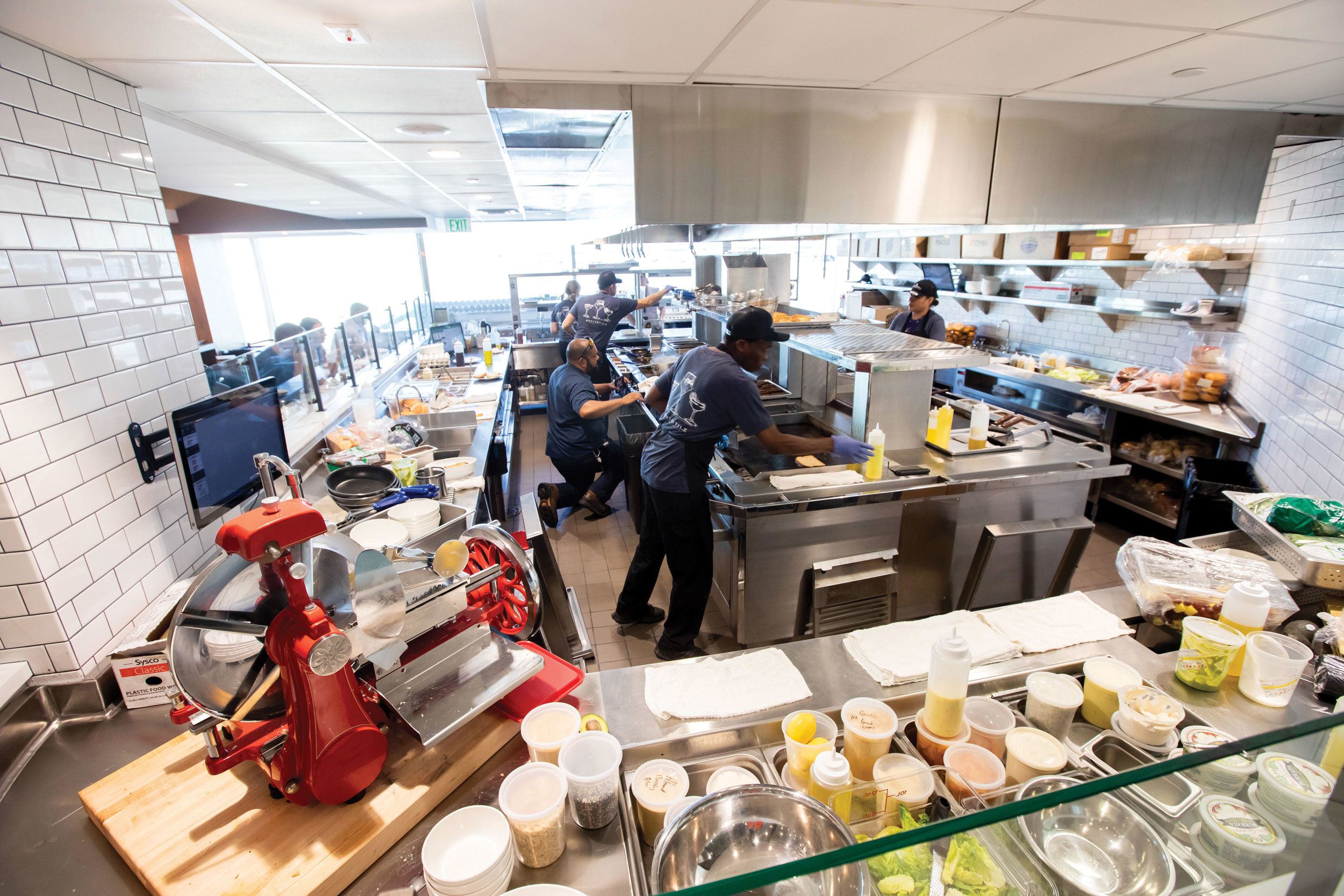
On a Wednesday afternoon in January, business was steady at Essex Burger in LaGuardia Airport’s Terminal C as Dejan Mileski took a walk through the kitchen that supports Essex and three other restaurants.
As he peered at the griddle, Mileski, the regional executive chef of culinary operations for the airport food and beverage operator OTG, said that lines sometimes stack up for Essex’s popular smashed burgers. But by using an assembly line process — one person smashing and cooking the burgers, one assembling them and a third packaging the order — Essex can prepare burgers to order in four to six minutes.
“I mean, it’s amazing what we do here with very little space,” Mileski said while giving an online tour.
Operating in tight spaces while dealing with rushes of nervous customers, on edge from their journey or worried about making an upcoming flight, is a typical day in the life for Mileski and his team at LaGuardia.
And they are challenges common across food and beverage operations in airports everywhere.
At LaGuardia, for example, OTG’s 36 restaurant concepts average a combined 14,500 transactions per day. (OTG can have more than one concept in the same space: For example, Essex is breakfast sandwich restaurant Eggy Weggy in the morning.)
At Newark Airport, where OTG has 69 restaurant concepts, all in United’s Terminal C, the company recorded 28,300 transactions on its busiest day last year. That was in late June, when a United operational collapse left thousands of flyers in the lurch — and hungry.
Major flight delays are among the unpredictable rushes an airport eatery may face. It’s a business model where surges and lulls are dictated as much by flight schedules as they are by time of day, a dynamic that can make operations more nuanced than at restaurants outside of airports.
Then again, in these airport mini-cities, practically every operating element is more complex than it is on the street, concessionaires say.
Security protocols impact food deliveries. Airline passenger counts factor into daily inventory orders. Back-of-house spaces can be a third the size they’d typically be at streetside restaurants. Staff training must account for the often-harried state of airport customers. And never mind the extra hurdles airport restaurants go through to manage their knife inventory.
“You have to not look at them as challenges,” said J. Allen Adams, director of operations for Tastes on the Fly in Denver, which operates seven restaurants at the airport there, with six more on the way. “You have to look at them as opportunities to solve things creatively.”



Airport concessions face unique challenges
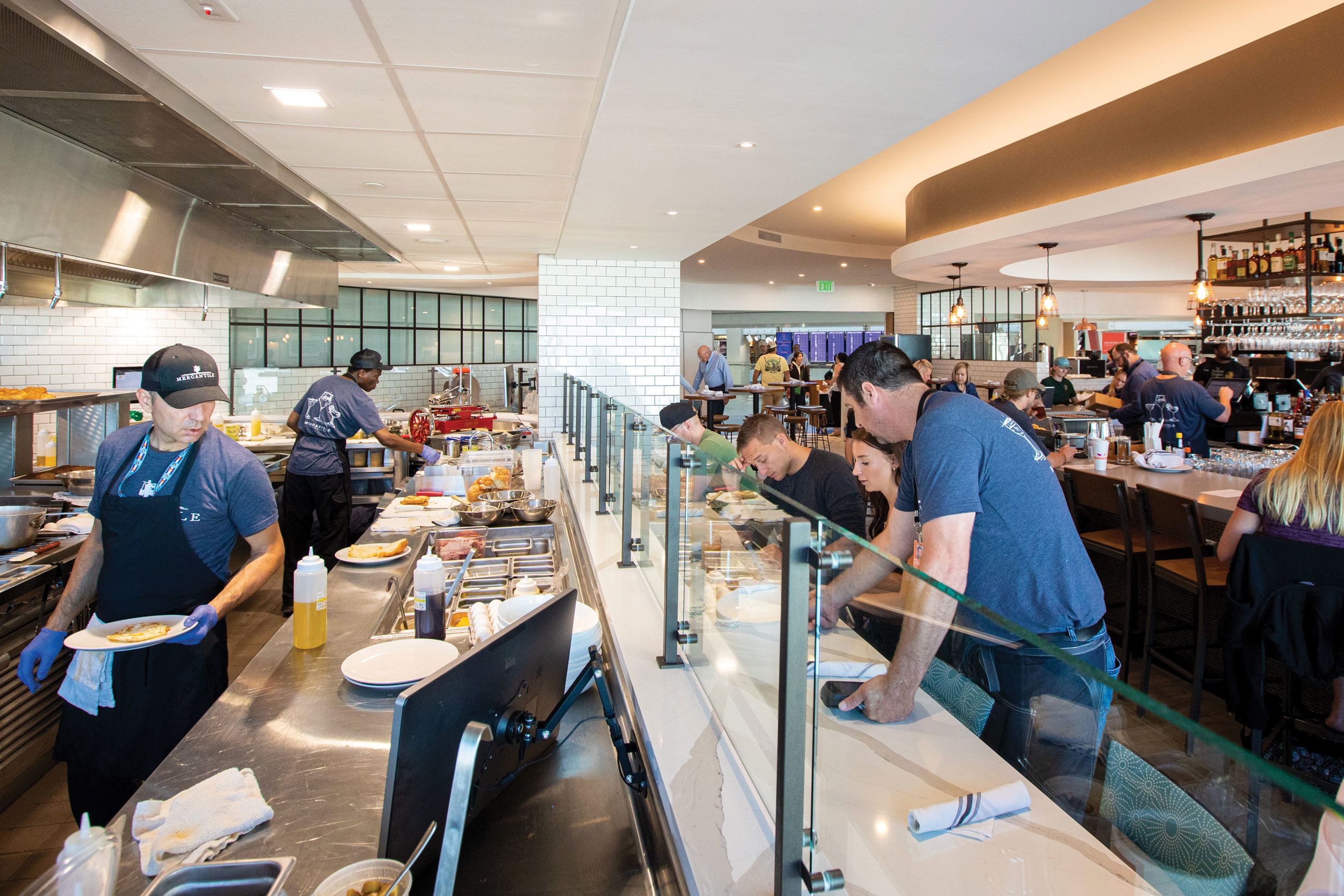
On another Wednesday afternoon in January, Adams and Denver Airport concessions chief Pam Dechant sat down for an interview at Mercantile, an American bistro concept with an open kitchen, a bar and a barista bar. Founded by James Beard Award-winning chef Alex
Seidel, Mercantile also has a popular downtown location in Denver’s Union Station.
Amid the ordinary clamor of an airport that served 77.8 million visitors in 2023 — 213,000 per day on average — Adams offered his take on the mindset of an airport customer.
“They are rushed to get to the airport,” he said. “They are not sure where they are going to park. Once they get parked, they are rushed to get through security. They have to take off half their clothes and unpack their bags and then repack it all. They get on the train and find out where they’re going. They find their gate and then they’re like, ‘I’m hungry. I’ve got time to eat.’ So, yeah, they’re a little on edge when they get to us. Our job is to make sure that we take them in hand and within about 40 minutes — because that’s the average stay for our guest — make them feel like they’re better.”
But even before those harried customers arrive, what airport restaurants do to get that food on the table is a much more arduous process than it is on the street.
It starts with ordering.
For OTG’s more than 350 concessions across 11 North American airports, ordering requires more than the usual day-of-week and time-of-year considerations.
Management teams look at projected passenger counts, starting with a broader overview a week ahead and then zeroing in as passenger loads become clearer a day or two before a flight, said OTG president Aaron Kling.
Because the company uses almost entirely fresh ingredients, orders need to be especially fine-tuned. But culinary teams must also build buffers into orders in case there is a surge of flight delays that lead to business spikes. “Sometimes we pray for bad weather. I don’t think the airlines do, but we do,” Kling said.


‘Sometimes we pray for bad weather. I don’t think the airlines do, but we do.’
Steering clear of frozen product, he said, makes ordering more complicated, but it’s worth it: “The quality of the food is so much better.”
Adams described a similar process for Tastes on the Fly in Denver. In addition to analyzing TSA traffic reports, he speaks daily with airlines to know passenger loads and talks to gate agents to assess how many flights are planned on given days in different sections of the airport.
Weather is also a factor. “If we know snow is coming, we’ll order extra because we know the next day delivery trucks aren’t going to be allowed on the tarmac,”
Adams said.
Once those orders are in, delivery presents the next challenge.
First, there’s security. Every order is subject to TSA inspection, though processing procedures differ by airport. At LaGuardia, Mileski said, food deliveries must be vetted at an inspection facility a couple of miles from the airport before being transported to airport loading docks.
Special permits are required to deliver food to airports, Kling said. Some smaller, locally sourced purveyors OTG uses don’t have these permits. They must work through licensed distributors, adding expense to the process.
Back in Denver, Dechant said “receiving product is 10 times harder than it is on the street.”

‘Receiving product is 10 times harder than it is on the street.’
That’s in part due to TSA checks but also to the complexities of moving products around the airport.
Companies wanting to streamline deliveries need to drive across taxiways, which requires a $10 million insurance policy. Concessionaires without it typically move deliveries from a central loading dock via golf cart through the airport’s network of tunnels, from where deliveries are loaded onto elevators and taken up to concourses — and inspected again.
“The entire ecosystem for our business partners is impacted by very stringent rules,” Dechant said.
Given the high security in an airport, it’s no surprise that some of those stringent rules involve knives.
In Denver, Dechant said, airport security must approve a restaurant’s knife plan prior to opening that details the number and types of knives it will have. Knives longer than 14 inches aren’t allowed.
Once in business, restaurants are required to conduct and log a knife audit three times a day, in part to make sure customers don’t walk away with them.
In addition, Denver Airport security and the TSA conduct random inspections.
At LaGuardia, Mileski said, OTG must also maintain a knife log that is subject to daily checks. To replace a knife, the company must inform the oversight team at the airport operator, the Port Authority of New York and New Jersey, which sends a security official to witness the knife swap and dispose of the old knife.


Making the most of limited space
Despite the many extra protocols that accompany running F&B operations in an airport, space constraints are the most pervasive challenge.
Adams said Tastes on the Fly typically has half as much kitchen space per customer seat as restaurants he has run outside of airports. Mileski said that the two restaurants he previously owned had triple the kitchen space of what he works with at OTG, despite having less dining space.
Such tight confines are one reason that OTG operates multiple brands out of some of the same front-of-house spaces, changing the signage at 10:30 each morning. Sharing kitchens across multiple restaurants is also common.
Those tight confines, Kling said, influence everything about OTG’s operations, including how it designs production areas, what equipment it buys and how it builds its menus.
With those space constraints, he said, OTG has to be innovative when it comes to the tools it uses and the spaces to fit them, ultimately impacting what gets served. “You need to design the menu in a way that utilizes the equipment effectively,” he said.
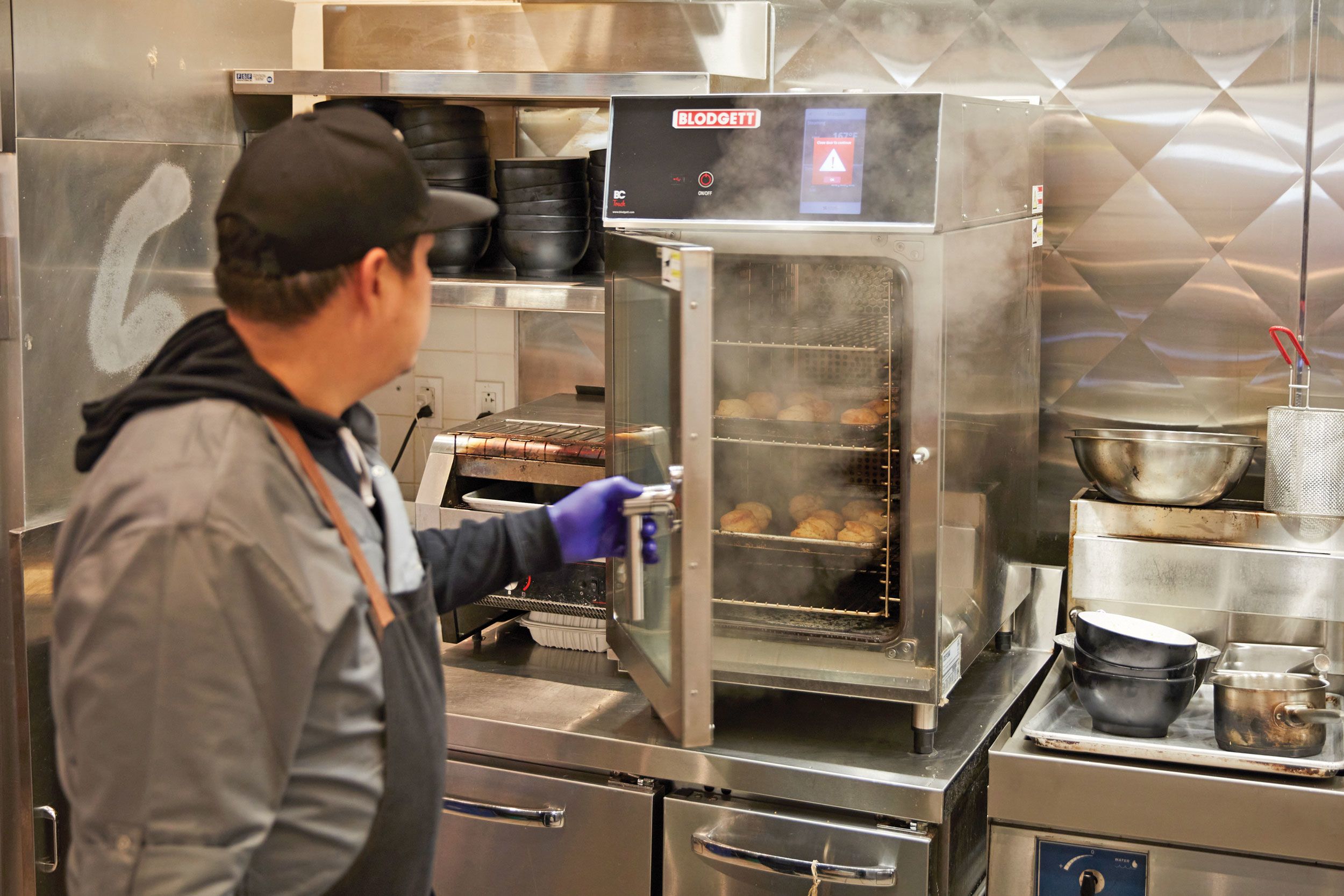
One space-saving item that both OTG and Tastes on the Fly use are combi ovens, which can steam, roast and bake and come in small sizes. At LaGuardia’s Terminal C, OTG uses a combi oven to steam buns for its Chuko Ramen restaurant and for baking breakfast items at Poppy’s Bagels and Eggy Weggy, which operate from the same kitchen.
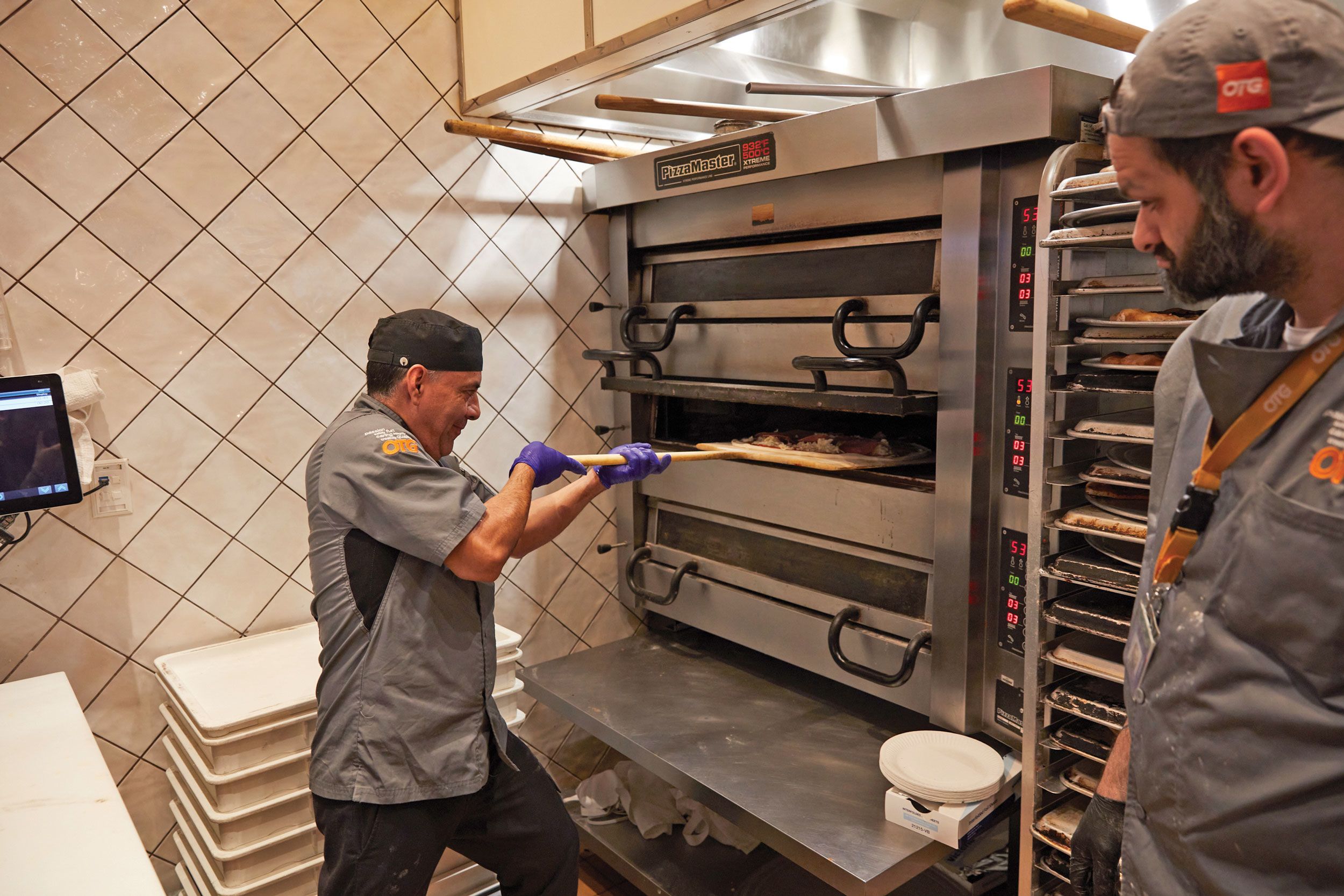
During the virtual tour last month, Mileski pointed out other equipment that enables OTG to better handle high volumes in tight confines, like the triple-decker pizza oven that supports the Sunday Supper Italian restaurant. Local pizza parlors, he said, would likely have no larger than a double-decker oven.
Mileski also called attention to the clamshell flat-top grill in the kitchen at LaGuardia’s The Line Sports Grill. The closeable, two-surface grill radiates heat between the top and bottom, cooking a rib-eye steak in as little as 2 minutes, 17 seconds.
Adams said “cooking times and simplicity of recipes is paramount,” not just to conserve space but to help upscale airport restaurants like Mercantile turn customers quickly — a necessity for many who are closely eyeing the clock as departure time approaches.
Adams said that at Mercantile and other full-service Tastes on the Fly restaurants, the goal is to keep the time between a food order and table delivery to 10 minutes or less. At the group’s fast-casual restaurants, the goal is four minutes or less.
Making sure time-limited customers don’t get too ambitious is also crucial.
“One of the initial pieces of our training program is we train our staff to ask people, ‘How much time do you have before your flight boards,’ so that we can cater the experience to what your needs are,” Adams said.
Easing the time crunch with tech
Technology helps OTG be especially innovative when it comes to enabling quick turnarounds.
Across the company’s 11-airport network, customers place orders and settle their bills on their phones — no waiting for a server to place an order or bring the check.
Digital ordering brings down the time between when a customer sits down and when an order reaches the kitchen by two-and-a-half minutes on average, according to Kling, and paying the traditional way typically takes six to nine minutes. “Here, you’ve already done it,” he said. “You can leave when you want. It really puts the time in the hands of the guest.”

‘You can get to five-star food in an airport. You just have to be creative about it.’
Despite space and time constraints and the myriad complicating protocols, both Kling and Adams say that they’re able to produce great meals in the airport environment, just as they could on the street.
“You can get to four- or five-star food in an airport,” Adams said. “You just have to be creative about it.”
 Built with Shorthand