
Navigating a new landscape
As more travelers use generative AI tools to research travel plans, advisors are developing the best ways to surface their wares in platforms like ChatGPT, Claude and Gemini.


NEW YORK — Since generative AI (genAI) exploded onto the technology scene nearly four years ago, calling the pace of its innovation “rapid” would be an understatement. It has been so swift that Nelson Boyce, Google’s managing director of travel, likened only the first three months of this year to being “shot out of a cannon” in terms of its advancement.
Boyce was speaking here last month during Phocuswright’s inaugural Travel Marketing AI Summit, which focused on how the industry should respond to traveler behavior around AI, specifically through the lens of effective marketing.
AI has changed the way people deal with information, Boyce said, and the travel business needs to evolve. That includes how marketers leverage traditional and genAI-powered searches.
Among the biggest challenges companies now face is making the shift from search engine optimization (SEO), long the strategy to rank high in online search results, to generative engine optimization (GEO), answer engine optimization (AEO) and generative search optimization (GSO), or ways to surface within the information provided by genAI engines.
While true marketing expertise in the age of genAI seems to be a white whale, best practices are starting to emerge as the industry begins to understand how genAI models like ChatGPT, Gemini and Claude explore the internet in different ways.
Some travel agencies, and even individual advisors, are already seeing success in courting the attention of genAI. And that is increasingly important to any agency or advisor that wants to reach clients via the internet.
“It depends on your goals,” said Jake Peters, co-founder and chief product and technology officer at the host agency Fora. “There are many agents and agencies which have built SEO-driven businesses and for those agencies, thinking about how they appear in AI results will be important to continued growth. For agents and agencies who drive new business from existing client referrals, this probably matters less.”


I can safely say this is the fastest consumer behavior shift that we’ve tracked in a very long time of tracking consumer travel behavior.
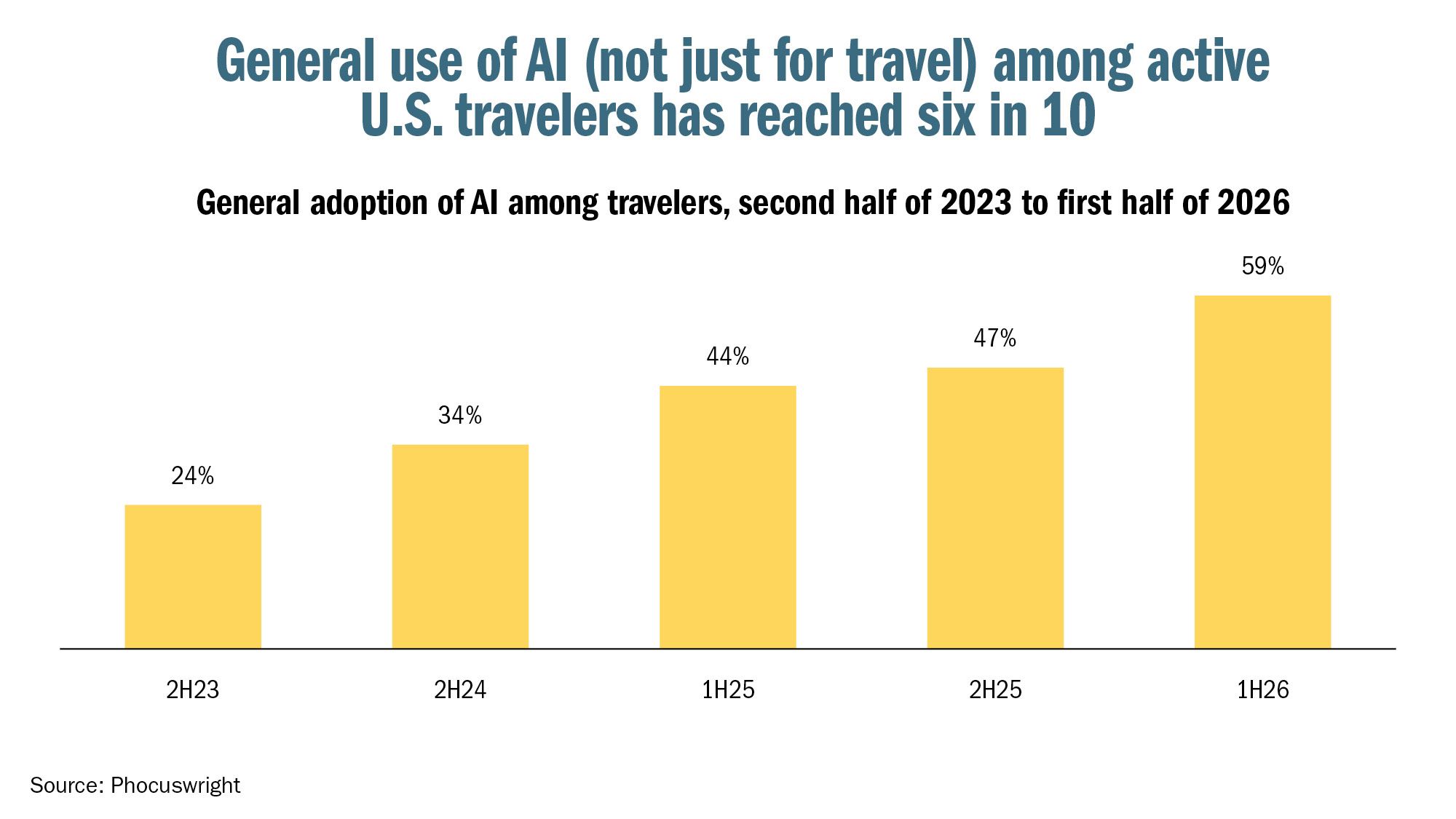
There is no question travelers are increasingly using gen-AI. A Phocuswright report last month, “The AI Surge: Travel’s Fastest Behavioral Shift in a Decade,” found that 59% of U.S. travelers are using AI as of the first half of 2026, skyrocketing from the second half of 2023, when it stood at 24%. And 56% of U.S. travelers are using AI specifically for planning or booking travel, or for in-destination assistance.
“I can safely say this is the fastest consumer behavior shift that we’ve tracked in a very long time of tracking consumer travel behavior,” Mike Coletta, Phocuswright’s senior manager of research and innovation, said at the Summit.
The report also found that in that same time period general search engines went from being the top online resource for travel product research to being just ahead of genAI platforms.
As Coletta summed it up, there are “big shifts afoot in the travel research, product research landscape.”

Making websites ‘scraper’-friendly
While the underlying technology principles behind
genAI platforms are generally well understood, the specific architecture of those platforms is often closely guarded by the companies that own them, such as Meta, OpenAI and Google. That makes it more difficult to predict exactly how the platforms surface information to end users.
While SEO has been around for decades, strategies for surfacing in genAI searches — GEO, AEO and GSO — are still nascent.
It’s a veritable alphabet soup, and participants at the Phocuswright summit couldn’t help but joke about the multitude of new acronyms, referring to them as everything from “A-E-I-O-U” to “E-I-E-I-O.” No matter which acronym wins for genAI search optimization, the importance of having online content discoverable by the bots gen-AI platforms use to crawl the web is undeniable.
And in some good news for marketers, right now that ability is closely linked to SEO.
“GEO is built on top of SEO to a certain degree,” said Matt Davison, CEO of digital marketing agency Travel Tractions Marketing. “So although your content might not be seen by humans, it’s being seen by AI and regurgitated by AI.”
Brennen Bliss, founder and CEO of AI tourism marketing agency Propellic, similarly said that genAI models utilize traditional search to fill in their knowledge gaps.
“The stuff that you would do to optimize for Google Search — Google Gemini, they use Google Search to produce the results,” he said, meaning optimizing for Google produces similar outcomes with genAI.
To surface more effectively in genAI search, companies try to better establish their brand as an expert in a field, Bliss said, and optimize their websites for genAI crawlers, which along with scrapers are tools used by large language models (LLMs), the technology behind genAI platforms, to find and extract data from websites.

Although your content might not be seen
by humans, it’s being seen by AI and
regurgitated by AI.
Fora’s Peters said that means having a clear website structure with a well-defined internal layout, such as headers, body text, etc., as well as templates that scrapers can read without requiring further interaction. “The key is for the site to be able to be parsed by scrapers, which is similar to what you need to do for SEO,” he said.
Tom Howe, director of field engineering at data platform and analytics firm Hydrolix, also said agency owners who want traffic from genAI platforms should be thinking about SEO first. If they’ve already got a handle on that, he recommended thinking about the most direct pathway for a genAI platform, and the LLM powering it, to find their site and the content on it.
“A lot of it has to do with, if you were searching on a site, you know what you want the LLM to tell you,” Howe said.

A lot of it has to do with, if you were searching
on a site, you know what you want the
LLM to tell you.
He offered a simple way to get started: “Write down what you want that final response to be, feed it to an LLM and say, ‘Hey, I want to optimize my site to get LLMs to this point fastest, and iterate back and forth with it.’”
Traditional web browsing and searching are getting smaller in the face of genAI platforms, and that’s unlikely to stop, Howe said.
Fine-tuning the algorithm
One of Travel Leaders Network’s flagship technologies is its Agent Profiler system. Members are encouraged to fill out profiles — more than one, even, for different specialties — that become part of an online lead-generation system that fuels around $750 million in sales per year. The profiles have traditionally done very well from an SEO perspective, with TLN advisors often ranking high in search results for an advisor and location, such as, “travel agents in Detroit, Mich.”
For the last 12 months, TLN has been working to make that content more digestible by AI bots, said Cory Voss, chief information officer. That has involved ensuring that the profiles are structurally easy for AI bots to read and understand.
The pages are particularly suited to genAI searches because they not only detail who an advisor is but lay out their expertise in clear language, demonstrated by real-world examples like detailed descriptions. They also often include customer reviews, emphasizing the advisor as an expert.
“That’s where everyone should be focused, and that is where we’ll continue to push our agents to provide that detailed expertise,” Voss said.
Having that detail has made TLN’s Agent Profiler an SEO success, and TLN is focusing on adjusting the way its profiles are structured to well-position them for genAI searches, he said.

We’ll continue to push our agents to provide that detailed expertise.
That doesn’t mean all bots are welcome. Websites can block bots from accessing their content, and with millions of bots crawling the web at any given time, Voss said, TLN has been conservative in giving only certain ones access to avoid overwhelming its servers. That has also kept website traffic-related costs stable.
Ensemble is banking on editorial content through its magazine and editorial brand, Range, to pull in genAI platforms, and in turn direct those consumers to member agencies.
Thia Gnanakumaran, Ensemble’s vice president of information technology, said the consortium has spent time improving its brand recognition and content direction for the past few months. It’s meant balancing an editorial feel with the content genAI bots are looking for and formatting it properly so it’s accessible to the platforms.
“The hope is that we can attract people by being authoritative in certain areas and be referenceable within ChatGPT,” he said.
Constantly changing
Avoya Travel (No. 37 on Travel Weekly’s Power List) has a robust system of online lead generation for its affiliates. Andy Craig, the host agency’s vice president of marketing, said it works closely with growth advisory firm Relay Insights, which focuses on SEO, conversion and consumer marketing, to execute its digital marketing strategy.
“We are continuing to identify that the space is changing, and the Relay team helps us identify those changes and how the evolution of AI is impacting things,” Craig said.
Houston Neal, founder and partner at Relay, said the company’s strategy for Avoya is increasingly focused on GEO/AEO (“TBD, yet, which is the preferred acronym,” he said).
Like other experts, he pointed to the symbiotic relationship between SEO and GEO, noting that optimizing websites for one often helps the other.
“It’s a little dependent on what the topic is, but we do see in many categories a lot of searches that are just these crawlers going out and ingesting the web,” said Michael Koploy, also a partner at Relay.
Unique content is particularly appealing for GEO purposes, he added, especially as genAI platforms get better at creating their own content.
Koploy recommended “focusing on your brand, creating content that’s really unique and leveraging your unique relationships and content and other resources to create really valuable resources.”
It seems to be working for Avoya. According to Craig, traffic coming to Avoya from genAI platforms tends to be “very, very high intent and high quality.” He also said some top producers are getting cited by genAI platforms, in many cases, because they’ve added personalized content to YouTube pages.
And while it’s tough to compete with “the Royal Caribbeans” on surfacing high in genAI search results on broad topics like Caribbean cruises, Craig said they have success with niche travel topics like escorted tours, guided vacations and ship comparisons.

Focus on your brand, create content that’s really unique and leverage your unique relationships.
The successful advisors are those who tend to be on the road often, collecting unique, firsthand content in the form of photos and videos, he said.
Propellic’s Bliss also said that individual advisors who have a more general focus might struggle to get picked up by a genAI engine, while those with more specific niches could see success.
“If you’re single-destination focused, or you’re there to serve a specific group — not high-net-worth individuals but, like, doctors with families — you’ve got to get super specific on your customer or the market, your traveler destinations,” he said. “And then if you have a lot of really good content, you can potentially show up.”
Ultimately, agencies that have well-structured websites, good SEO practices, unique and authoritative content and are experts in what they do should be able to navigate genAI marketing, but it may require commitment.
“You don’t want to get too ahead of the curve, because then you invest in things that don’t matter,” said Hydrolix’s Howe. “But I think that there’s an opportunity for a fairly low investment that keeps you on that leading edge.”