


(Illustration by TierneyMJ/Shutterstock)
(Illustration by TierneyMJ/Shutterstock)


(Illustration by TierneyMJ/Shutterstock)
(Illustration by TierneyMJ/Shutterstock)
Travel tech gets a boost
After years of lagging in the dark ages, the travel trade finally has the attention of developers, resulting in a boom of travel tech choices.
For decades, the average travel advisor’s toolkit felt like a time capsule.
While developers focused on sleek websites and apps for consumers, travel agencies made do with older technology that, in many cases, wasn’t designed for travel planning (Microsoft Word itineraries, anyone?).
But that dearth is over. Venture capitalists and developers, emerging from both within the agency community and outside the industry, have taken note of the sales channel’s viability and are turning a once-stagnant niche into a tech-rich sector.
“Candidly, I think people are wisening up,” said Katie Williams, COO and co-founder of agency platform Tern. “Travel is one of the largest contributors to GDP. It’s a massive category. These users have been largely underserved.”
Following a long innovation drought, agency tech providers have proliferated, giving advisors a menu of options to choose from that make advisors more efficient and better at their jobs.


‘I think developers are wisening up. Advisors have been largely underserved.’
There are so many choices now that in October 2024, Host Agency Reviews (HAR) — a site known for its profiles and reviews of host agencies, consortia and franchises — added a new profile category: technology companies. One year later, it launched an event, HAR*Wired: Travel Tech Week, to help advisors and agency owners explore new tools and systems.
This publication also took note of the burgeoning field of agency tech: In 2025, Travel Weekly and TravelAge West devoted an entire season of the “Trade Secrets” podcast to travel agency tech.

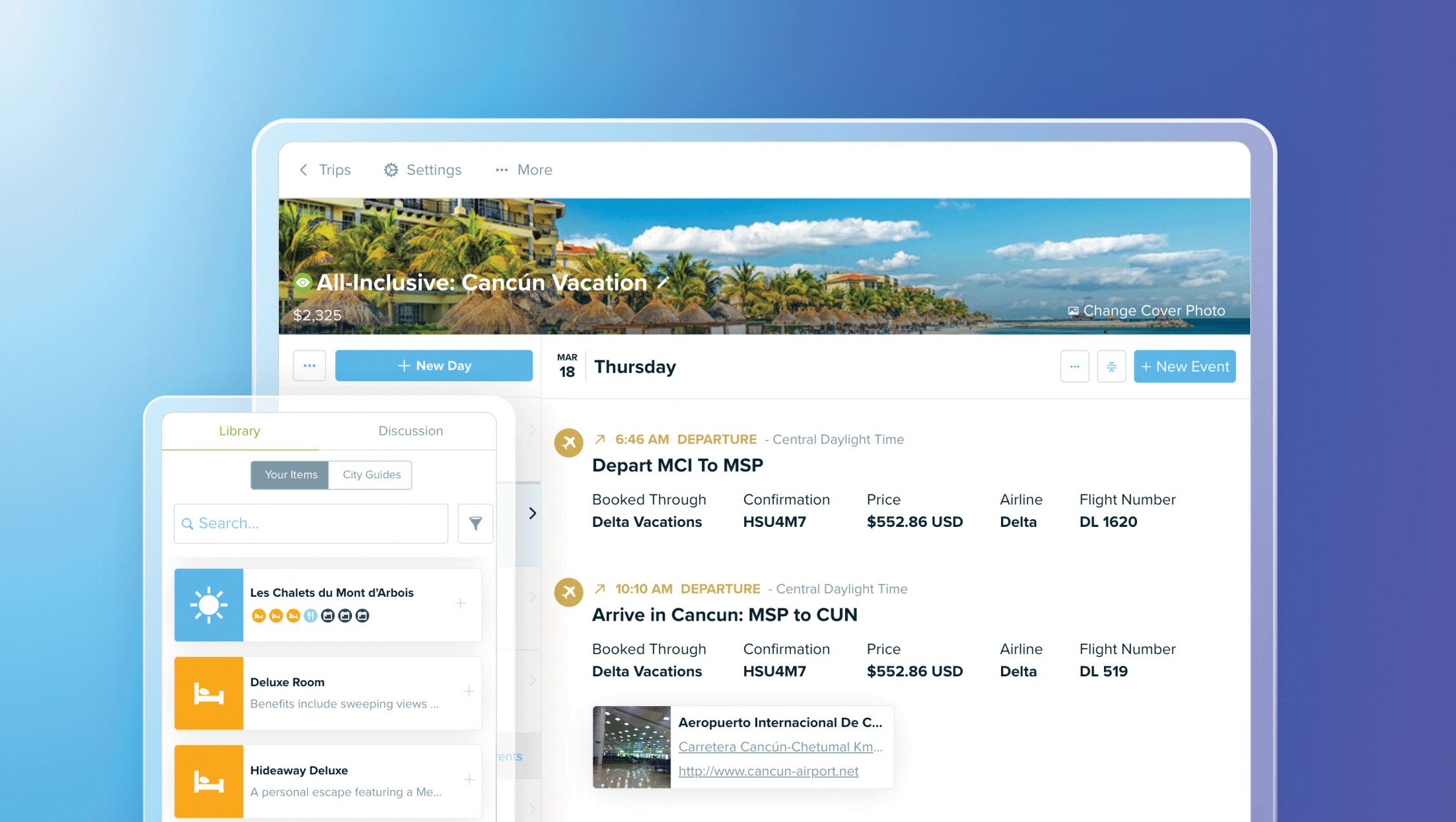
Travefy launched in 2012 as one of the first digital itinerary apps. (Courtesy of Travefy)
Travefy launched in 2012 as one of the first digital itinerary apps. (Courtesy of Travefy)
THE DARK AGES
The new wave of agency-focused technology started with a trickle a little more than a decade ago when digital itinerary apps for advisors emerged: Axus (now owned by Travel Weekly parent company Northstar Travel Group), Travefy, TripScope (acquired by Travefy) and the now-shuttered Umapped.
In recent years, the pace of innovation accelerated, with new tech providers regularly coming online.
To understand the boom, it’s important to understand the preceding bust, or what Lee Rosen, founder of Tres Technologies, calls the “dark ages” of agency technology.
In 1987, Rosen founded agency technology company Trams, which included Trams Back Office, ClientBase and ClientBase Marketing Services. He sold the company to Sabre in 2006 but reacquired it in 2021. Today, users of Trams and ClientBase are encouraged to migrate to Rosen’s newest agency technology platform, Tres.
Rosen asserts said that when Sabre owned Trams from 2006 through 2021, it didn’t invest much into its development, a stagnation he said created opportunity for others. Several modern customer relationship management (CRM) platforms and other pieces of agency technology came from agency owners who were frustrated with ClientBase’s lack of enhancements and developed their own.
Rosen created Tres to provide agencies with a more modern solution. It has CRM functionality, data capture, marketing and a traveler portal featuring itineraries.
“I would say ClientBase and Trams did some really creative things; but look, after 20 years those things become dated,” he said.
Stagnation was also a result of a trade unwilling to change how it booked travel and communicated with clients.
Shayna Zand, managing director of HAR, said the travel industry is a “forever career … Most people at a lot of these companies have been there for 20, 25 years. You get very set in your ways.”

‘ClientBase and Trams did creative things, but after 20 years those things become dated.’
It’s a phenomenon Natasha Mendal Sasson, head of partnerships and growth at Forest Travel in North Miami Beach, has also observed. She joined the industry after working in other fields and found that travel lagged behind many industries in terms of tech.
“I think it’s just the nature of this industry,” she said. “It’s always been so rooted and really traditional. Reinventing the wheel is really, really challenging.”
The retail travel landscape is also very complex. Tern’s Williams said its many layers — travel advisor, travel agency, host agency, consortium — can be viewed as inefficient by investors and led technologists to ignore the industry, calling it “wildly misunderstood.”
“What we found when we started digging in was like, yes, layers equals complication, but with each of those layers comes value,” Williams said.
Gaurav Tuli, a partner at venture capital firm F-Prime, said that over the past few years he’s witnessed the strengthening of the travel agency channel, calling it “a quiet engine of the overall booking ecosystem. I think people have underestimated how large it is,” especially in the luxury segment.
The trade has also gotten a shot in the arm in recent years due to more advisors entering the market, many of them younger technology natives who want tech stacks that are easy to use.
“There is a lack of tooling that caters to that newer agent and, frankly, newer agencies that are more technology driven,” Tuli said.


Screenshots of TripSuite, which offers a full CRM, commission tracking and accounting. The agency is also working with booking tool TravelWits, which integrates with TripSuite. (Courtesy of Jacey Jones)
Screenshots of TripSuite, which offers a full CRM, commission tracking and accounting. The agency is also working with booking tool TravelWits, which integrates with TripSuite. (Courtesy of Jacey Jones)
TECH INTEGRATION
With new players entering the scene at an unprecedented pace, agencies are taking advantage and reinventing their tech stacks from the ground up.
For instance, Sasson’s agency, Forest Travel, migrated from Trams to Tres and is currently looking at itinerary builders.
Brownell, in Birmingham, Ala., pivoted from ClientBase and Trams to TripSuite, which offers a full CRM, commission tracking and accounting. The agency is also working with booking tool TravelWits, which integrates with TripSuite.
“Tech has just blown up” in the last three years, said Brownell COO Rene Alldredge, adding that for Brownell, Covid was a big factor in deciding to upgrade its technology; after surviving the crisis, the agency felt “a little more fearless.”
The pandemic also arguably gave travel advising as a career more attention than ever. Consumers who booked travel themselves were left scrambling, while those who booked with advisors had a helping hand in navigating rebooking (in many cases, over and over again) and refunds. At the same time, with more visibility about the profession, a wave of new advisors joined the industry. That caught investors’ eyes, too.
“They saw how archaic the travel industry technology was, and I think that need, they saw that,” Alldredge said.
Even before Covid, the agency community was seeing the massive shift from travel advisors historically being employees of agencies to mostly being independent contractors. As a group, ICs are more entrepreneurial and often younger, said Gilad Berenstein, the founder of VC fund Brook Bay Capital and a member of Virtuoso’s board.
In a number of cases, he said, “They saw how crappy the tools and tech they were given were and all of a sudden said, ‘Well, let me try to build this.’” Once technology was built, they shared it with other advisors.
Berenstein credited Virtuoso as a champion of agency technology. He was first invited to speak to the consortium about AI-driven personalization in 2013. And CEO Matthew Upchurch has been particularly welcoming to technologists, Berenstein said.
Indeed, Berenstein and Upchurch came up with the Travel Tech Summit concept, an event that brings startups, investors and VC funds together. It’s shown investors and VCs that there is real opportunity in travel, he said.
“From the very beginning, the concept wasn’t just about us learning from startups and from investors, it was bidirectional,” he said. “It was startups and investors learning from us.”
Another factor behind today’s tech boom is the phenomenon dubbed “vibe coding,” or AI-assisted coding that makes it easier to build technology, Berenstein said.
“All of a sudden, you can build stuff without needing to have deep technical talent,” he said. “What these people do have is deep industry talent or knowledge — deep advisor, agency knowledge.”
Like Berenstein, HAR’s Zand said younger advisors joining the industry are driving the tech boom. Not only are they creating technology, but they expect it.

‘All of a sudden, you can build stuff without needing to have technical talent.’
“This is a way of life for them,” she said. “They don’t understand the world without efficiencies and something taking five minutes versus two hours.”
In response, agencies are investing much more in technology, even creating positions such as chief technology officer, roles that didn’t traditionally exist in the agency space, Zand said.


Screenshot of a dashboard in Tern. (Courtesy of Tern)
Screenshot of a dashboard in Tern. (Courtesy of Tern)

Travefy launched in 2012 as one of the first digital itinerary apps. (Courtesy of Travefy)
Travefy launched in 2012 as one of the first digital itinerary apps. (Courtesy of Travefy)

Travefy launched in 2012 as one of the first digital itinerary apps. (Courtesy of Travefy)
Travefy launched in 2012 as one of the first digital itinerary apps. (Courtesy of Travefy)

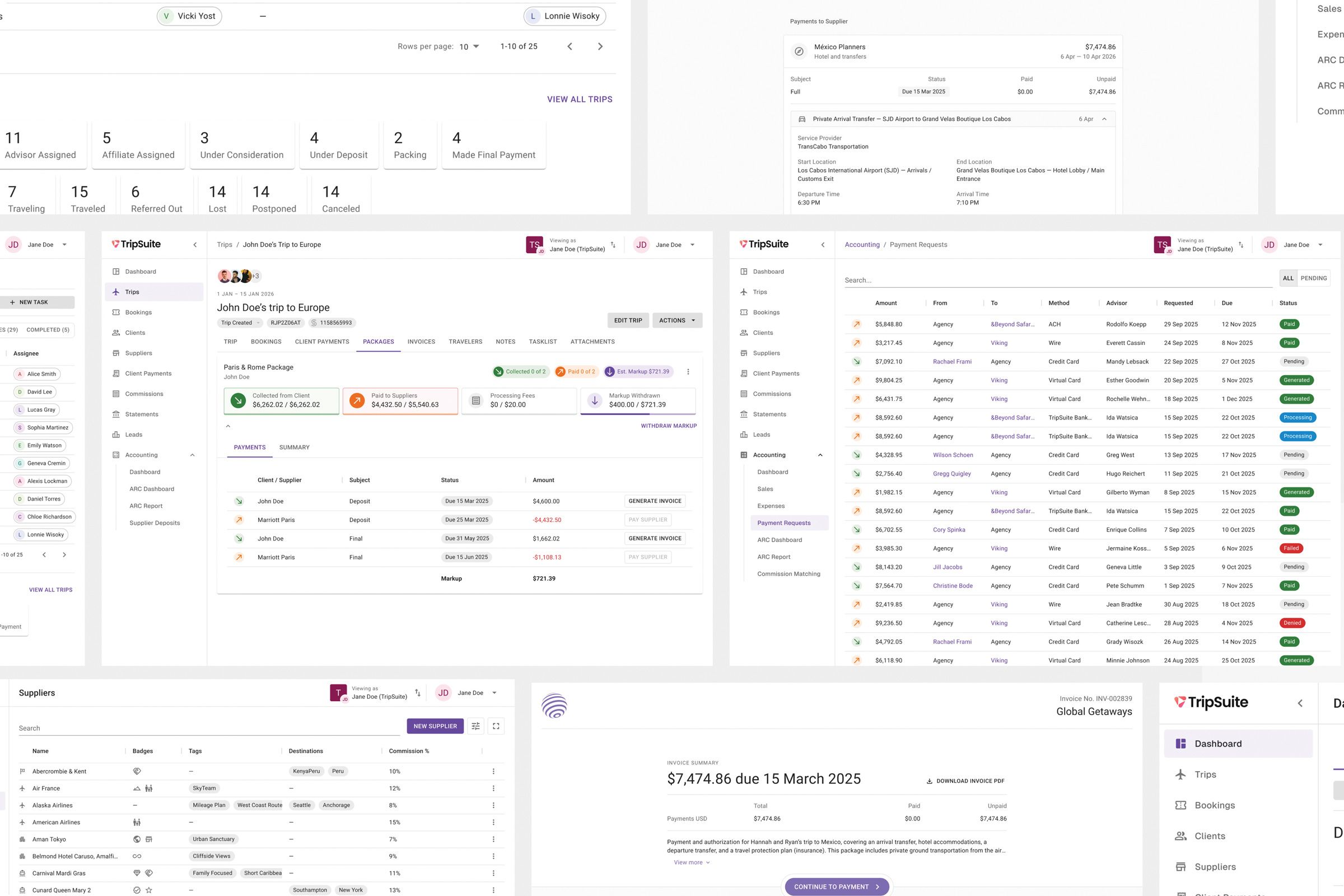
Screenshots of TripSuite, which offers a full CRM, commission tracking and accounting. The agency is also working with booking tool TravelWits, which integrates with TripSuite. (Courtesy of Jacey Jones)
Screenshots of TripSuite, which offers a full CRM, commission tracking and accounting. The agency is also working with booking tool TravelWits, which integrates with TripSuite. (Courtesy of Jacey Jones)
THE UPGRADE CYCLE
Jacey Jones, CEO and co-founder of TripSuite, said the industry is in the midst of an upgrade cycle, or a period of time when most are moving platforms or adopting new technology.
For travel agencies, Jones said, there has been a reckoning: what worked 20 years ago doesn’t necessarily work now.
“It’s less about, ‘Do we make a switch or not?’ and more about, ‘Who do we switch to?’” she said.
Now, both legacy providers and newcomers are looking to fill that agency tech gap. For some developers, entry into the space was intentional. For others, the agency community found them, illustrative of the hunger for modern tools and technology.
Jones started TripSuite after an investor pointed her toward the agency channel as a viable place to build a startup. Several years ago, she started cold-calling agencies, asking what kind of tech they wanted or needed. They were very receptive, which she called a “green flag” for a tech developer.
Travefy, an itinerary builder founded in 2012, was among the first wave of modern technology for agencies. The initial product was a consumer group travel tool, but the need in the travel agency community became clear very quickly, said David Chait, founder and CEO.
“We very quickly found large adoption among travel advisors who, frankly, had been left behind with technology,” he said.
Travefy wasn’t targeting advisors, but they found the platform; it became a pure B2B play in 2016.
Like TripSuite, Tern’s founders spent time getting to know agencies and their needs when they decided to develop software together. Williams said they spent close to 18 months investigating common problems faced by agencies.
“Especially when you’re building, at least in our case, a venture-backed software company, you’re looking for something that is sort of like a secret problem,” she said. “So when we started digging into the space, we were like, oh my gosh, actually, this checks exactly that box. This is sort of this sneaky, massive part of the travel ecosystem that nobody is paying good enough attention to from a technology standpoint.”


A screenshot of Tres Technologies’ agent platform. (Courtesy of Tres Technologies)
A screenshot of Tres Technologies’ agent platform. (Courtesy of Tres Technologies)
VC’S CASE FOR HUMANS
Venture capitalists are bullish on the agency space in large part because of its human factor.
Berenstein, whose VC fund focuses on AI, said the human connection of travel makes the space particularly viable.
“I think in the world of ubiquitous AI, of disconnection, of loneliness, of all these things, these human experiences of travel provides the two things we need, which is novel, experiential type of things as well as a deep connection both to the humans you’re traveling with as well as the humans and cultures you are visiting,” he said.
Consumers, even younger generations, are seeking real humans to help with travel planning, especially in the luxury space, he said. Advisors provide them with the “bespoke, unique experiences” they are craving.

‘There’s just a lot of money to be had in travel. There’s so much to be done.’
Venture capitalists, technologists and agency executives all believe investment in the space will continue going forward.
Chris Hemmeter, co-founder and managing partner at Thayer Investment Partners, agreed, saying that while the space can be challenging for investors, travel advisors are more relevant than ever, especially with the rise of AI in travel planning and discovery.
“Trust,” he said “is a real premium.”
F-Prime’s Tuli believes opportunity abounds, especially in integrating AI to help advisors work better. The modernization of the sector technology-wise “is still very, very early days,” he said.
That opportunity will likely continue to attract investors into what is deemed a lucrative space.
“There’s just a lot of money to be had in travel,” Sasson said. “To me, it’s such a blank space. There’s so much to be done. I feel like, for anyone in tech that wants to dive in, they’re like, ‘Oh my God, this hasn’t been done, this hasn’t been done.’ There are so many opportunities to optimize the entire industry.”