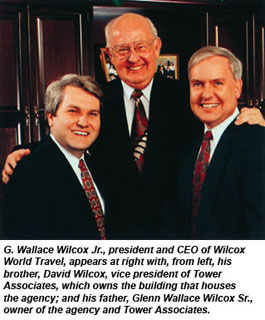
 They may be sitting in Asheville, N.C., but the staff at Wilcox World Travel & Tours/American Express have a particular insider's view of the international community's struggles to bring relief to victims of the deadly cyclone in Myanmar.
About a week after the May 3 catastrophe, the agency had sent more than 20 clients to Bangkok to lay the groundwork for the movement of additional aid workers into the afflicted country. Preparing the way has been more difficult than usual because the Myanmar junta was so reluctant to allow the entry of foreign help. But G. Wallace Wilcox Jr., the agency's president and CEO, said the junta "will open the gates. It happens everywhere."
Three of Wilcox's clients were already in Myanmar for other humanitarian reasons. The first wave of post-cyclone personnel went to Bangkok to set up logistics for the scores of aid workers to come as well as try to get visas. Once the doors are open, Wilcox said, "we start shoveling people over."
He said his clients come through six state Baptist organizations, but he estimated that at least 20 state groups would provide an average of 100 relief workers each.
Wilcox Travel is an $18 million agency, and about half of the business is so-called "specialty travel," meaning travel undertaken by missionaries, humanitarian organizations and relief agencies.
Another 30% of the business is "secular corporate," Wilcox said, and the remaining 20% is leisure. The staff of 21 work in a single location. Wilcox's father, Glenn Wallace Wilcox Sr., the agency's founder and chairman, owns the agency, and by family agreement, the junior Wilcox will eventually buy it.
The agency's commitment to a business with a hefty humanitarian element is part happenstance, part deliberate policy and part inspiration.
The senior Wilcox had spent a number of years driving a bus between Johnson City, Tenn., and Savannah, Ga., and he was the agent in his hometown, Boone, N.C., for Railroad Express, a cargo service.
The junior Wilcox said airline friends advised his father to open a travel agency, which he did in 1953 -- after Piedmont sponsored his domestic airline appointment and Eastern, his international appointment -- in a town 75 miles from any airport. When his airline supporters advised moving to a city with an airport, the Wilcox family shopped North Carolina cities in 1965 and chose Asheville, the younger Wilcox said.
Wilcox said he already had been working at the agency from age 9, filing brochures and later maintaining the tariff book. As a young teen-ager, he began collecting res cards, calling airlines to make bookings. After working in a branch on his college campus and keeping the agency's books on weekends, he came to the agency full time in 1970.
By then, his father had already taken the agency's first big step into the religious market. A woman in the senior Wilcox's Sunday school class managed the Rev. Billy Graham's radio station. She advised the elder Wilcox to solicit Graham's travel, saying the evangelist was calling airlines directly for tickets. She set up a meeting with T.W. Wilson, executive vice president for Graham's operations.
That was 1967. Graham has been a client ever since. Today the client is the Billy Graham Evangelistic Association.
The next major new connection came in 1982. While serving the Graham account, Wilcox dealt with Raptim Travel, a Netherlands-based agency. Raptim opened a U.S. location soon after, and Wilcox Travel became an agent for Raptim. At that time, Wilcox said, a friend at Delta "helped educate us" on getting into and managing travel for relief groups. Since then, he said, much of the agency's business in this field has come by word of mouth.
Wilcox recalled times when, in the immediate wake of a disaster, he has received calls at home from airlines telling him they had just created a new fare for the situation. "They know we won't sell these [specially priced] tickets to secular corporate accounts. I have lost corporate accounts over this," Wilcox said, when the agency refused to grant them access to the rates.
Relief organizations, whose travelers are generally volunteers, not staff, qualify for specialty airfares but not for other features of airline corporate programs. Wilcox views the business as one type of corporate travel and regrets that "specialty salespeople won't rock the boat" the way corporate salespeople will in order to add benefits.
Looking at the big picture, Wilcox said the agency pursued its niche because "we feel God called us to do this. We have this ability and this knowledge" to share with good Samaritans who happen to need plane tickets.
Think you're a good candidate for an upcoming Agent Life? Contact Nadine Godwin, Agent Life editor, at [email protected], and please include your agency name, agency location, telephone number and e-mail address in the message and put "Agent Life" in the subject line.
Mark My Words
Creating opportunity from travel expertise
By Mark Mancini
 Diamonds, DC-3s and seaside property. What do all three have in common?
They're expensive, you say. And you're right. But it's more than that. All three are scarce -- and getting scarcer.
Just so many diamonds are in circulation or still lurk in the earth; that's why their cost over the past decades has risen twice as fast as inflation. DC-3s? Though 10,629 were built, these workhorses of 1940s aviation are down to a few hundred and cost far more to buy today, used, than when they rolled off the Douglas assembly line.
And seaside property? In the 1960s, my parents thought about buying a nice little beach house at Westport Point, Mass. Asking price: $10,000. Today that same house goes for a cool, breezy $3 million. And, no, they didn't buy it, despite that timeless bit of wisdom that "there's just so much oceanfront property."
These three examples illustrate that basic law of economics: Scarcity creates demand, which in turn drives prices skyward.
So here's my investment tip for you: Here are three more things that currently are scarce and getting scarcer, things you should invest in right now: time, service and expertise.
Nobody has time to spare these days, and it's getting worse. Good service is evaporating from the marketplace; no one seems to know how to treat people well anymore.
And expertise? In today's Web world, there's so much information that a professional who can find, sift through and interpret what's relevant has a rare skill indeed.
These scarcities, I believe, are about to become even more acute. Think of your agent peers. Most are in their 50s and 60s. They'll be retiring or semi-retiring soon. Do we have 20-something agents in the wings to take up the slack? No.
So the scarcity of good, new agents will worsen the problem, deepen the scarcity and make the agents who are left even more valuable.
So let's repeat: Things that are rare become expensive, sought after and profitable.
Perhaps, then, you should no longer to think of yourself as somebody who sells travel. You're someone who sells time savings, accurate, insightful information and caring service.
Yes, all this is sort of obvious, yet most of us have yet to integrate it into the way we work, sell and market. You must target customers who don't have the time to buy online and who hit the Internet to book travel only when they can't find anyone knowledgeable and efficient enough to do it for them.
The problem is: How do you find these prospects? Where are they? The answer: Hiding in plain sight.
Prospects who fit the description are everywhere: your doctor, your bank manager, the accountant next door, the Foot Locker manager down the street, your plumber. Yes, your plumber. He makes lots more than most Americans, plus he probably has too little time and knowledge to put together a complicated, successful vacation on his own.
So the next time you go, say, to the dentist, find an excuse to strike up a conversation about how difficult it is to find good service today, then mention how that's especially true for travel agents, then see what happens. (Do it, of course, when you can speak coherently.) It's amazing how many people who we deal with professionally simply don't have the time to fashion their vacation.
Another tactic: Promise in all your promotions and networking to do things more efficiently and better than anyone or anything else (that includes the Web). Underscore the time savings you can provide. Cite your certifications and expertise. Volunteer to write a travel column for your newspaper or write a blog; anything that brands you as an expert.
What about the service issue? This is your ace in the hole, because a computer may provide personal service, but not personalized service. It's a machine, after all, not a person.
It has an especially difficult time dealing with more experiential, unique or complicated products, like cruises, resorts, tours and FITs.
In fact, the Internet's content is so dense, biased and contradictory that many customers who'll happily book a flight online fear buying a more complex or expensive product on the Web.
For such purchases, a customer wants someone, not something. And if they feel you know your stuff, then loyalty will almost surely follow.
I once met a couple who were on their first cruise. I asked them how they chose the line, ship and sailing we were on. "Well, we started with the Internet, but we simply got more confused. So we went to a travel agent our neighbor uses. She recommended this sailing."
"Is it what you wanted?" I asked.
"Absolutely," they replied.
And then they said something quite unexpected. "And you know, that $150 service fee we paid her was totally worth it."
Marc Mancini is an industry speaker and consultant who chairs the travel program at West Los Angeles College.