As the Obama administration last week accelerated the
continuing thaw in relations between the U.S. and Cuba, the travel industry
began to detect speed bumps that could slow the realization of new Cuba travel
products.
Just days after the two countries signed an agreement
allowing direct commercial flights for the first time since the 1950s,
President Obama announced that in March he would become the first sitting U.S.
president to visit the island in nearly seven decades.
Those developments might suggest to travelers that a new
era of casual Cuba vacations is nigh. But according to many experts, even if
the leisure travel ban were lifted, the island is far from ready to handle a
rapidly expanding number of flights and cruises, along with a general influx of
tourists from the U.S.
“[People think] well, it must all be in place. If the
U.S. government is authorizing it, the Cubans must be ready to receive it,”
said Tom Popper, president of Insight Cuba, a longtime operator of
people-to-people tours to the island. “Unfortunately, it’s just not the case.”
As Carnival Corp. can attest, the wheels of change move
slowly in Cuba.
Its social-impact cruise line, Fathom, received U.S.
approval in July to sail the first cruise ship from the U.S. to Cuba in 50
years.
It is currently accepting deposits and bookings for
cruises to the island beginning in May.
However, Fathom is still awaiting final approval from
Cuba, though the line last week expressed confidence that it would receive
approval in time to sail.
“Carnival Corp. recently had a very positive meeting in
Cuba and it remains extremely optimistic that we will be approved to sail
there,” the cruise line said in a statement. “There is nothing from any of our
conversations or meeting that would have us think otherwise.”
A flood of business overtures
People familiar with Cuba’s government and travel
industry said there are numerous possible reasons for the delay and that such
incidents are sure to challenge other cruise lines, airlines and hotels
attempting to do business there.
One of those reasons is simply that there is a backlog of
applications. It has been just over a year since the U.S. and Cuba took the
first steps toward normalization, resulting in relaxed travel and trade
restrictions, opening a floodgate of business overtures.
“Right now, the Cubans are inundated with business
proposals of all kinds from the U.S.,” said William LeoGrande, a professor at
American University who has written extensively on U.S.-Cuba relations. “It’s
just going to take the Cubans some time to digest the proposals and decide
which ones they want to accept and which ones they don’t.”
In addition, some observers think that the Cuban
government is wary of making the infrastructure investments necessary to handle
a surge in U.S. tourism, knowing that if a Republican wins the White House in
November, he could potentially roll back the changes.
“There is no question that a Republican president could
just reverse everything that President Obama has done, because everything he
has done has been with his executive authority,” LeoGrande said. “Nothing has
been passed by Congress.”
Popper said that based on conversations he has had with
Cuba’s minister of tourism over the years, political tensions in the U.S. over
rapprochement with Cuba are a real concern.
He recalled the minister questioning whether to put what
little resources Cuba has into infrastructure to accommodate the American
market, “and all of a sudden a new president gets elected and it all goes away.”
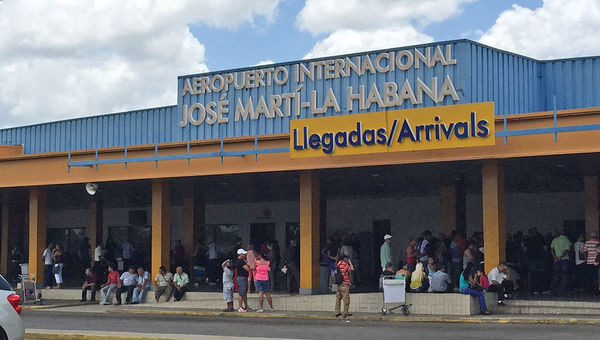
Cuba’s airports are one of the areas in the nation that seem ready to handle an influx of American tourists. Photo Credit: Gay Nagle Myers
“The U.S. says, ‘Let’s do all of this overnight,’ and the
Cubans are trying to figure out how to accommodate it,” Popper said. “U.S.
companies, when they’ve got good news, they want to run it up the flagpole,
they want to publicize it and start selling right away. Unfortunately for
Fathom … and some of these other [cruise lines], it’s an awkward situation
because people have made plans based on these approvals, and I have not heard
anything about [the approvals] being forthcoming.”
While LeoGrande acknowledged the possibility of a
Republican reversal of Obama’s Cuba policies, he also said he believed it was
unlikely, based on their popularity both in the U.S. and among its allies.
“It would be politically costly to completely reverse it
all,” he said, although he suggested that certain candidates might bring the
process to a halt or potentially undermine commercial relations between the
countries.
“The Cubans have this ambivalence,” he said. “On the one
hand, they’re very aware that a Republican could turn back the clock, and so
they’re a little reluctant as a result of that. But at the same time, they are
politically savvy enough to understand that the more progress that’s made in
the next year, the harder it would be for a Republican to reverse things.”
Infrastructure is lacking
In order for Cuba to accept additional flights, cruises
and the tourists they would bring, the island will need to make a significant
investment in its tourism infrastructure. Part of the government’s delay in
making approvals is believed to be because it is aware of those limitations and
the costs to alleviate them.
There is already a shortage of hotel rooms, LeoGrande
said, and adding potentially thousands more tourists would be “a strain.”
“You can already see a strain on the hospitality sector
just from the increase in U.S. visitors since December 2014,” he said. “Last
year, the number of U.S. visitors was up 77%,” which he said made it very
difficult to book hotel rooms.
Popper agreed, adding that there also were not enough
restaurant seats.
“Even right now … it’s so hard to get reservations,” he
said. “It’s hard to feed people. Everything is starting to get stretched a
little bit. People are correct in saying the Cubans are apprehensive. They
don’t want to create a problem, and once they give everybody the authorization,
it’s hard to pull back.”
According to Mike Boyd, the president of aviation
consultancy Boyd Group International, one area that might not need major
infrastructure improvement is Cuba’s main airports, which already serve
international flights from Europe.
A recent Boyd Group report about Cuba estimated that its
current airports could even handle the 850,000 more visitors to the island that
ASTA suggested could materialize if all travel restrictions were lifted.
“Even with current runway capacity at key airports, this
would not appear to be an onerous burden on Cuban airports,” the report stated.
That is good news for the six U.S airlines that last week
said they planned to apply for permission to operate commercial flights to Cuba
later this year as a result of the Feb. 16 aviation agreement made between the
U.S. and Cuba that enables the reestablishment of direct commercial flights
between the countries.
American, Delta, United, Southwest, JetBlue and Spirit
have all said they will file route applications with the U.S. Department of
Transportation ahead of a March 2 deadline.
Under the agreement, each country can authorize up to 20
daily commercial roundtrip flights between the U.S. and Havana.
Carriers from each country can also offer up to 10 daily
roundtrips between the U.S. and nine other Cuban airports.
The DOT said it expects to make decisions on the route
applications this summer.
“The airport infrastructure isn’t the problem,” Boyd
said, expanding on the report. “It’s when you get off the airport property,
that’s where you have the infrastructure problem. As a mainline destination
that competes with other resort destinations, they have a long way to go.”
Frequent visitors to Cuba say this is something travelers
will have to learn to accept for many years.
“The infrastructure just isn’t there for tourism the way
people in the U.S. understand it,” said Dan Burkhardt, who has taken three
trips to Cuba in the last five years. “It’s just very dilapidated. There hasn’t
been any maintenance to speak of in 60 years. You walk down the [Paseo del
Prado], this beautiful 100-year-old boulevard leading to the ocean, and you are
stunned by how great it was once and how badly it’s fallen into disrepair — and
what it’s going to take to fix it.”
___
Tom Stieghorst and Robert Silk contributed to this
report.