Last year, the river cruise industry got its first serious dose of reality. After several years of insatiable growth and a shipbuilding boom that saw individual companies adding up to two ships a year in Europe, doubts started to set in.
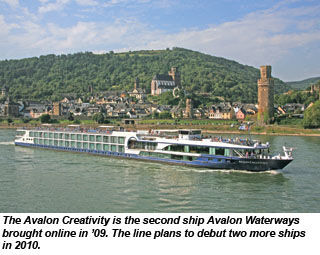
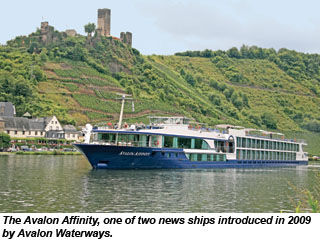
"Absolutely, there are always doubts when you look at what you were looking at 12 months ago," said Patrick Clark, president of Avalon Waterways, one of the more aggressive ship-ordering companies of late. Avalon introduced two newbuilds in 2009 and has two more coming on in 2010, ships that were contracted well before the economic crisis.
"With the two that we're launching in 2010, that adds 30% in terms of berths," said Clark. Avalon's total fleet size will be 10 after the two ships launch this year. And while a year ago, that additional capacity coming on would have made any river cruise operator nervous, demand is returning just in time to fill the extra ships.
"Right now, if you look at the U.S. volume, we have literally doubled the number of passengers that we have on the books for 2010 compared to a year ago," Clark said. Consequently, now "the commitment [to building new ships] is really being rewarded."
 Not that 2009 was all that bad -- operators reported load factors up into the 90% range for the year, stimulated by aggressive discounts -- but you can hear a virtual sigh of relief sweeping across the river cruise industry as demand starts to return.
"Currently, until July 1, we are 92% full," said Rudi Schreiner, president of Ama Waterways. "Until November, we are currently 84% full. We are really expecting to fill the ships close to capacity." Ama added two ships in 2009 and is adding another ship in 2010, which will be devoted primarily to the Australian market and will bring the company's fleet size to 11.
The bottom line, Schreiner said, is that despite the challenges and the added capacity, "Last year, we had an increase of 37% actual passengers over 2008."
Last year's casualties
Bookings might be trending stronger now, but no one had that kind of foresight 12 months ago.
"We could see from the fall of '08 and the financial crisis that things were going to be tough, so we reduced capacity," said Mark Frevert, executive vice president and chief architect of Grand Circle Travel, which sold three of its vessels at the start of 2009: the River Symphony, the Debussy and the Ravel. The 140-passenger River Symphony, built in 1998, was the oldest vessel in Grand Circle's fleet, and the two other ships were smaller, 120-passenger vessels. The sales reduced Grand Circle's fleet size to 12.
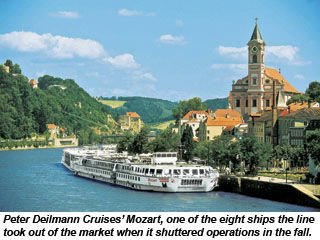 Then in June, news that Peter Deilmann Cruises would be shuttering its river cruise business at the end of the '09 season not only cast a shadow of doubt on the health of the European river cruise market but reduced the market's capacity by the eight river cruise ships Deilmann took out of service in the fall.
Additionally, Viking River Cruises scaled back some of its operations in 2009. Viking did not renew the long-term charters on either of its France vessels, the Viking Burgundy and Viking Seine, which are being replaced by the Viking Spirit and Viking Neptune for 2010.
On the flip side, four ships -- the Viking Legend, Viking Fontane, Viking Danube and Viking Lomonosov -- are sailing a full season this year compared with a partial season in '09, either because the ship was new, as was the case with the Viking Legend, or was dry-docked for part of the 2009 season. And two ships (Viking Peterhof and Viking Helvetia) are being switched over to the U.S. market from the European market. Consequently, Viking estimates it has an additional 10,000-passenger capacity for the U.S. market in 2010 compared with 2009, according to Richard Marnell, senior vice president of marketing at Viking.
And it might need it. With river cruise capacity cut in 2009 and the building pace slowing in 2010 just as demand starts to grow again, it is possible capacity won't keep pace with demand.
"I'd prefer to be one ship short than have one ship too many," said Frevert.
But while river cruise operators are optimistic about 2010, no one is quite ready to go so far as to predict a capacity shortfall just yet.
"I think there will be adequate capacity among the operators that will take care of the capacity over the next 24 months," said Avalon's Clark. "Then you might see something beyond that in 2012 ... there will be more ships coming online for 2012."
Less aggressive deals in 2010
In an attempt to fill berths, river cruise operators, like everyone in the travel industry, doled out the deals last year. And leading the pack was Viking with its aggressive two-for-one promotions.
"Like the rest of the market, we had some fantastic deals," said Marnell. "It certainly helped."
 Ama Waterways touted free air deals; Avalon had discounted airfare offers; Uniworld River Cruises offered early-booking savings.
But in general, the pricing environment heading into 2010 is "much better," said Clark. "Demand has increased so that is helping. Viking's two-for-one deals are not anything like they were last year. So we're still offering some deals, but it's much more select. It's targeted to certain departures, ones that need the most help. It's allowed us to keep the pricing integrity intact."
In fact, for 2010, Avalon is trying to enhance its pricing structure (as well as commission opportunities) by offering beverage packages for its river cruises that can be purchased in advance; one for nonalcoholic beverages and one for alcoholic beverages, the latter of which includes everything except select cocktails.
Clark said that published prices for Avalon's 2010 European river cruises are either flat or slightly up compared with 2009 prices. Other river cruise operators reported the same.
Last year, "98% of the berths were filled, but with significant price reduction actions," said Frevert. "The demand and the capacity is always part of the equation for how you structure your pricing. We're at about 70% sold out through June. If you looked at a year ago, we would have been about 60% sold out, which means that we don't have to reduce prices as much."
Now, the hope is, from an operational standpoint, to rely less on reductions and to start building revenue back up.
For 2010, "it's not as highly competitive on the discounting side as it was," said Schreiner. "What happened last year is Viking came with the two-for-ones ... but now, there's much less discounting going on in the marketplace. The revenue is really increasing fairly strongly."