Royal Caribbean International will begin to require agents
to submit client email addresses in order to complete bookings, citing the need
to reach guests in emergencies.
Royal has already been soliciting addresses voluntarily when
agents contact its call centers, said Juan Silva, director of trade e-marketing
and distribution. It will add a field in automated bookings for the information
this month.
Agents will not be able to submit final payment on booked
cruises until the email address is added to the booking, he said, though they
will have the option of providing their own email addresses if they affirm that
their clients don’t have an email account and supply cellphone contact
information instead.
Silva said the email addresses will only be used if Royal
needs to contact guests in last-minute situations in which the agent is not
available to contact clients on Royal’s behalf.
“We’re not going to use this emergency information for
anything besides emergencies,” he said. “That was the deal.”
Vicki Freed, senior vice president of sales, trade support
and service, said the need for contact data was made apparent in late January
when a burst water pipe ruined dozens of cabins on the Serenade of the Seas as
it awaited departure in New Orleans.
The incident occurred on a Saturday, and Royal was not able
to contact some people until they arrived at the terminal for their Sunday
departure, Freed said.
“We could have stopped those people from flying to New
Orleans,” Freed said.
Freed acknowledged that some agents aren’t too thrilled
about giving up personal contact information that could be used to bypass the
agent in communications.
“We know there are agents that, for whatever reason, don’t
trust the supplier,” she said.
Requiring agents to divulge client email addresses appears
to be unusual. Officials at Carnival Cruise Line, Norwegian Cruise Line and
Princess Cruises all said they do not require it, although some seek email data
voluntarily.
Silva said feedback about the change was generally positive
at a Miami session to train agents on Royal’s new Espresso booking engine.
“There was no concern about how this was going to be used,” he said.
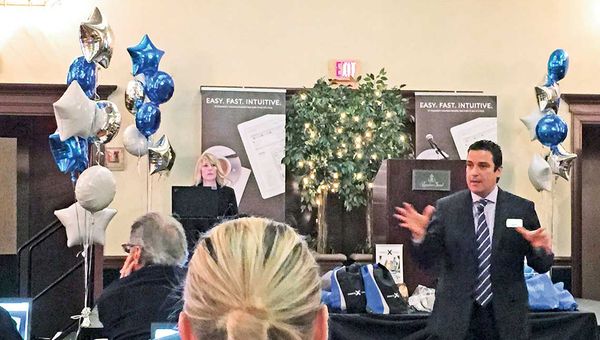
Royal Caribbean’s Juan Silva training agents on the Espresso booking engine in Davie, Fla. Photo Credit: Tom Stieghorst
Some agents at an Espresso training session in Davie, Fla.,
were concerned but tried to see the upside of giving out client data. “If
they’re truly only using it for emergencies, then you have to convince your
client they’ll be happy that [Royal] has it,” said Ronni Rothstein, of Cruise
Planners in Davie.
Another agent in the office, Alexandra Zamora, said her main
issue was staying in the communications loop on anything that is sent to her
client.
Page Barker, an agent at Online Vacation Center in Fort
Lauderdale, said she was fine with the change. She said clients often give
their email to suppliers anyway when booking shore excursions.
The change coincides with Royal’s March 29 introduction of
Espresso, the replacement for Cruise Match that brings increased functionality
to Royal’s automated booking.
About 100 agents attended the four-hour training session in
Davie, which will be repeated in five other cities over the coming weeks.
Agents were especially excited about the interactive deck plans in Espresso,
which are much larger than in Cruise Match.
Barker also said she liked Espresso’s utility on mobile
technology and tablets, which is better than other res systems, she said.
“The interface is beautiful,” added Kat Jastrjembskaia of
Aurora Cruises & Travel in Port St. Lucie, Fla. She said she is waiting for
a 2.0 version to roll out this summer that will allow for automated booking of
suites.