 Travel Weekly reporter Michelle Baran is spending two weeks in Peru. Her trip includes an Amazon River cruise and a visit to Machu Picchu. Baran’s fourth dispatch follows.
After spending one week in the Peruvian Amazon, I did what many people who visit South America do -- I combined my trip with one of the continent’s must-see attractions, Machu Picchu.
Of the 22 people on International Expeditions’ Amazon Voyage trip, at least seven people went on to Machu Picchu, in addition to me. Like many of them, and in the spirit of this ultimate backpackers’ destination, I decided to do it on my own.
I visited the soaring Incan archaeological site the way most people do: I took the train to Aguas Calientes at the base of Machu Picchu, and then took a 30-minute bus trip to the site entrance.
It sounds a lot easier than it is.
To get to Machu Picchu, first you have to fly from Lima to Cusco. Many people use Cusco as their hub for visiting Machu Picchu as well as the Incan villages, markets and other archaeological sites of the Sacred Valley.
I decided to save Cusco for one night at the end, and instead stayed in the Sacred Valley at Hosteria Rumichacha, a charming nine-room, 27-bed guesthouse recommended by my brother, who had just been there in December. This was home for three nights, with owners Jose and Irene my surrogate Peruvian parents, cooks and bartenders.
The Sacred Valley appears to be gaining in popularity as an alternative to Cusco, perhaps partly because it is closer to Machu Picchu. The train ride from Cusco to Aguas Calientes is about four hours, whereas the train ride from Ollantaytambo, about 20 minutes down the road from the Hosteria, is an hour and a half.
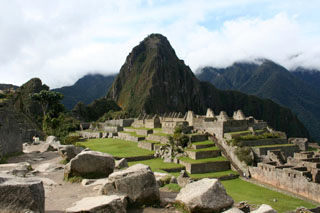 No matter what, visiting Machu Picchu (photo at left) takes time and, surprisingly, a fair amount of money.
At every turn, money was flying out of my pocket. What was I to do? There’s no turning back once you get this far. And I got the sense that everyone -- from Orient Express' PeruRail, operator of the train to Aguas Calientes, to the guys standing at checkpoints to charge for parking at every site -- know that and exploit it.
There are no fewer than four different types of trains between Cusco and Aguas Calientes. There’s the cheapest, the Local train, mainly for locals. Then there’s the somewhat-reasonable Backpackers train. Then the Vistadome, a slightly more upscale train, and the Hiram Bingham luxury train.
As far as I’m concerned, a train’s a train. I tried to buy a Backpackers ticket, but they were sold out. So I paid $120 roundtrip for the Vistadome train. The difference? The Backpackers train looked a little fuller, and I got a snack box and a drink on the Vistadome.
The 30-minute bus ride up the mountain is $14 roundtrip. Entrance into Machu Picchu is about $40 per person. The “boleto touristico,” a pass to 16 archaeological sites and museums in Cusco and the Sacred Valley, costs around $35. The pass for just four sites in the Sacred Valley costs $23. It adds up.
At the Incan market in Pisac, I spotted two beautiful little girls dressed to the nines in traditional Andean outfits, complete with colorful materials and flowers in their hair. My photojournalistic instincts took over, so I crouched down and snapped a picture without hesitation.
How naive I was.
Not 30 seconds later, I was chased down by the girls’ manager, a slightly older girl who explained the ways things worked in Machu Picchu and its surrounding environs.
The photo was worth the two Peruvian soles. I would have given them more.
I guess I could say the same about Machu Picchu. It’s a beautiful, breathtaking racket.