 When analyzing Austria's performance last year as a leisure destination for North Americans, Michael Gigl, North America director for the Austrian National Tourist Office, put the numbers in perspective.
"We were pretty average for most European destinations; it could have been much worse," he said. Although the final numbers for 2009 have not been tabulated, preliminary figures indicate that arrivals from North America were down about 7% over 2008. Worldwide numbers were stronger, however, dropping about 1% to 1.5% from all source markets.
"At the beginning of the year, it looked like it would be worse, but then we saw a flattening off of the downward curve in the third and fourth quarters, with some months even showing positive numbers," Gigl said.
Bottom line, however, is that he does not see a "steady climb back" yet, and he predicts that 2010 will be a difficult year.
One factor in the plus column is improved pricing from tour operators, Gigl said. Seventy-five percent of Austria's arrivals are individual travelers, but even savvy visitors often combine some tour operator components, such as first- and last-night hotel stays and airport transfers, into their travel plans, he said.
The exchange rate also has improved over last year, but these gains have been partially offset by diminished airline capacity, which is likely to keep prices up, even off season.
The Austria travel product can be divided into two segments, he said, the first of which is the typical cultural traveler who focuses on visiting Vienna. In fact, nearly half of all travelers from the U.S. visit Vienna, which has become a year-round destination without a clearly defined low season.
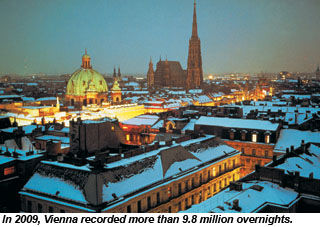
In 2009, Vienna recorded more than 9.8 million overnights, its second-best year on record, with arrivals from the U.S. down about 2% from 2008. December established a record for visitors to the city, with more than 900,000 overnights, although it is unclear whether this is the start of a trend.
The second group wants to include scenery and some outdoor activity into their travel itinerary, although not necessarily adventure travel. That group, many of whom explore the Alps, tends to visit between May and mid-October.
Skiers are a particularly loyal market, although Gigl describes them as a very specific niche segment whose numbers from North America are relatively small. True fans of the sport revere such big-name ski areas as Innsbruck, Arlberg, Kitzbuhel and Lech, he said, noting that there weren't any big drops in visitor numbers to those resorts in 2009.
Ski deals
What is not well known is that a ski vacation in Austria costs about the same or, in some cases, even less than a stay in a top resort in the Rockies, although both products fall squarely into the luxury category, he said.
Lift tickets are about one-third the cost of tickets in the U.S., top Austrian ski hotels are relatively affordable and even the food tends to be less expensive, Gigl added.
Overall, Austria receives about a half-million visitors from the U.S. annually, but those numbers don't include travelers on a Danube river cruise, which would increase the total by about 10%.
Because of the country's location in the center of Europe, most visitors combine Austria with other destinations. The tourist office is actively engaged in collaborations with its neighbors in the Alps, particularly Switzerland and Germany, on joint promotions, as well as with other countries in central Europe.
This year marks the 150th anniversary of composer Gustav Mahler's birth as well as the 90th anniversary of the Salzburg Festival, while 2011 will focus on the 200th birthday of pianist and composer Franz Liszt, who was born in Raiding.
The tourist office also is seeking to broaden its appeal beyond its imperial past, emphasizing wine and culinary travel among other niches.
In the last few years, Austria's reputation for producing high-quality wines has grown, particularly for its sweet wines and gruner veltliner, a white wine.
Another way that wine tourism in Austria differs from that of other countries is that there is wine production within Vienna city limits, in vineyards overlooking the Danube, and other notable wine regions are situated about an hour from the capital.
Travel agents looking to get to know the destination better can take advantage of the free Austria Experts program, an interactive educational program that enables graduates to be listed on www.austria.info/us as recommended partners.
In November, the tourist office will unveil a destination summit for select, invited agents that Gigl described as an "exploration of Austrian culture that goes beyond a fam trip."
Visit www.austria.info/us.