Ireland’s “Celtic Tiger” boom years may be over for now, but at least one sector of the country’s economy — tourism and hospitality — is showing signs of recovery, according to Tourism Ireland.
Niall Gibbons, CEO of Tourism Ireland, which markets both the Republic of Ireland and Northern Ireland abroad, called 2011 a “pretty good year” in terms of leisure visits from the U.S.
For the year, Ireland welcomed 900,000 U.S. visitors, a 5.5% increase, and U.S. visitor spending totaled about $1 billion.
The figures were even better out of Ireland’s European source markets, which collectively posted 12% growth for the year. Gibbons said that when the final revenue figures were in, he expected “they’re going to be pretty good, as well. What’s even better is that we are at a stage where Ireland’s share of the [U.S.] outbound market to Europe is at its highest level ever.”
 He added that Q2 and Q3 of 2012 “are looking very good, as well.”
Ireland recorded its best year in 2007, with more than 4.9 million arrivals.
Gibbons predicted that 2012 will end up missing that mark by about 5%, adding, “We hope that from North America alone next year, we’ll see more than 1 million visitors.”
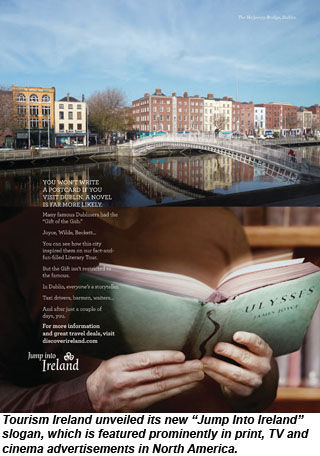
To help make that goal a reality, Tourism Ireland on Feb. 16 launched its new “Jump Into Ireland” slogan in North America, officially introduced by Ireland’s prime minister, Enda Kenny, at a tourist board luncheon in New York. (See Arnie Weissmann’s report, “Ireland’s prime minister calls tourism a government priority.”)
Kenny’s presence at the stateside event was testament to the importance Ireland’s government places on the tourism sector.
“In the last year or two, there’s been a huge emphasis on tourism as an economic driver,” Gibbons said. He noted that the government slashed the value-added tax on tourism-related purchases from 13.5% to 9%, is waiving visa requirements for travelers from 16 important Asia markets who already can enter the U.K. and is considering eliminating the country’s 3-euro-per-person airport tax.
“The message is that we’re open for business,” Gibbons said.
The new “Jump Into Ireland” slogan features prominently in new print, TV and cinema advertisements, many of which will stress upcoming events likely to appeal to transatlantic travelers. These include the March 31 opening of Titanic Belfast, a $160 million visitor center commemorating the centennial of the legendary shipwreck, and in late June and July, the first Irish Open golf championship to be held in Northern Ireland since 1953.
“Of course, we also have a lot of things we already do well: the friendliness of the welcome, the scenery, the culture, etc.,” Gibbons said. “The Irish brand and the interest in visiting Ireland are still very strong. We just have to continue to translate that into travel bookings, given the complex economic climate we’re in.”
Nico Zenner, president of Brendan Vacations in Chatsworth, Calif., described Ireland as a “bright spot” among the company’s destinations that is “selling very well indeed. Ireland is good value for the money … and among the European destinations we sell, it’s doing better than anywhere else. That goes for both escorted tour and FIT product.”
In fact, Brendan Vacations has recorded double-digit growth in bookings to Ireland since last year, though Zenner speculated that the growth might be tied to the firm’s specializing in the destination.
“We focus on Ireland, do a lot of tours and FIT arrangements there and have invested quite a bit in product development,” he said. “We even bought an office building there and hired a full-time staff, which I can’t say in the case of, say, Germany.”
Paradoxically, Ireland’s tourism sector may be growing thanks to the recent downturn in its economy. Accommodations booking website Hotels.com has found Ireland is home to the cheapest hotels in Western Europe, offering prices only slightly higher than those in Eastern Europe.
Compiled from bookings made through Hotels.com for 130,000 properties worldwide, the site’s Hotel Price Index found that the average Irish daily rate in 2011 was 81 euros, or about $107. That represented a modest 2% increase over 2010 rates, but Ireland’s average hotel rates had dropped by a precipitous 35% over the previous three years.
Average rates nationwide now range from a low of $83 per night in Limerick to a high of $138 in Wexford and Kilkenny.
“Even at leading Irish properties such as Dromoland Castle, Castlemartyr and other high-end properties, you’ll find rates that are extremely competitive,” said Gibbons, who noted that Ireland’s room count rocketed from 28,000 to 60,000 in the past decade.
Gibbons also pointed to packaged deals as a good value: “Right now, for just $699 you can fly, stay five nights and rent a car.”
For his part, Brendan Vacations’ Zenner cautioned that “I can’t say we have seen an appreciable drop in prices specifically due to [Ireland’s] economic problems, but compared to the rest of Europe, it’s certainly a better value.”
“If you have $1,000 to spend, you will get more for your money,” he added. “There are very few other countries where you can stay in castles and manors, such as Ashford and Dromoland, for the amount of money Americans are willing to spend.”
Tourism Ireland has found, in fact, that the destination appeals to an older, upscale clientele. Gibbons said the typical U.S. visitor is older than 45, is college-educated, earns more than $75,000 and typically has visited Europe before.
Among niche markets, Ireland does particularly well with golfers as well as with the 40 million Americans of Irish descent, although the importance of Irish-Americans is decreasing.
“Ten years ago, about 60% of all visitors had Irish ancestry,” he said. “Now, that figure’s about 30%.”
For 2012, Tourism Ireland will focus on capturing run-off business from the Summer Olympics in London, courting more airlift (beyond its 100-odd flights on five carriers from eight U.S. gateways each summer) and driving arrivals from beyond traditional U.S. East Coast source markets.
“We feel there are still opportunities on the U.S. West Coast and in the South,” Gibbons said. “We used to have San Francisco and Los Angeles, and we’d like to see them come back.”
Follow Ken Kiesnoski on Twitter @kktraveleekly.