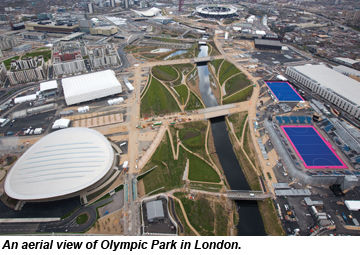
 With only 25 days until the opening ceremony of the London 2012 Olympic Games, Britain’s capital seems fully ready. The venues are completed. Security has been beefed up. What is less certain is how the event’s millions of visitors will manage to get around this summer in one of Europe’s most densely populated cities.
While there is no official estimate of the number of Britons and overseas travelers who will be in London for the Olympics, there were 11 million tickets available for sale, according to the London 2012 Organising Committee, and the British media is estimating that some 6.5 million people, Britons and overseas visitors combined, will be in London for some part or all of the Games.
During the weeks the Games are under way, Transport for London will be implementing what it is calling the Olympic Route Network, 109 miles of streets and roads linking the Olympic venues and other major hubs such as Heathrow Airport. One-third of that network will be dedicated to “Games Lanes,” driving lanes that will be reserved for accredited Games vehicles and on-call emergency services only. There will also be other traffic restrictions such as suspended turns and suspended bus lanes. Some bus and coach stops will be moved.
BBC News reported that London’s transport commissioner, Peter Hendy, was advising motorists to steer clear of central London and the Olympic Route Network from mid-July on.
“During the Games, London will be turned into a massive sporting and cultural venue,” Hendy told BBC. “Our advice to motorists is clear. From mid-July, avoid driving in central London, around the Olympic Route Network and Games venues.”
Travelers heading to London during the Olympic Games, July 27 through Aug. 12, or during the Paralympic Games, Aug. 29 through Sept. 9, should take note of Hendy’s warning with regard to travel times and the ability to get around London.
During the Games, there will be some changes to Underground service, as well. On certain days and at certain times of the day during the Games, there will only be one-way movement allowed at some stations or stations where capacity is not high enough to deal with the demand might be closed, Transport for London has warned.
For more information on how to move around London during the Games, Transport for London has set up a website, GetAheadOfTheGames.com.
Hotel prices drop, airfare still high
While the city is certain to be crowded, the actual level of demand for the Olympics has been called into question by a recent drop in hotel rates during the event. Hotels.com reported last week that prices for London accommodations during the Games had dropped about 25%, to an average of $248 per night, during the last two weeks in June.
The hotel bookings site said that the drop was due, in part, to the fact that the organizing committee released a lot of accommodations back into the market earlier this year. Additionally, many hotels have started to lift their length-of-stay restrictions and are selling more one-night stays, Hotels.com reported.
“Demand has not been as strong as originally expected, as tour operators in particular booked their regular groups to other European capitals, giving London a miss this year,” Hotels.com stated in a release.
While it now appears that finding accommodations in London might not be as challenging as originally predicted, flights are another story, with transatlantic fares still soaring for the summer. High fares, in turn, could also dampen demand.
And getting through Heathrow as the airport grapples with the more than half a million overseas visitors expected in London this summer could be a considerable challenge. Aug. 13, the day after the Olympic Games closing ceremony, is expected to be the busiest day in the airport’s history, with airport officials anticipating that 137,000 people will fly out of Heathrow.
Security and support
Travelers will have plenty of support in London this summer. During the Olympic and Paralympic Games, thousands of London Ambassadors, volunteers from all over the city, will be positioned to provide locals and visitors with information about transportation options, avoiding crowds and any other helpful hints.
Additionally, security is being ramped up considerably. The Games will be protected by 12,000 police officers during peak times and 23,700 security staff, which will include some 13,500 troops on standby, the Associated Press reported. Britain will impose a no-fly zone over the Olympic venue areas from July 14 to Aug. 15.
While the Olympics have always been considered a high security threat due to the large number of participants, the massive transportation challenges, venue entry logistics and the event’s global visibility, U.K. officials said they will be getting additional assistance from U.S. intelligence and law enforcement officials as well as from Interpol.
Military and police forces are stepping up counterterrorism efforts in addition to designing massive security efforts on the ground.
Follow Michelle Baran on Twitter @mbtravelweekly.