Hawaii Tourism Authority (HTA) officials were quick to support the dengue fever state of emergency proclamation made by Hawaii County Mayor Billy Kenoi on Feb. 8, but the Aloha State’s tourism marketing organization doesn’t want visitors to get the wrong impression.
“Travelers should not be alarmed by the County of Hawaii’s state of emergency declaration for Hawaii Island or allow this decision to alter their travel plans to any of the Hawaiian Islands,” George Szigeti, the HTA’s president and CEO, said in a Feb. 9 statement. “This declaration is a good strategic move by the County of Hawaii, as it will provide government officials with additional funding and resources to eliminate dengue fever from Hawaii Island.”
At press time, the Hawaii Department of Health had confirmed 254 cases of dengue fever acquired locally on the Big Island, saying the onset of the mosquito-borne viral illness there dates back to Sept. 11, 2015, with the most recent cases contracted on the island on Feb. 6.
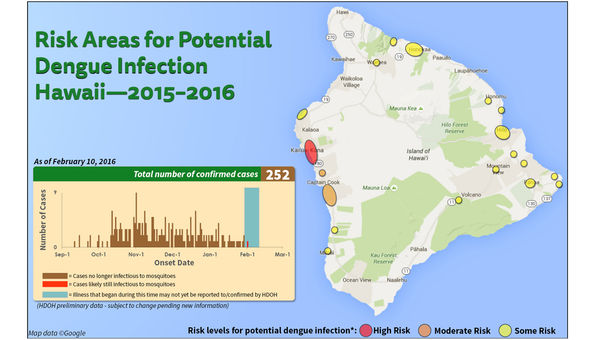
* Risk levels of areas where confirmed cases may have contracted dengue fever are determined by the number of confirmed cases with recent onset dates who reported visiting those areas. Photo Credit: Hawaii State Department of Health
Hawaii DOH officials said Feb. 11 that just “two of the confirmed cases to date are potentially infectious to mosquitoes. All others are no longer infectious.”
Darryl Oliveira, administrator for the County of Hawaii Civil Defense, echoed the HTA’s assertion that the Big Island remains a good choice for vacationers.
“Our island is still an excellent visitor destination,” he told Travel Weekly. “It’s still very safe. When you look at the overall number of dengue cases we’ve had associated with visitors, it’s a fraction of what the total case count has been.”
Through Feb. 11, just 24 visitors have contracted dengue during the Big Island’s recent outbreak, and according to Oliveira, “none of the cases can be traced to exposure at any of the resort properties.”
“The visitor cases we have seen have been connected to backcountry activities,” he reported.
Dengue fever is not endemic to Hawaii — nor is the Zika virus — but the state is home to the Aedes mosquito capable of transmitting both diseases. Dengue has been imported to the Islands in the past from endemic regions by infected travelers, who’ve then infected the local mosquito population, according to Hawaii health officials. The Aloha State’s last dengue outbreak occurred in 2011, when four cases were confirmed on Oahu.
According to Hawaii Department of Health spokeswoman Janice Okubo, there have been no cases of Zika virus reported in Hawaii this year.
“In 2014, there were two imported [Zika] cases,” she said. “And in 2015 there were four imported cases. These imported cases acquired the disease while traveling abroad before coming to Hawaii.”
Through Feb. 11, the Big Island of Hawaii was the only island in the state reporting confirmed, locally acquired dengue cases.
Oliveira said he was “cautiously optimistic” regarding the Big Island’s current dengue struggle, noting that the destination has gone through a period of unusually low rainfall totals recently and is facing drought forecasts, which could be helpful to the county’s ongoing effort to eliminate the infected Aedes mosquito population. But he did voice concern about misjudging the number of currently infectious people on the Big Island.
“We need to make sure we aren’t underestimating the number of non-reporting [individuals],” he explained. “We do know that happens in every outbreak around the world. Not everybody comes forward and reports being ill. Now in the case of dengue, because there’s no cure and you’re basically treating the symptoms, we’ve heard anecdotally that many people don’t come forward, saying, ‘What do you have to offer me?’”
Dengue concerns among travelers, meanwhile, have had an impact on business at the Sheraton Kona Resort & Spa at Keauhou Bay.
“We experienced a drop in Q1 pace and have received cancellations for January, February and March due to dengue,” said Mathew Grauso, the property’s general manager.
Barry Wallace, the executive vice president of hospitality services for Outrigger Enterprises Group, said visitors’ dengue concerns took their largest toll on the company’s four Big Island properties in late 2015.
“We did lose a couple of groups at the end of last year, which was unfortunate,” he said. “But for the first quarter, demand is strong, and we’re not really noticing any drop-off.”
Wallace said Outrigger’s Big Island properties received many phone calls from travelers asking about dengue during the final quarter of 2015, but he noted those phone calls have dropped off dramatically.
And while Outrigger’s Big Island bookings for the first quarter of 2016 “look pretty good year over year,” according to Wallace, he did concede the company is concerned that Kenoi’s emergency proclamation could be misinterpreted by travelers and impact second-quarter business.
As for the Sheraton Kona’s Grauso and his Big Island-based family, day-to-day life appears to be unfolding pretty normally.
“We are enjoying the outdoors, going on hikes, playing at the beach,” Grauso said, noting that he feels the dengue difficulties have improved quite a bit from last fall. “Since the height of the outbreak in November, the number of confirmed cases continues to decrease.”
Hawaii health officials continue to encourage both residents and visitors to reduce their risk of contracting dengue by using insect repellent and wearing long clothing. The state’s DOH has posted an updated map of potential Big Island risk areas here.
Dengue fever symptoms include a sudden fever, severe headaches along with eye, joint and muscle pain. Symptoms usually subside completely within one to two weeks.