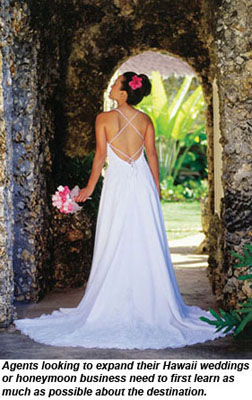
 Romance made a comeback across the Aloha State in 2010, with more than 613,000 visitors traveling to the Hawaiian Islands for either a wedding or a honeymoon, an increase of 4.2% when compared with 2009.
And according to the state's Department of Health, last year marriage licenses were issued to 14,790 U.S. couples residing outside of Hawaii, a 5.6% climb year over year and the most since 2007.
"Everybody felt the effects of the economic downturn, and everything went down to a degree," said Paula Simpson Takamori, the Oahu-based president of Travel to Paradise and a Hawaii destination weddings veteran of more than 15 years. "Last year was better. This year is better again. Everybody is seeing the recovery here in Hawaii a little bit quicker and faster and to a bigger extent from what they anticipated. I've talked to some of my friends who are wedding coordinators, and they are holding steady. I don't think they are as busy as they were before the economic downturn, but I'm not sure that anybody is."
Frank Robinson, chief executive of Oahu-based Island Events, regularly coordinates weddings across Hawaii and said he's also noticed a spike in business.
"Weddings over the past eight months have increased," he said. "But what I've seen is that, like the corporate world, conspicuous consumption is particularly down. People are realizing that they don't need to have all of the things that they used to have at a wedding, so their cost per person is considerably lower and their cost for the overall event is lower. But there certainly have been more weddings recently than, say, in the past three years."
Robinson said bridal couples have cut back significantly on things like in-room arrival amenities for their guests, transportation to and from the ceremony, elaborate archways and even lavish flower arrangements. Getting married legally on the beach in Hawaii has also changed.
"You can't set things up on the beach the way you used to three years ago," he said. "There's a law now that you have to get a permit, which is $20. And it can be an administrative challenge if you don't use a planner."
According to Takamori, however, many of her clients are now choosing Hawaii as a wedding destination where they can actually save money.
"Sometimes they decide on Hawaii rather than having the big wedding at home," she explained. "And that way the only people that come to their wedding are the ones that really, really want to be there, and they get to have a wedding and a vacation and a honeymoon all rolled into one for less money than it would cost them to have the big ceremony at home. So, in fact, for some people it's a money-saver and not a money-spender."
Expert advice
Both Takamori and Robinson agreed that agents interested in expanding their Hawaii weddings or honeymoon business need to first learn as much as possible about the destination.
"That's really critical," Takamori said of knowing the Islands. "In all honesty, most people who are coming on their honeymoon or for their wedding, whatever the situation is, they really don't intend to just sit in the hotel room or at the pool or on the beach. Of course, they need some time for that, but unless they're from Hawaii or have been here many times before, people want to get out and see stuff."
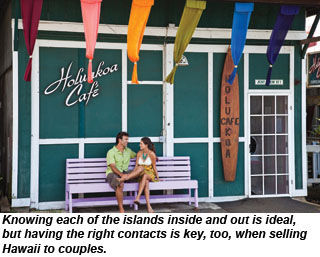
Knowing each of the islands "inside and out" is ideal, according to Robinson, but having the right contacts also makes a big difference.
"So when your client says they 'want to go to a place where ... ,' you know where to find it," he said. "Or, at the very least, develop a great network of resources and partnerships who you can call when you [need] to learn about it."
 Thoroughly understanding what clients are actually hoping to experience is another must.
"I have to get to know them and find out what sorts of things they are looking to do and then try to understand how much time they've got," Takamori said. "Do they have time to go to more than one island? What's the most important thing about coming to Hawaii? What is the one thing that [they] absolutely don't want to miss? It comes down to having a great knowledge of the Islands and the properties and getting to know your own client, so you can team them together to put them in the best possible place you can so they'll have the best possible time."
When working with agents, Robinson said it's also a great deal easier when people know their roles. In other words, clearly defining one's involvement in the wedding-planning process beforehand makes it easier for everybody.
"Do you want to book the air and hotel and simply recommend a destination wedding planner in Hawaii, or do you want to be involved in every step of the process?" he said. "Or somewhere in the middle? Each is fine, but know it up front and communicate it with the wedding planner you partner with in Hawaii. It will help you in getting your needs met and the expectations of the bridal couple met, as well."
Building partnerships
For many agents, the thought of handling each and every detail of a Hawaii-based wedding is a daunting, and often costly, proposition, so fostering lasting partnerships with wedding coordinators across the destination can not only eliminate headaches but also lead to increased earnings.
"Every wedding planner is different," Robinson said. "Some commission travel agents, while others don't realize that's how travel agents make their money. Everything that I do, based on the packages on my website, is commissionable. And even if somebody decides to do an hourly consult as opposed to a full package, then those hours are commissionable, too."
For Takamori, who said she always works with Hawaii-based coordinators for her destination wedding bookings to the state, a variety of options is helpful.
"I have a number of different wedding coordinators I can suggest that couples take a look at," she said. "Then they can go from there and find whoever suits their personality. It really depends on how big a wedding they are having.
"Are they talking barefoot on the beach or are they talking about a fancy one in a resort with a big, sit-down dinner?" Takamori added. "So the wedding coordinators take care of all that other stuff."
Both Takamori and Robinson suggested agents interested in locating qualified coordinators begin by perusing the wedding associations for each of Hawaii's four main islands (the Big Island, Kauai, Maui and Oahu).
"The great thing about those is that they do connect to wedding planners and professionals on those particular islands," Robinson said. "So those listed are all specialists on each of the different islands, which is really helpful."
Robinson also encouraged hesitant agents with Hawaii questions to reach out to the destination's coordinators.
"If you have questions, feel free to call," he said. "We're not terribly secretive. It's not the cutthroat business that you often have on the mainland. We're all excited that people want to come here, and we really want to build the wedding community in the Islands."
For more about Hawaii's wedding associations, visit www.oahuweddingassociation.com, www.mauiweddingassociation.com and www.kauaiwedpro.com.