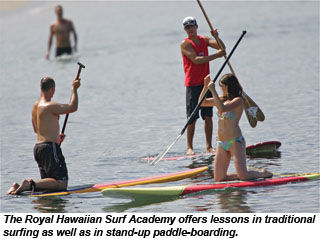
 I am on a quiet beach in west Maui, standing in the soft sand next to a brightly painted, 10-foot-plus surfboard. There's a broken line of casually undulating sailboats moored just offshore, interrupting the gleaming stretch of Pacific between me and the distant islands of Molokai and Lanai.
Dressed in a snug rashguard -- picture a springy, spandex-like T-shirt -- my favorite board shorts and a pair of rubber-soled aqua socks, I'm holding a long, surprisingly light paddle and worrying some about what I've gotten myself into.
Spend any time at most beaches in Hawaii and you're likely to see at least a few stand-up paddle-boarders. The watersport has developed into something of a statewide craze over the last five years or so, particularly among residents, and when the folks at Lahaina's Royal Hawaiian Surf Academy offered to take me out for a lesson during a recent Maui visit, I just couldn't say no.
Benny Martin, a tall, tan, blond Lahaina native, was my instructor for the morning, and there was no doubt the 23-year-old loved his job. On more than one occasion, he told me, "Every day in the water here in Maui is a blessing."
It wasn't long before Martin's relaxed and easy-going nature rubbed off on me, and most of that earlier anxiety faded in a hurry. We spent a good 15 minutes on the beach going over the basics: where to put my feet on the board, how to stand up, when to bend my knees, how to fall off. From there it was into the water with my board and paddle, over some light resistance from the shore break, and time to try out what I'd learned.
That being my first time on any board in the water, I was surprised to find -- thanks in no small part to my extra-patient teacher -- that standing up on the thing wasn't too terribly difficult. Staying upright and paddling, on the other hand, was much trickier.
But after a couple wobbly-kneed, slow-motion splashdowns, I started to get a feel for the balance and was paddling next to Martin in no time, enjoying all sorts of stories about growing up in Lahaina, the history of west Maui and details about the vibrant reef and fish below our boards.
"No matter what, if you're doing something of a private nature, you're going to get a lot of talk," said Kimo Kinimaka, owner of the Royal Hawaiian Surf Academy. "You're going to end up knowing a lot about your instructor, and he's going to know a lot about you."
Kinimaka, who started surfing at about age 5, opened Royal Hawaiian Surf in 1996 after more than 15 years working as a flight attendant. Although he's no longer taking care of airline customers, Kinimaka insists his surf shop's friendly, highly personalized brand of instruction owes its origins to his time above the clouds.
"I took my experience with customer service from Hawaiian Airlines, and I basically applied that to what we do at the surf school," Kinimaka said. "Here everybody feels like an individual, everybody gets that one-on-one attention, and it's all about the experience."
Maui visitors looking to try a standard surfing lesson, rent a board or try their hand at stand-up -- either on their own, with a significant other or the entire family -- can take advantage of Royal Hawaiian's Lahaina shop or meet with one of Kinimaka's certified instructors at one of the company's two beachfront locations at either end of the Kaanapali Beach Resort.
At least two hours long, Royal Hawaiian private lessons are $130 for individuals and $190 for couples, while group lessons, never with more than four students to an instructor, are $65. Visit www.royalhawaiiansurfacademy.com.