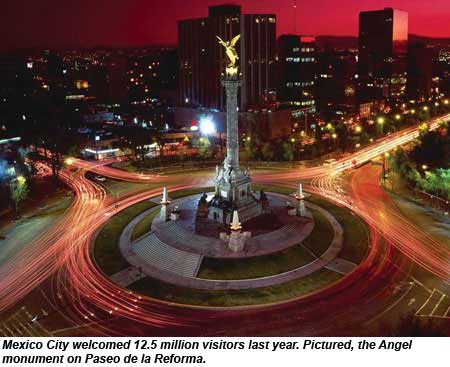
 Mexico City, long one of Mexico's top destinations for business travelers as well as a convenient hub for changing planes, is touting new hotels, restaurants, attractions and neighborhoods in a sustained push to grab more leisure business.
Not that the capital city of 8.8 million residents lacks visitors, having welcomed 12.5 million in 2012.
Of that total, 3.1 million were international travelers, and more than 40% of those hailed from the U.S. and Canada, Mexico's main markets.
The balance consisted of visitors from Europe, primarily Spain, France and the U.K., followed by Latin America.
Luring the leisure visitor appears to be working, according to Mauricio Reyna, general director of Mexico City's Tourism Promotion Institute.
"Our visitor numbers in 2012 grew 9% from North America, helped by an increase in airlift from U.S. hubs," Reyna said during a Travel Weekly webinar last month. "Average spend also increased to $827 per visitor, and we've seen a longer length of stay in recent months."
The reason, he said, is that,"there's such a choice of accommodations, attractions, antiquities, archaeological sites and great food that the visitor needs to map out a plan in advance as to what to see and do."
He advised travelers, especially first-time visitors, to drink a lot of water and ease into the sightseeing on the first day, due to the city's 7,352-foot altitude.
High-end hotels
As for hotels, Mexico City has 604 properties totaling 49,000-plus rooms at last count. Moreover, the city has seen one hotel open every month for the last three years.
"More than 80 [of the city's hotels] are five-star hotels across a range of international brands," Reyna said. "One hundred are four-star, and many are boutique luxury properties that reflect the design and feel of Mexico City."
As for attractions, visitors can check out 31 historical and archaeological sites, including four Unesco World Heritage Sites, 175 museums, 100 galleries and "Magic Neighborhoods," described by Reyna as "traditional areas that maintain our rich culture and history."
Surveys have indicated that Mexico City's gastronomy is a top reason for at least 10% of all visitors to the capital. "We are tapping into this market," Reyna said.
If time is of the essence for visitors, Reyna recommended several options: hiring a car and guide, hopping on a double-decker Turibus, taking a subway or renting one of the 4,000 Ecobici bikes at the 270 bike stations in 17 areas of the city.
New developments continue to change the face of Mexico City, Reyna said.
"Twenty years ago this was an old city," he said. "We're growing again. We've recovered and have renovated public spaces, created pedestrian-only streets in downtown, opened several new museums, welcomed new hotels and put security at the top of our list for residents and visitors."
Mexico City has 8,000 cameras monitoring streets and pedestrians and 6,000 more keeping an eye on subway stations.
"Security always is a challenge, but we are on top of it," Reyna said.
Follow Gay Nagle Myers on Twitter @gnmtravelweekly.