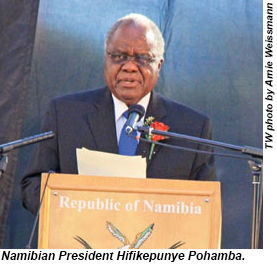
 Prior to my arrival in Namibia for the Adventure Travel Trade Association's World Summit, I had put in a request to interview Hifikepunye Pohamba, the country's president, who was to give the opening address at the summit in Namibia's capital, Windhoek.
I was asked to submit questions in advance, and so I did.
I asked about tourism's strategic importance to the country and how important the U.S. was as an inbound market.
I asked how he resolves environmental conflicts between mining (the largest contributor to the Namibian economy) and tourism.
I asked about the importance of the BRIC countries (Brazil, Russia, India and China) to tourism.
I asked what Namibia learned from South Africa and Botswana about tourism and what those countries could learn from Namibia.
In reply, I was told, essentially, to stand by; I would be notified about the status of my request later.
Upon arriving in Namibia, I toured Namib-Naukluft National Park with Sunrise Tours and Safaris. I was out of the range of cell towers more often than not, but I checked my inbox whenever I seemed to have a bar or two of connectivity, looking for confirmation of the interview.
The day before the conference began, I received an email to call the president's office. I was told that the request had been granted, and I was to meet with him just before the opening session of the summit the next day.
After I had submitted the questions, I had become aware of the seal harvest, and when I arrived in Windhoek, I told a government official that I wanted to also include a question about that.
Shortly afterward, I was told to meet with the president after his speech, rather than before. But when I showed up, I was told he had already left and that he had been expecting me before the speech. I said I would be available to meet with him any time over the next few days but was advised he would answer my questions by email instead.
That being the case, I forwarded this question:
"The issue of harvesting Cape fur seals has been raised to question Namibia's environmental commitment and credentials as an ecofriendly destination. What is your response to the charge that seal harvesting is not in alignment with environmental responsibility?"
The president responded (what follows is edited for length):
Tourism, he wrote, is a high strategic priority for Namibia: "Tourism is everyone's business and must benefit all Namibians."
The BRIC countries hold "significant potential for Namibia."
As regards conflicts between mining and tourism, "Challenges are indeed present in all development sectors [and] overcome by critical inquiry and constructive dialogue."
Competition among Namibia, Botswana and South Africa "is good, and we welcome it." He did not offer specifics about what his country has learned from them or what they could learn from Namibia.
With regard to the question about sealing, the cover note sent by Sem T. Shikongo, director of tourism and gaming, stated, "I have been directed to point out to you that the president has been clear in his statement about our obligation by our highest law to assure sustainable utilization of all natural resources and the need to ensure intergenerational fairness to all Namibians both current and future. ...
"I have been directed to further point out the report of the ombudsman on the issue of the Namibian Cape fur seal. This document is attached. ... His Excellency the President will therefore not make any pronouncement on the seal issue."
Email Arnie Weissmann at [email protected] and follow him on Twitter.