 KUWAIT CITY -- I was bound for a new luxury property, the Hotel Missoni in Kuwait City, opened in March by the Italian fashion house in cooperation with Brussels-based Rezidor Hotel Group. But as I boarded my early morning Emirates Airline connecting flight from Dubai last month, nary a well-heeled Continental vacationer was in sight.
Most of my fellow, and overwhelmingly male, passengers appeared instead to be from the subcontinent: Indian or Bangladeshi laborers weighed down with lots of bags, boxes and bundles. The passenger manifest hardly came as a surprise, as I'd read en route to Kuwait that 70% of the booming emirate's population of 3.1 million is made up of foreign workers.
But the fact that I was on, basically, a commuter flight got me thinking about Kuwait's potential as a leisure destination and, for all its promised stylish charms, the odds of the Hotel Missoni -- or any of the host of other new hotel and resort properties under construction in the emirate -- attracting many long-haul Western guests.
The question was not merely academic. In fits and starts, and without much government support, some private-sector players in Kuwait's suddenly booming hospitality sector, which to date has been largely driven by business travel and diplomacy, are hoping to expand their horizons and play catch-up with nearby Dubai, Oman and even little-known Qatar in the field of pure, unadulterated tourism. (View a slideshow of Kiesnoski's trip to Kuwait here or by clicking on the images.)
"Certainly Kuwait is interested in tourism; in fact, the whole region is very keen on the tourism market," said Marcello Nisi, operations manager at the country's first and largest inbound operator, Kuwait Tourism Services. "So, slowly, Kuwaitis are starting to increase their activity in the market."
But Kuwait faces a few hurdles in that race. This tiny country, an oil-rich, stalwart U.S. ally wedged between Iraq and Saudi Arabia on the Persian Gulf, is not widely regarded as a tourism hotspot. International energy executives and American military personnel are more frequent visitors.
There's no Taj Mahal, Great Pyramid or Petra in Kuwait, no renowned landmarks beckoning across the ages to potential sightseers. Hence, attention from European and North American tour operators and travel agents has been spotty at best.
Even firms that have offered, or will soon include, Kuwait on Middle East itineraries acknowledge its charms are more subtle.
"You see antiquity but not in the volume or grandness of a place like Egypt or Jordan," said Harry Davis, a travel director at Travcoa in El Segundo, Calif. "And Kuwait admittedly doesn't have the intensity of Dubai or the natural beauty of Oman." That said, Davis added, most Americans "of a certain age" have a familiarity with and interest in Kuwait due to the Iraqi invasion of 1990 and the first Gulf War.
But the country, conservative and Muslim, is a land of at least nominal teetotalers, so there's no local equivalent of the mai tai or daiquiri and thus no nightlife as understood in the comparatively libidinous West. Instead there are coffeehouses and restaurants.
 What's more, its neighbors include countries that either pretty much discourage tourism, apart from Islamic pilgrimages (Saudi Arabia); are perceived as unwelcoming to Americans (Iran); or are to various degrees unstable due to recent wars or political unrest (Iraq and a good part of the rest of the Middle East). Kuwait, if it hopes to attract tourists, has its promotional work cut out for it.
In fact, longtime operator to the region Adventures Abroad reported a temporary downturn in interest in itineraries to Persian Gulf destinations when the "Arab spring" uprisings began in January.
"We noticed a drop in inquiries for tours to the region earlier in the year when the unrest was all over the news," said Martin Charlton, assistant manager, destination specialist and senior tour leader at the Blaine, Wash.-based operator. "But it appears as though enough time has passed, and travelers are again feeling confident about traveling to the region."
Regional unrest aside, Kuwait -- well off and largely free of domestic strife -- faces other challenges. Currently, according to Kuwait Tourism Services, 82% of visitors (most arriving from neighboring states) do not stay overnight in the country, and the average visitor spend per head is less than $100. Moreover, visits from abroad have dropped sharply in the last three years from the peak of 3.8 million in 2008, sparking private-sector concerns that the nascent inbound leisure market might falter. According to London-based research firm Euromonitor International, in 2009 Kuwait's outgoing tourist expenditure came to nearly $4.3 billion, but incoming tourists spent only about $400 million.
Indifference at the top
Nor does the Kuwait government show much interest in developing an inbound tourism industry, say sources. Unlike Dubai or Oman, the country has no tourism ministry or board to speak of; the sector is handled by a small division of the Ministry of Commerce and Industry. Any and all promotional activity to date, such as stands at international tourism fairs like ITB in Berlin and World Travel Market in London, has been undertaken by a private-sector triumvirate: the Kuwait Hotel Owners Association, national carrier Kuwait Airways and operator Kuwait Tourism Services.
Private-sector efforts to promote the country as a destination have long met with government indifference, according to Abdul Ilah Marafie, CEO of the Marafie Group of companies and owner of one of Kuwait's oldest luxury resorts, the Radisson Blu Hotel, Kuwait. (Read more with Marafie In the Hot Seat.)
"In the government, no one listens to us or gives us feedback," the outspoken Marafie complained. "For 25 years, we've been fighting for recognition, [but] they're not supporting us. We just want the government to recognize us as an industry."
Those pleas fall on deaf government ears despite the fact that, according to Marafie's estimates, private investment in Kuwait's hospitality infrastructure now totals about $3.3 billion, compared with less than $2 billion in manufacturing, a market sector long deemed worthy of its own ministry.
"They have their own agendas," Marafie said of Kuwait officials with a dismissive wave of his hand.
"All the other Gulf states -- I think the last was Qatar five years ago -- have established [hospitality] regulatory bodies, but we in Kuwait are still working for and supporting ourselves," he said. "We want to promote Kuwait and do whatever we can to give [the outside world] a better view of the country."
(Kuwaiti government officials were unavailable for comment for this article. However, according to published reports, Majda Behbehani, director of marketing and foreign relations in the tourism sector of the Ministry of Commerce and Industry, has stated that Kuwait is, in fact, aiming to attract 1 million visitors per year within a five-year period.)
Pascal Gadet, general manager of the Hotel Missoni and a Kuwait resident for seven years, agreed that the drive to bring Kuwait up to speed in Gulf-area tourism is a largely private-sector effort, advanced by far-sighted local businesspeople.
"I think Kuwaitis have come to realize that a more well-rounded economy is going to bring more of a secure future than just an oil-reliant approach," Gadet said. "That's why this development is taking place now."
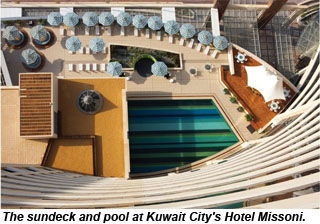 In fact, development has been taking place in spades since about 2004. Some 25 hotels and resorts flying the flags of brands such as Hilton, Four Seasons, Jumeirah and InterContinental have opened, are being built or are planned. They will join existing properties from Marriott, Rezidor and Starwood.
The surge in available hotel rooms in Kuwait City is accompanied by Dubai-like plans for megadevelopments such as the 62,000-acre, $85 billion City of Silk complex north of Kuwait City. Plans call for the development of an attractions-rich resort destination to eventually feature a 3,284-foot skyscraper and redevelopment of Failaka Island, an archaeologically rich but largely ignored island some 12 miles off the coast of Kuwait City. Failaka might eventually become home to another 20 hotels, a golf course and a marine park.
Some of this strikes existing hotel owners as overdevelopment, Marafie said.
"Even with the recent opening of new hotels such as the Missoni and the Jumeirah Messilah Beach Kuwait, the market will be saturated [so] there will be more rooms and less demand," he said. "We expect a drop in occupancy due to the newcomer hotels; 60% occupancy for 10,000 rooms is different from 60% for 15,000 rooms."
Hence, a drive has begun to spur leisure visits to help fill all the new rooms.
But to build tourism, Marafie said, "We need to get that support from the authorities." Pointing to the country's long heritage as an open-minded nation of seafaring traders and merchants, he added, "We Kuwaitis, pioneers in the Gulf region, can do anything." The problem, he said, is "that Kuwaitis are often the first to think and plan and the last to execute."
Growing demand
Faced with an imminent oversupply of rooms, hospitality players in Kuwait are working, slowly but surely, to drive up demand from abroad.
"We're trying to create awareness of and interest in Kuwait to get it included in more [Middle East] tours," said the Hotel Missoni's Gadet. He noted that the vast majority of his guests originate from the neighboring Gulf Cooperation Council states of Saudi Arabia, the United Arab Emirates, Qatar, Bahrain and Oman.
Travcoa's Davis said that while Kuwait enjoys a certain familiarity among Westerners old enough to recall Operation Desert Storm, its appeal as a leisure destination has been overshadowed by both that very legacy and the prolific promotional efforts of regional rivals, such as Dubai and Oman.
"Kuwait has not been as dynamic as ... the other GCC countries have been," said Nisi of Kuwait Tourism Services. "But I think the good years are ahead of us with all this development coming on and all the initiatives that are being undertaken."
 Not that Kuwait has been ignored in source markets such as North America. A handful of U.S. operators, including Travcoa and Adventures Abroad, offer or soon will offer stays in Kuwait as part of broader itineraries to the Persian Gulf region.
Adventures Abroad has sold Kuwait as part of its 19-day Arab Gulf States tour since 2005. "[It's] very popular, as there is nobody else out there with a similar product," Charlton said. "Sure, everyone is including the [United Arab Emirates] these days, [but] there is nobody out there who covers Kuwait, Bahrain, Qatar, all of the UAE and Oman in a land-based tour."
Every year since 2005, Adventures Abroad has offered three to four departures to Kuwait, where a two-day stay begins each Gulf tour. Charlton said nearly all have operated at full capacity, with 21 clients. The operator plans two departures in 2012, on Feb. 1 and Oct. 10.
Travcoa last offered Kuwait in 2009, dropping the destination in 2010, when management decided a shorter itinerary to the Gulf region might sell better. But Travcoa now plans to restore Kuwait in 2013.
"I can't imagine doing the region without including Kuwait, or, for that matter, just doing Kuwait without visiting all of its interesting neighboring countries," Davis said.
Moreover, Kuwaitis and non-Kuwaitis alike seem to agree that the destination works best as one stop on a larger tour. During my own stay -- above-average in duration at four nights and five days -- I heard locals repeatedly opine that, at worst, "there's nothing to do or see in Kuwait" and, at best, one should stay no more than two days before moving on.
Officials at Kuwaiti inbound operator Nuzha Touristic Enterprises are familiar with those refrains. "We heard about this many times, too: that Kuwait has nothing to offer when it comes to the category of tourism," said spokeswoman Imee Alvarez. "But our team never loses hope. And it serves as a challenge, too, of promoting touristic destinations to the locals and especially to foreigners who want to visit interesting and historical places like the Grand Mosque, National Museum, Kuwait Towers and many more."
Charlton at Adventures Abroad acknowledged the comparative lack of attractions for long-haul visitors. "Kuwait is an excellent addition to any multicountry itinerary in the region, but I still think that they have some distance to go before becoming a true leisure destination," he said. "North American travelers will not be likely to travel that distance without taking in some of the sights of the nearby countries."
Trawling Kuwait's attractions
Admittedly, during my stay I wasn't offered the four-wheel-drive sand dune safaris, camel rides or overnight Bedouin camp experiences I enjoyed in neighboring Qatar four years earlier, but there was plenty to do and see. At first glance a forest of hyper-modern skyscrapers under construction, the city on a deeper level proved an exotic, affluent, welcoming, easy-going and largely easy-on-the-eye destination, if a tad expensive for a recession-pressed American.
At first glance, costs look absurdly low, thanks to a current exchange rate of $3.60 to 1 Kuwaiti dinar. One-eighty for a grande iced latte at Starbucks? No problem, you think; but when you do the math, you realize that's almost $7. Similarly, postlunch puffing on a grape-flavored shisha, or water pipe, at seaside Lebanese eatery Burj Al Hamam ran $15 a pop.
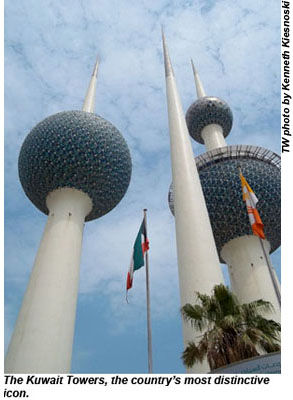
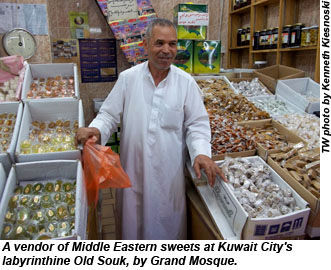
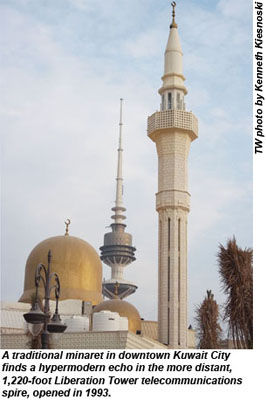 But Kuwait offers very interesting diversions that are inexpensive or free, as well. A ride up to the revolving "viewing sphere" of the iconic Kuwait Towers (600-plus feet high and nearly blasted to bits by an invading Saddam Hussein in 1990) costs just 1 dinar. Wandering the spice, produce, souvenir and clothing stalls of the labyrinthine Old Souk by the Grand Mosque, is, of course, free. Until, that is, you succumb to the charm of its shopkeepers.
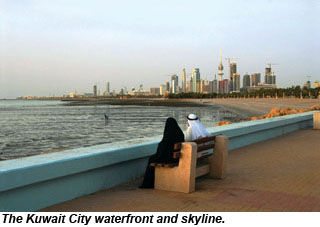
And then there's always people-watching along the verdant, waterfront Corniche, where most passersby sport traditional Kuwaiti dress: white dishdashas, sandals and checkerboard headscarves for gentlemen; black cloaks, or abayas, and in many cases veils for the ladies, all accessorized with the latest designer sunglasses and jewelry, to be sure.
Asked to list his own favorite recommendations, the Hotel Missoni's Gadet pointed to the Hashimi Dhow, a large traditional fishing vessel and "must-see" that's in the Guinness Book of World Records; Failaka Island, home to Greek ruins dating to the time of Alexander the Great; and "a number of fantastic shopping malls that rival those in Dubai."
All or most of these attractions and activities are included in itineraries offered by local operators such as Kuwait Tourism Services and foreign outfits like Adventures Abroad. Highlights of the latter's Kuwait program include the fascinating Tareq Rajab Museum, a private collection housed in a villa that includes thousands of examples of calligraphy; pottery; metalwork; glassware; textiles; costumes; musical instruments; and wood, ivory and jade carvings from across the Islamic world.
There's also the awkwardly named Kuwait House of National Works Memorial Museum, which documents the Iraqi invasion and its aftermath with an alternately winning and harrowing set of dioramas, photos and artifacts, accompanied by dramatic lighting effects and audio commentary. It was at the memorial museum that I had my first encounter with a unique Kuwaiti cultural phenomenon, the diwaniya, which could, in the opinion of the experts, hold great appeal for tourists in search of experiential travel and authentic cultural encounters.
After my tour of the museum, I was invited, to my surprise and confusion, to take a seat in a special sofa-lined room, where I was served a choice of coffee, tea or lemonade and the museum director engaged me in polite conversation.
Gadet later explained that "Kuwaitis in particular have a very honest and genuine way of inviting you into their homes. The diwaniya is a kind of meeting place where you gather in a room with a sofa, or divan, to socialize."
Every Kuwaiti family hosts a diwaniya two or three times a week, and anybody is invited. "You can walk in not even knowing the hosts, uninvited, and you will be welcome to drinks and snacks and have a nice conversation," he explained. At the end of my stay, I was treated to a longer diwaniya, by the Marafie clan, owners of both the Hotel Missoni and the Radisson Blu. Upon leaving two hours later, I was gifted with bags of hand-packed dates from the family orchard.
Travel agents' and tour operators' clients in the U.S. might find that sort of experience appealing, said Nisi of Kuwait Tourism Services, adding, "Operators are looking to discover new experiences for their clients who have been all over."
Travcoa's Davis concurred that Kuwait possesses a special something that greatly appeals to his clients. "Every single time we've ended the [Persian Gulf] route and our clients reminisce, they mention Kuwait as a highlight," he said. "It may not have all the glitz and glamour, but they were so glad they'd visited."
Adventures Abroad's Charlton agrees that "Kuwait has something different to offer. Sometimes the lack of development is an attraction unto itself [and] the lesser-known regions often end up being the highlight of one's travels."
Noting that travel to hospitable and secure Kuwait is "easy and rewarding," Charlton added that he believes it "truly has something for everyone."
"My own memories of Kuwait are mostly related to unique personal experiences and meeting with the people," Charlton said. "That is what true travel is all about: getting a sense of the 'now.'"
For destination news and updates worldwide, follow Ken Kiesnoski on Twitter @kktravelweekly.