On a sunny afternoon in July, Miami Beach Mayor Philip
Levine, joined by mayors of four nearby coastal towns, gathered on the sand
before assembled media to make a plea to county and state officials: Spend more
money restoring eroded beaches, Levine said, standing on the narrowest stretch
of Miami Beach to emphasize his point.
“By not protecting the sand beaches, you’re ignoring your
most important economic generator at your own peril,” Levine said, according to
the Miami Herald, which covered the event.
Indeed, in Miami and around Florida, tourism is booming, in
large part due to the state’s famed beaches and its other outdoor attractions.
In 2014, the state hosted an estimated 98 million visitors, who contributed $82
billion to the economy, according to Visit Florida. This year, that figure is
expected to leap past 100 million for the first time.
But though Florida’s 825 miles of beaches continue to offer
unquestioned beauty, many aren’t as healthy as they might appear to the
untrained eye. In fact, the Florida Department of Environmental Protection
(FDEP), which annually spends between $25 million and $40 million on beach
restoration and nourishment, estimates that the state now has 407 miles of
critically eroded beaches, nearly double the damage that existed when the
agency first did such an audit in 1989.
Critically eroded beaches, by definition, have receded or
eroded enough to threaten recreational interests, development or wildlife. And
while erosion is a natural process, it is often accelerated by human
activities, such as development on protective sand dunes, offshore channel
dredging and the installation of seawalls.
While beaches are Florida’s most popular attraction, they’re
by no means the state’s only outdoor draw, nor are they alone in facing
substantial environmental challenges as Florida’s population edges toward 20
million and the visitor count crashes across the nine-figure threshold.

A Burmese python in Everglades National Park.
The Everglades, possibly the world’s most famous wetland,
has been so affected by water diversion and development that it is now just
half of what it was at the dawn of the 19th century.
Meanwhile, Everglades National Park, the 1.5-million-acre
preserve that sits at the southern end of that Everglades ecosystem, has become
so overrun by invasive Burmese pythons during the past 15 years that in some
areas 99% of midsize mammals, such as opossum and raccoons, have been lost to
predation.
The Everglades provides the drinking water for southern
Florida and also serves as the watershed to coastal estuaries, including
Biscayne Bay and the Ten Thousand Islands. Fixing the wetland’s environmental
problems is regarded as so crucial that the ecosystem is the subject of a $13
billion joint state and federal restoration, the costliest environmental
project in history.
Environmental problems have also reached beyond Florida’s
coastline to its reefs. The third largest barrier reef system in the world,
behind only the systems that lie off the eastern coasts of Australia and
Central America, the reefs are an especially important economic driver in the
Florida Keys, where 26% of annual visitors either dive or snorkel, according to
a 2010 study sponsored by the National Oceanic and Atmospheric Administration
(NOAA).
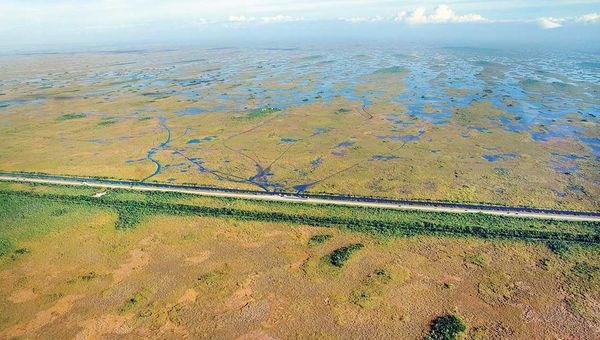
A highway blocks natural water flow south in the Everglades, leaving the park below the road parched while areas north are inundated with water. Photo Credit: Lori Oberhofer, Everglades National Park
However, fueled by everything from higher water temperatures
to polluted urban and agricultural run-off and the direct impact of visitation,
living coral cover along the South Florida reef tract has declined by nearly
50% since rigorous monitoring began in 1995.
Pollution, water diversion and crowding have also taken
their toll on Florida’s diverse saltwater fisheries, which, according to state
records, accounted for 1.6 million recreational license sales during the 2014
fiscal year.
Several species are on the rebound after tougher federal
fisheries rules implemented in 2007 led to stricter management. But that
stricter management, at both the federal and state levels, has meant tighter
recreational catch regulations on everything from Atlantic Ocean and Gulf of
Mexico fish such as red grouper and greater amberjack (new rules were
implemented this year) to snook, a popular species that roams shallow water mud
flats and mangrove shorelines.
Meanwhile, 2016 will see the onset of a new fishing closure
zone in Biscayne National Park, just south of Miami, where snapper and grouper
have not only declined in abundance but also rarely live long enough to even
reach legal catch size, according to the National Park Service.
No drop in the fun factor
Despite Florida’s myriad environmental problems, few would
argue that its sun, beaches, waters and wilds fail to offer enough to please
most visitors.
“I don’t worry that we’re going to overstress our
eco-assets,” said Visit Tampa Director Santiago Corrado, whose county saw a
6.2% year-over-year increase in visitors in 2014. Meetings and cultural
attractions are a major draw in Tampa, but the area also offers paddling and
fishing on Tampa Bay and the Hillsborough River, and it benefits from the
appeal of the beaches in the adjacent St. Petersburg/Clearwater area.
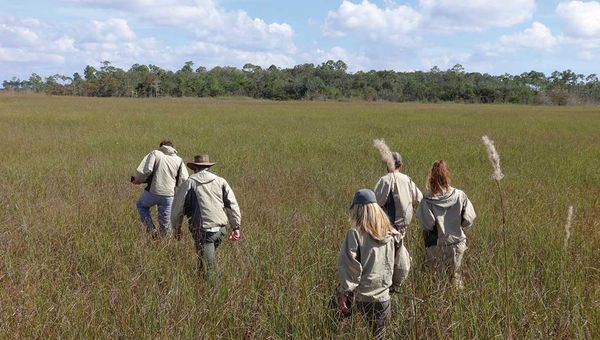
Hikers make their way through a sawgrass prairie in Everglades National Park. Photo Credit: Robert Silk
Even people who have closely witnessed Florida’s ecological
decline say that the state has a great deal to offer.
“There is still so much to see,” said Everglades guide Garl
Harrold, who lamented the loss of small mammals over the last 15 years to the
Burmese python invasion. “You’ve got plenty of alligators, the crocodiles are
doing better than they were before, and we’ve got real good birds still.”
Mark Sosin, who has fished Florida waters since the 1950s
and had a fishing show, “Mark Sosin’s Saltwater Journal,” on ESPN for 12 years,
is quick to assert that the fishing was much better decades ago, when far fewer
people were on the water. But he also says that he’d still recommend Miami,
with its combination of reef, deep water and flats fishing as well as its fine
hotels and plentiful dining and entertainment, over any angling destination in
the world.
Nevertheless, it’s not just mayors in the Miami vicinity who
are concerned about Florida’s environmental problems potentially damaging
tourism.
In the Florida Keys, for example, the local tourism council
is planning to partner in the coming two years with NOAA on a study that will look
at the impact that NOAA’s Florida Keys National Marine Sanctuary, which
surrounds the island chain, has on visitation. Tourist Development Council
Director Harold Wheeler said the study will also delve into what needs to be
done to protect sanctuary resources such as reefs and fisheries.
Wheeler said he was definitely mindful of the need to strike
a balance between visitation and the Keys’ outdoor resources.
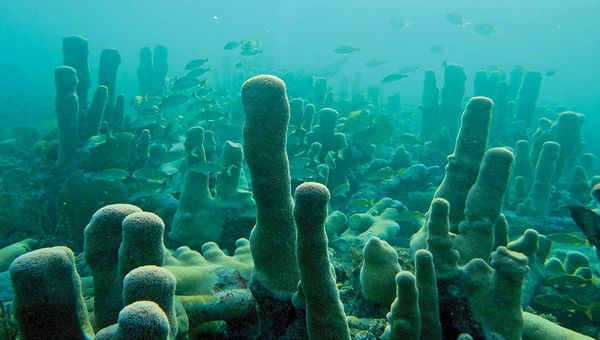
Healthy pillar coral, a threatened species, in the Florida Keys National Marine Sanctuary. Photo Credit: Florida Fish and Wildlife Conservation Commission
“Some of that starts with how we brand ourselves and how we
target the tourists we are looking for,” he said, adding that his agency also
uses its Fla-keys.com website to promote outdoor voluntourism and to educate
people about how to tread lightly on the reefs.
Concerns about beach quality
What the reefs are to Florida Keys tourism, beaches are to
tourism throughout most of the rest of coastal Florida. According to Visit
Florida data, 43% of domestic tourists in 2013 participated in a beach or
waterfront activity, more than double the percentage of people who visited one
of the state’s famed theme parks.
In fact, domestic visitors comprise 84% of Florida’s overall
tourist market, and more of them spent time along the water than went out to a
restaurant or visited relatives or friends.
Maintaining the beaches, though, is no simple matter,
especially when one of the goals is to compete with other regional
destinations, where the beaches might be wider and the sand might be whiter.
In July, for example, Miami-Dade County Mayor Carlos
Gimenez, having heard the message sent by his fellow Florida mayors a few weeks
earlier, pitched a $40 million beach erosion plan by noting the importance of
competing with the rapidly opening Cuba beach market.
“We have to make sure that our beaches are as beautiful and
as large and as inviting to our tourists as they can possibly be,” he said in
an interview with the Associated Press.
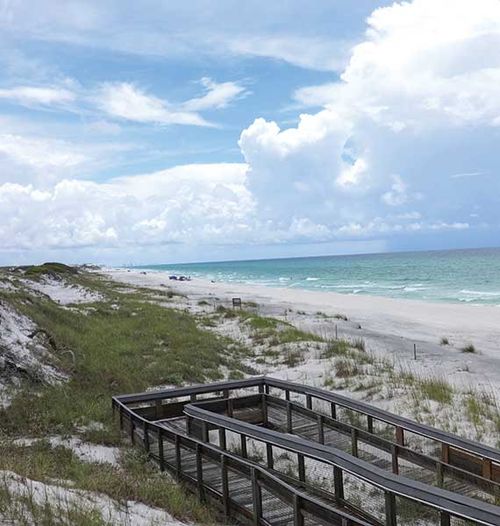
The beach at Deer Lake State Park in Walton County, where 19 miles of beach will be restored. Photo Credit: Robert Silk
This year, the FDEP will undertake 13 beach restoration or
nourishment projects spanning from the Fort Lauderdale area in southeast
Florida to Pensacola in the state’s Panhandle.
On Lido Key, just west of Sarasota, the local, state and
federal governments partnered on a $3.6 million restoration to repair damage
caused by Tropical Storm Debby in 2012. In St. Lucie County, on the central
east coast, work crews constructed a two-acre limestone jetty to reduce the
beach erosion caused by waves.
Drawing tourists is a goal of restoration projects, as is
creating a buffer against potential storm surges. Since 1998, the FDEP has
restored and subsequently maintained 227 miles of the state’s most eroded
beaches.
Robert Brantly, an FDEP engineer who has worked for nearly
three decades on the state’s beach program, said the restoration projects work.
“A visitor now in Florida, going to a restored beach, I
don’t even think they would know the beach has been restored,” he said.
But not everyone is so bullish about beach restoration as a
catch-all solution for either tourism or the environment.
“There’s a lot of examples of beach projects that have gone
terribly awry,” said Holly Parker, Florida’s regional coordinator for the
Surfrider Foundation, a nonprofit dedicated to the enhancement of beaches
worldwide.
She pointed to a 2013 Delray Beach nourishment project in which
a barge transporting the dredge that was to be used to mine offshore sand for
the beach dragged the bottom, damaging a three-mile stretch of a local reef.
In a case this spring, Palm Beach residents claimed that the
contractor for a $17.6 million nourishment project was short-changing the city
by using low-quality sand. Indeed, fears about sand quality are often a
sticking point in Florida’s beach restoration projects.
“We are very, very conscious of the materials we use,”
Brantly said of projects that the FDEP co-sponsors.
But such assurances have not assuaged opponents of a planned
$52 million nourishment project on an 19-mile stretch of the Panhandle’s Walton
County that could commence as soon as October 2016.
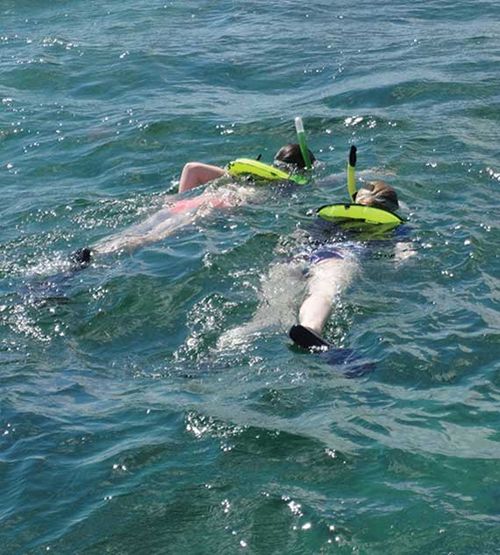
Snorkelers swim in the water off Key West. Photo Credit: Robert Silk
To be funded jointly by Walton County, along with the state
and the federal governments, the project calls for the mining of 3.9 million
cubic yards of sand from four miles offshore in the Gulf of Mexico. It will add
50 to 100 feet of width to the beach as well as fortify the sand dunes immediately
beyond the beach.
Visit South Walton Executive Director Jim Bagby said the
location of the mining was chosen because the U.S. Army Corps of Engineers has
said it contains the whitest sand in the vicinity.
Still, opponents say the sand won’t be white enough.
A statement on the website for an organization of beachfront
property owners who have fought the project, said: “The beaches in Walton
County are among the best in the world and known for their sugar-white sand.
The inferior sand that this project wants to pump onto our coastline comes from
a source never before used for nourishment projects.”
To settle the matter, Walton County is considering
conducting a new core sampling of 20 spots within the area selected for the
sand mining in order to reconfirm the sand’s quality.
But while the debate on the central Panhandle coast centers
on sand quality, the debate in Miami also focuses on quantity.
The Southeast Regional Climate Compact, a confederation of
the four counties that stretch from the Keys north to the Palm Beach area,
projects that sea levels in the area will rise nine to 24 inches by 2060. In
low-lying Florida, such increases would jeopardize the Everglades, fresh water
supplies, highways, farmlands and, yes, beaches.
For beach lovers, there was good news to be found in an
offshore sand inventory published jointly by the state and federal governments
in 2013.
Even accounting for sea level rise, the study found, there
is enough offshore sand to meet the overall needs of the six counties along the
Atlantic coastline between the Keys and St. Lucie County for the next 50 years.
However, the study also showed that individually, the Miami and Fort Lauderdale
areas are already out of acceptable offshore sand deposits.
For a place like Miami Beach, that means that efforts to
compete with Cuba and the rest of the Caribbean for beach tourists will require
getting sand from up the coast, from inland deposits or from another country,
most likely the Bahamas. Any of those choices will drive up costs, said Florida
International University coastal scientist Stephen Leatherman, who is widely
known as “Dr. Beach” due to his annual ranking of the top 10 beaches in the
U.S.
And if Miami were to purchase sand from the Bahamas, it
would also lose the option of using federal grant money.
Meanwhile, the specter of sand being mined in federal waters
off the St. Lucie County coast for use in Miami has already sparked outcries
from the area’s county officials and state legislatures.
Leatherman said that as resources dwindle, he sees an era of
beach sand wars on the horizon.
“It’s getting more controversial and more expensive,” he
said of beach restoration and nourishment. “It’s controversial because of the
quality of sand not being the same level as it has been in the past. Tourists
might not think it is that much of a problem, but the people who have been
coming there a lot, they are going to want to see that same sand, and I understand
that.”