To hear the mainstream media tell it, the 2012 winter sports season was over before it began. But industry experts insist there's snow in them thar hills. The bad news? Most of it is artificial.
 "It's not good" was the frank assessment of the season so far by Kelly Davis, director of research for the SnowSports Industry America, based in McLean, Va. "We've got 20% snow cover across the U.S., and typically we would have 45% to 50%."
Davis, who spoke to Travel Weekly from the slopes at Jiminy Peak, Mass., said that at press time British Columbia was the most notable exception to the drought. In fact, according to Whistler Tourism, Whistler-Blackcomb had trumped the rest of the industry with 15 feet of snowfall as of the first week of January.
"You can definitely ski and ride here [at Jiminy Peak], and it's surprisingly good, but we don't have 100% of the skiable acres open, and that's the situation across the country," Davis said.
AccuWeather.com reports that the California Sierras, Nevada and Utah have been particularly hard hit. The bleak early season is especially notable when compared with last season's boom snow packs nearly industrywide.
"Resorts in the leisure travel industry always have weather as a wild card," said Ralf Garrison, director of the Mountain Travel Research Program, known in industry circles as MTRiP. "The last couple of years have been really good snow years in all regions, so both resorts and guests have begun to take good, natural snow almost for granted. This is the first year in several that snow, or the lack thereof, has become a consideration."
Jessica Kunzer, spokeswoman for Ski Utah, agreed, pointing out that last year was Utah's second best season on record.
That said, the dearth of powder does not directly translate into catastrophic bookings. This season's holiday traffic was only "a bit" below last year's, Kunzer said, but "currently Utah has 106 of 138 chairs running and 595 runs open."
At Vail Resorts, lift ticket revenue was actually up over last year's early season, according to CEO Rob Katz.
"For the first time in 30 years, a lack of snow has not allowed us to open the back bowls in Vail as of Jan. 6, and, for the first time since the late 1800s, it did not snow at all in Tahoe in December," Katz said. "Despite these conditions ... our total lift ticket revenue was up 0.6%, and ski school revenue increased 0.9% compared to the prior year, when record snowfall was reported across our resorts."
 Katz credited the mix of attractive season-pass programs, off-slope activities and aggressive resort improvements for the positive numbers.
"This is most apparent in Tahoe, where our investment in snow-making has allowed us to open up more terrain than all the other resorts in the area combined."
Industry experts stressed the importance of snow-making techniques, which have improved significantly from the days when skiing on man-made snow felt like sliding on sugar granules.
Ski Lake Tahoe spokesman Eric Doyne said, "Snow-making systems and grooming technology used by our resorts are totally state-of-the-art, creating man-made blizzards that have led to over 100 open ski trails at Tahoe-area resorts." He added that holiday traffic was "positive."
"The snow-making is so good that Northstar just opened a 22-foot superpipe, one of just a handful in the country, and it's 100% snow, not dirt fill," Doyne said.
Likewise, Jen Butson of Ski Vermont reported that "skiing and riding are very much alive in Vermont," adding that during the weekend of Jan. 7 and 8, "Vermont had 600-plus trails open across the state."
Butson touted Vermont's snow-making operations, which cover more than 70% of the state's trails and can lay one foot of snow on 60 acres in an hour. "That's like filling Giants Stadium with 40 feet of snow in an hour," she said.
It is also important to keep in mind that the early ski season is often spotty even in good snow years.
Doyne said, "Most resorts, and especially Western resorts, rely on supplemental snow-making in the early season. We're officially only two weeks into winter, so it's not uncommon to still see snow guns being used."
In addition, conditions can change on a dime with a good snowfall. Just look at Utah, which received five fresh inches of snow the weekend of Jan. 7 and 8.
"We are looking forward to February and March, which are traditionally our snowiest months," SkiUtah's Kunzer said.
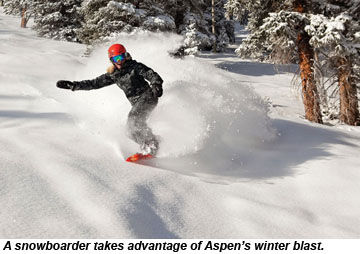
Colorado also received a welcome winter blast the same weekend, with nine inches dropping at Beaver Creek, eight at Aspen/Snowmass and Vail, seven at Breckenridge and five at Keystone.
Mother Nature delivered 20 inches of snow at Jackson Hole, Wyo., over New Year's weekend, and destination visits were up, said resort spokesman Zahan Billimoria.
The travel agent role
For agents, the real challenge doesn't lie so much in peering into the weather gods' crystal ball but being nimble in helping clients book a satisfying winter vacation.
MTRiP's Ralf Garrison asserted that "those resorts with the most, best natural snow, the highest elevation or the best snow-making are in the position to play offense, and the rest are obliged to play defense."
He added that each resort has to make a decision on how it will treat the interest of its guests. This might mean offering guests more to do off-slope, moving them to another time of year or even to another resort if the conditions are really inadequate. They also can upgrade guests to a nicer unit or provide a lower cost more commensurate with their experience, he said.
Kirkwood Mountain Resort in Tahoe unveiled a guarantee whereby unsatifisfied visitors receive a lift ticket for another visit to Kirkwood for the 2011-12 season with no questions asked.
Grand Targhee Resort in Teton Valley, Wyo., which has had strong early snowfalls of nearly 12 feet, is offering a ski free program to skiers who have bought season passes to any U.S. or Canadian ski resort for the 2012 season. The offer requires a three-night lodging package at the resort.
"Tour operators and agents play an important role in this process because they are typically more guest-centric," Garrison said. "They may be in a position to guide a guest to a destination that best meets his or her needs."
Die-hard winter sports enthusiasts are the customers who are most likely to require top snow conditions, he said, while those looking for a destination resort experience are less likely to choose their stay based solely on the ratio of fresh to man-made snow.
For the consumer, he said, the bottom line is that "when times get tougher, the expertise of travel professionals is even more important."