Biofuel is not just an aviation pipe dream. The use of fuel made from vegetation or industrial or domestic waste is a big part of the industry’s plan to cut its carbon emissions by 2050 to half of what they were in 2005, said Haldane Dodd, head of communications for the Air Transport Action Group.
Nancy Young, vice president of environmental affairs for Airlines for America, recalled that in 2006, the aviation industry set out to find and produce alternative aviation fuels.
To that end it created fuel specifications so that jets could fly on a combination of carbon-based and sustainable biofuel. Initial test flights followed, then hundreds of commercial flights operated by airlines all over the world.
 The next step will be to make the use of biofuel not just a test but business as usual, by ensuring a regular supply at prices competitive with carbon-based fuel.
Last spring, in testimony before Congress, Young told lawmakers that the focus going forward would be on scaling up supply to make it cost competitive. And that is starting to happen.
At the end of this year, United Airlines will start using sustainable biofuel on a regular basis on flights out of Los Angeles. It has signed an agreement with AltAir Fuels, which has retrofitted part of an existing petroleum refinery, creating a $30 million biofuel refinery near Los Angeles.
United has committed to buying 15 million gallons of this fuel over the next three years, with an option to buy more and at prices competitive with traditional, petroleum-based fuel.
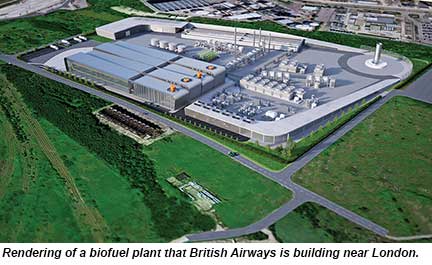
Next year, British Airways will break ground on a plant on the site of an old oil refinery on the Thames River that will turn domestic, industrial and agricultural waste into jet fuel.
BA is working with Solena Fuels, which uses a high-temperature plasma-gasification technology to produce synthetic gas by converting waste that would otherwise have gone into a landfill or have been incinerated.
It will start producing about 50,000 tons of jet fuel a year, about 2% of BA’s total needs, in 2017. For its part, BA will use the biofuel on flights out of City Airport or at Heathrow.
“We see this as a proof of concept,” said Jonathon Counsell, head of BA’s environment department. “Once we can demonstrate that we can make jet fuel commercially, our plan is to build a number of these.”
Counsell said there is plenty of waste available, along with plenty of former refinery sites, not just in England but all over the developed world.
“We’re quite excited about it,” he said.
Alaska Airlines, which in 2011 tested flights using a fuel mix that included a 20% blend of sustainable biofuel made from used cooking oil, has signed an agreement with Hawaii BioEnergy to produce sustainable biofuels starting in 2018.
All of these efforts are tailored both to give airlines experience using the fuel and biofuel providers an incentive to create an aviation market for their products.
Young said that biofuel’s advantage over petroleum-based fuel lies in the fact that it is recycling carbon rather than adding still more carbon to the atmosphere.
That’s because the crops and waste that are the source of biofuel took carbon from the air when they were growing or otherwise being produced and are now releasing that carbon back into the atmosphere, essentially cycling it back whence it came.
Petroleum-based fuel, on the other hand, takes carbon that has been stored below ground for millions of years and releases it into the atmosphere, adding to the world’s CO2 levels.
Young acknowledged that fuel production, regardless of what kind it is, creates emissions. So the airline industry has done a life-cycle analysis, looking at each stage of fuel production to ensure that even when taking production into account, airlines will continue to reduce CO2 production.