The finance and housing industries have crashed, and the travel industry sometimes seems to be in a tailspin. Paradoxically, fledgling space tourism appears to be on a solid trajectory.
Will Whitehorn, president of Virgin Galactic, the Richard Branson company that plans to offer suborbital spaceflights to the paying public by the end of this decade, said that despite the economy, Virgin Galactic is continuing unabated to book seats at $200,000 a pop.
"One of the remarkable things about this project is that sales of tickets are continuing to go well," Whitehorn said.
 In fact, he said, Virgin Galactic has amassed almost 300 bookings and collected $40 million in deposits for a product that doesn’t yet exist. Whitehorn suggested that the gloom on Wall Street actually might be boosting bookings.
"Certainly, one or two people who were in the stock market possibly liquidated their portfolio," he said. "They’re sitting with a lot of cash and decided they might as well put something into this. … We’re pretty confident we’ll achieve our original goal of selling the first year’s flying program before we start to fly."
Specially trained travel agents known as "accredited space agents," or ASAs, are responsible for more than two-thirds of the seats sold to date. In the U.S., Virgin Galactic signed an exclusive arrangement with Virtuoso in 2006. Beyond that, Whitehorn said the company has an international network of accredited agents.
The commission that Virgin Galactic pays ASAs is a closely guarded secret. Joshua Bush, vice president of Park Avenue Travel in Swarthmore, Pa., and a Virtuoso ASA, said agents were asked to sign a nondisclosure agreement.
"But it’s not about the commission," he said. "For me, it’s part of making history. … There are a number of people out there who say it’s frivolous in this economy for anyone to spend $200,000 to go to space. But this is their dream, and they have the money to do it."
Virgin Galactic offers three levels of flight priority, based on the amount of the client’s deposit. "The more money you put up, the higher the flight order," Bush said.
The first 100 passengers who deposited the entire $200,000 fare are known as "Founders" and will be the first to fly.
"Pioneers," or those who deposit $100,000 to $175,000, will get the next 101 to 500 spots and are expected to fly within the first full year of operation. The "Voyagers" category, clients who put down smaller deposits, will be given seats on subsequent flights.
 Bush said that Virgin Galactic has already sold out the Founders category, meaning that new clients "can’t make more than a $150,000 deposit currently."
Bush has sold two tickets. One canceled, he said, but not because of the economy: "It was a surprise birthday present" that was not appreciated.
His other "astronaut in waiting," or AIW as Virgin Galactic clients are known, is a Russian entrepreneur and pilot in his mid-50s who bought his seat last March.
"He’s in the 200s of flight priority, so he’s one of the Pioneers," Bush said. "It’s the Founders and Pioneers who are providing the seed money to open the doors to a travel industry revolution and new opportunities for science and technology. There’s no reason why they shouldn’t spend their money."
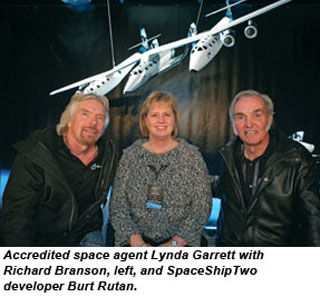
Lynda Garrett, president of Alpine Travel of Saratoga, Calif., and a Virtuoso ASA, said her only client is a 50-year-old pilot from Toronto who is vice president of "a very large financial institution" and "a Pioneer AIW, No. 51."
"My astronaut would never consider canceling," Garrett said. "He is a strong supporter of the Virgin Galactic project, knowing that not only will it be a lifetime experience for him but also that participating in the private space program helps the future of science."
The top Virtuoso seller of spaceflights so far is Jay Johnson, president of Coastline Travel in Garden Grove, Calif., with four reservations in the bank. Johnson, whose goal is to sell 10 flights, said that at one time he had seven people interested but two have not put down deposits. Of the five remaining, one canceled about a month ago, but it had nothing to do with the economy, he said.
"She didn’t even ask for her money back. Virgin Galactic is trying to return her deposit, but … she doesn’t seem to care about the money."
Coastline Travel's remaining four AIWs are all Pioneers, Johnson said. They include:
• Josh Resnick, a developer of video games and the president of Pandemic Studios in Los Angeles. He is in his late 30s and is bringing along his mother, Rheta Resnick, a Los Angeles travel agent.
• Larry Connor, a real estate developer from Centerville, Ohio, who once climbed Mount Kilimanjaro.
• Sheila Kessler of San Clemente, Calif., president of Competitive Edge, an executive coaching firm for businesses, and the author of several books. Kessler has cancer and is in remission, Johnson said. Her goal for her flight is to get people to pledge money for cancer research.
Bush credited Virgin Galactic with keeping clients involved in the program while they await their flights, which is crucial since "we’re one-and-a-half to two years away from launch."
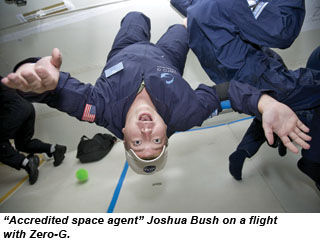 In the meantime, AIWs can get a small taste of what spaceflight is like by spending an extra $4,950 for a Zero-G flight out of Las Vegas or Florida or by boarding a flight simulator at the National Aerospace Training and Research Center (NASTAR) in Philadelphia.
NASTAR, the official training provider for Virgin Galactic, last year hosted 50 ASAs from 14 countries for a two-day forum, which included new "try before you buy" programs for prospective Virgin Galactic passengers.
How to sell space travel
Johnson said his bookings have come mostly through referrals from clients, though he also promotes it on his blog and in magazine ads. Similarly, Bush gets referrals and markets the flights through his website, ParkAvenueSpaceTravel.com.
"Selling space travel is like selling a private jet charter," Bush said.
This summer, he will hold a general information event for up to 500 targeted clients from across the country.
Garrett, too, has been holding client events, and she collaborated with Bush and two other ASAs in October to buy a booth at the Albuquerque International Balloon Fiesta in New Mexico, where they promoted Virtuoso and Virgin Galactic.
"I pinch myself all the time when I talk with prospects about the Virgin Galactic space program," Garrett said. "I’ve been selling luxury vacations to clients for 30 years, and this is by far the most fun. And knowing that you are becoming a part of history is humbling."
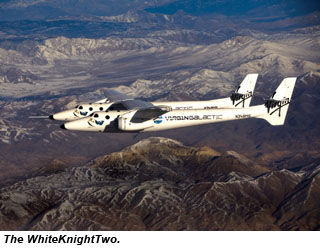
Bush said inquiries increase significantly whenever Virgin Galactic makes news, such as when it unveiled WhiteKnightTwo, its jet-powered mother ship, which began flight testing on Dec. 22.
Later this year, the company is scheduled to roll out its new, rocket-powered passenger vehicle, SpaceShipTwo, which will be carried aloft to its launch point 50,000 feet above Earth’s surface by the mother ship.
The final test, as yet unscheduled, will launch an unmanned SpaceShipTwo from WhiteKnightTwo in a trajectory that will take it to its target altitude some 68 miles above Earth.
"Whether it gets into space by the end of 2009 is unlikely but possible," Whitehorn said. "The testing will continue into 2010, by which time [SpaceShipTwo] will have gone into space with passengers, probably including myself."
Virgin Galactic continues to run a conservative testing and deployment program as it builds consumer confidence and rakes in deposits.
"We’ve set a milestone-based approach rather than an absolute date for the start of commercial flying," Whitehorn said. "We’re not in a race with anyone, and safety is really the main priority. As we say internally, we can only get this wrong once."
SpaceShipTwo will carry six tourists and two pilots at a speed of just over three times the speed of sound. Passengers will get three days of training before taking the two-hour trip into space, where they’ll experience 4.5 minutes of weightlessness, enabling them to unbuckle their seat belts and float around the cabin before the spaceship glides back to Earth.
Carrying tourists into space is only one element of Virgin Galactic’s corporate model, which is being developed as a series of businesses.
"One will be space tourism," Whitehorn said. "Then we’ll be doing space science. We’ll also be doing space cargo. … We are now entering the scientific marketplace."
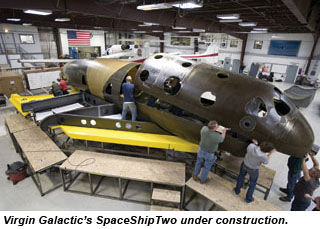 Whitehorn said Virgin Galactic designed SpaceShipTwo "with enough room for scientists to do gravity experiments. In addition to that, we are also looking now at developing another vehicle to go under the White-Knight: an unmanned launch vehicle that would carry a small satellite into space."
Sounding an even more ambitious note in an interview on Swedish television not long ago, Branson introduced a fourth prong: a space plane that would revolutionize the travel industry by one day enabling passengers to travel, for example, to Thailand from Switzerland in half an hour.
He described the feat as "popping out of the Earth’s atmosphere and then straight back again at an affordable price."
Spaceports and competitors
While testing continues in the Mojave, the state of New Mexico is footing the bill for a takeoff and landing facility there.
Construction is expected to begin in the second quarter on Spaceport America, the nation’s first passenger spaceport, which is expected to be ready for Virgin Galactic in 2010.
Whitehorn said the company has looked at other locations around the world where it could operate from existing facilities. It has also signed a deal with Spaceport Sweden, which will promote Kiruna, Sweden, as Europe’s first passenger spaceport.
In the meantime, Whitehorn doesn’t feel any competitors breathing down his neck.
"There are lots of people who say they’re open for business to take deposits," he said. "But what they have to offer are pictures on a website, not something that’s been built. What you must remember about the system we’ve got is that there has already been a prototype."
The group’s SpaceShipOne made history in 2004 when it captured the $10 million Ansari X-Prize by becoming the first privately owned, manned craft to make three flights to altitudes between 62 miles and 69 miles. It still holds the title. The plane is now on display at the Smithsonian National Air and Space Museum in Washington.
Defining ‘space tourism’
So while Virgin Galactic is already developing a commercial version of that technology, Whitehorn said would-be competitors "haven’t even flown a prototype of something into space, ever. I think we’re a long way from seeing any competitor emerge in any real sense of the word."
Would-be competitors are either too expensive or too unrealized to be called space tourism, he said.
Vienna, Va.-based Space Adventures, for example, sends clients into space aboard Russian rockets at $20 million or more a pop.
Founded in 1998, Space Adventures has brokered flights for the world’s first private astronauts, beginning with multimillionaire Dennis Tito in 2001. (Click here to read Margaret Myre's story about Space Adventures' latest millionaire customer.)
But while Whitehorn described Space Adventures’ program as "incredible," he insisted that it is not space tourism.
 "Space tourism for us is the chance for an ordinary person without particular specialist training, without particular fitness qualifications, to be able to take a week out of their lives to go to space," Whitehorn said.
Another competitor, Xcor Aerospace, in December completed a successful, initial test firing of the rocket engine it plans to use to power a suborbital plane to the edge of space. Xcor unveiled plans for the plane, which it named the Lynx, in March 2008.
Whitehorn described Xcor, also based in Mojave, as "a good, credible company" but described the Lynx as "a very different experience from a spaceflight."
For one thing, the Lynx will climb to a maximum altitude of 37 miles; scientists generally define the edge of space as 62 miles above sea level. Nevertheless, the lengthy drop from such an extreme height will enable Lynx passengers to experience weightlessness.
Xcor Aerospace CEO Jeff Greason said the company had always planned to be a wholesaler, leaving the organizing and selling of flights to retailers. On Dec. 2, Xcor announced a partnership with Phoenix-based RocketShip Tours, founded nine years ago by travel industry veteran Jules Klar.
Though the Lynx is still in a relatively early development stage, RocketShip Tours is selling rides for $95,000 per flight.
"Without difficulty, we’ve sold the first 20 seats in the last few months," Klar said. "We’re very comfortable with where we are with our launch and ticket sales. … The best way to sell is through the travel agency distribution network."
RocketShipTours has developed a package for the general public that Klar described as "a complete and total experience": a five-night stay at the Sanctuary Camelback Mountain in Paradise Valley, Ariz., with orientation, briefings, medical evaluations and a simulator test to measure passengers’ ability to handle G-forces.
Greason said Xcor hopes to fly passengers as early as 2011. The two-seater Lynx — a single passenger will occupy the co-pilot seat — will take off from a runway like a typical plane, reach a top speed of Mach 2, then descend in a circling glide to a runway landing.
The Lynx also has the ability to restart its engine for landing if needed. Xcor’s chief test pilot is Rick Searfoss, a three-time space shuttle pilot and commander.