Travel agent Eric Ardolino doesn't usually buy airline tickets for his ski-trip tour customers at the end of summer, but at least one airline's baggage fee policy changed all that.
Faced with the prospect of 70 customers being charged extra for their bags if tickets weren't purchased before the middle of last September, Ardolino, president of Wallingford, Conn.-based A&S Travel Center, spent five hours getting payment information from each tour member. The effort highlighted the challenge for both agencies and customers to keep up with myriad "optional" airline fees that have popped up over the last few years. (Click here to view a chart of some of the fees.)
"It's nuts," said Ardolino. "Every day we have to be debriefed on what's happening with another airline. I'm waiting for the day you have to slide your credit card to use the john."
Ardolino's experience illustrates how the rapid growth in revenue related to ancillary services provided by airlines has forced GDSs, online and offline travel agencies, customers and the airlines themselves to play catch-up in terms of setting standards for pricing, shopping, fulfillment and settlement.
Two GDS operators, Travelport and Sabre Holdings, both say that they're just months away from providing a centralized service to enable travel agents and online travel agencies to comparison-shop and possibly even purchase ancillary services.
Meanwhile, ARC is working with American to create an electronic format for agents and travel management companies to put all ancillary fees on a single document, eliminating the need for individual-item expense reimbursements, which industry groups say cost businesses billions of dollars every year.
The combination of those kinds of standards would help leisure travelers determine what Greg Schulze, Expedia's vice president of transport and tour, calls "the true cost of travel" while enabling corporations to better track employees' travel expenses.
"Standards are going to be critical to any success for an airline's ancillary strategy," Schulze said. "What travelers want are basically two things: transparency and convenience."
Such standards would help the industry cope with a slice of commercial aviation that had been steadily expanding for years before surging about two years ago, when most major U.S. airlines started charging economy passengers for either their first or second checked bag.
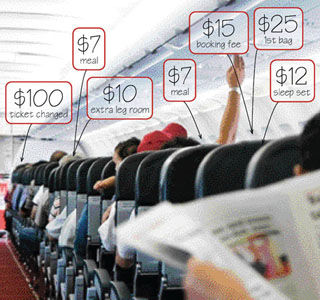 Airline revenue from a la carte fees associated with services such as baggage, premium seating and onboard food and beverages almost quadrupled, to $10.3 billion, in two years. American, United and Delta raked in more than $1 billion each, according to the IdeaWorks consultancy.
The surge in revenue from ancillary fees has been matched by the challenges of keeping up with all of them. In addition to baggage, each airline has its own fee policy for items such as meals, premium seating, blankets, WiFi and unaccompanied minors.
Things get even more complicated when factoring in whose policies apply in codeshare agreements between two carriers and international-travel issues such as whether the weight limit on a bag should be measured in pounds or kilograms.
Even something as simple as taking a single bag on a United international flight gets complicated quickly. The fee is determined by a combination of baggage weight, direction of travel, ticket class, the date the ticket was purchased, the date of travel and whether the bag will be registered at the airport or ahead of time on United's website.
The proliferation of such charges exacerbates an already challenging customer service environment, said PhoCusWright analyst Douglas Quinby.
"These are fees that airlines attach to services that were once part of the core airline service, and they're imposing them on infrequent travelers," Quinby said. "The general perception among travelers is that airlines are always trying to stick it to them."
Making the situation worse is an information vacuum that often makes new fees an unpleasant surprise for travelers when they get to the airport, said Paul Hesser, Travelport's vice president of advertising and merchandising solutions.
"The airlines are feeling the brunt of the customer satisfaction issues caused by that information not being available in the marketplace," Hesser said. "If someone shows up and has to pay $20 a bag, they don't call Orbitz to complain; they complain to the gate agent."
Additionally, with billions of dollars in services being handled at the airport in ad-hoc form, suspicion keeps growing that airlines prefer to confine ancillary fee payments to their own websites and call centers, limiting the role (and appeal) of agents and OTAs. The fees also fuel questions about how OTAs and agents will be compensated even if they can fulfill such services through their GDSs.
For example, Ardolino said, helping his customers work their way through the maze of baggage fees "is additional work for me with no additional revenue. They'll come down here and sit with me for 30 minutes to save $5 on two bags."
Similarly, Quinby wondered: "What incentive does an Expedia have to invest in a direct connection with American Airlines if they're not getting compensated for it?"
Expedia's Schulze argued that airlines would be well advised to make their ancillary fees as transparent as possible. "The airlines' websites still only account for a third of their business, and it doesn't allow a traveler to compare standards across the industry," he said. "There's every reason to believe they will make [the information] broadly available, and with a low-cost infrastructure."
As for the assertion that airlines are nickel-and-diming customers, Cory Garner, director of merchandising strategy at American, said carriers were merely providing myriad optional services to enable them to better serve customers by giving flyers opportunities to customize their flight preferences. Additionally, many airlines are trying to attract travelers to their frequent-flyer programs by including many of the services gratis that are being charged to occasional economy travelers.
"The airline business, for better or worse, has gotten a reputation of being a commodity," Garner said. "What we're learning is that as carriers break their product apart, the value proposition can be quite different. The customer will ultimately have more control over the shopping experience."
When that will happen, though, will depend on the standards that the GDSs and ARC are attempting to establish this year.
Last fall, ARC and American began developing an Electronic Miscellaneous Document, which is essentially an e-ticket for ancillary services and an updated version of the paper-based Miscellaneous Charges Order that agents already use. The first phase may be completed by the end of September, according to Mike Premo, ARC vice president of sales and marketing, who added that ARC's investment in the process is "a number with two commas in it" but declined to be more specific.
Premo stressed that it's very early in a multiphase process, noting that e-ticketing standards, which were first introduced in 1996, weren't fully adopted globally until last year, and that full implementation of an Electronic Miscellaneous Document across the industry will likely take a few years.
IATA estimates that, once implemented, Electronic Miscellaneous Documents will result in travel-related cost savings of $2.9 billion a year. With such standards expected to be fully rolled out by 2012, IATA has set an adoption deadline of 2013.
Steve Lott, North American spokesman for IATA, said, "There needs to be a deadline in order to give a boost to the industry and make sure there's momentum. Without the deadlines, some airlines may lag behind. It's really up to airlines working in cooperation with the GDSs to make sure that link is in place."
Meanwhile, Travelport, which owns Worldspan, Galileo and Apollo, has been working with the Airline Tariff Publishing Co. for almost two years to develop fee-publication standards.
Travelport's Hesser said the company expected to have a pricing clearinghouse of sorts in place within the next couple of months, so that GDS customers will at least be able to better price ancillary services, even if they can't immediately book them.
As for Sabre, spokesman Michael Brophy said that the GDS's Attribute Based Shopping project, which will let agents price and fulfill ancillary services, will be released later this year. Sabre's Flight Fee Explorer website, which outlines domestic and international ancillary fee charges for 60 carriers, was launched in December.
Meanwhile, Hesser said Travelport has been "spending a good amount of time on this issue because we believe it's going to be pervasive in the market. Our travel agents will be able to do a lot of those transactions in the second half of the year."
Industry professionals hope such standards will simplify the process of shopping for, purchasing and accounting for an array of ancillary services that is expected to continue as long as the unbundling trend produces results.
And the results are obvious. United started charging economy passengers a $25 fee each way for a second checked bag in May 2008. Two months later, US Airways and American followed suit, with American charging $15 for an economy passenger's first bag and $25 for the second.
The strategy worked. During Q3 2009, baggage fees for Continental, Delta, United and US Airways averaged about $7.42 per passenger, about eight times the average two years earlier, according to IdeaWorks. While ancillary fee revenue for 2009 -- the first full year airlines such as United and American charged economy-class passengers for first and second bags -- hasn't been calculated, the jump on per-passenger baggage fees suggests that the total likely dwarfed the $10.3 billion collected in 2008.
"Airlines put baggage fees in place during a time of desperation, when oil was $140 a barrel," said Expedia's Schulze. "The impressive amount generated by the fees has accelerated their push into a la carte pricing."
The airlines continue to tweak their strategies. For example, in October, United started offering annual $249 "subscriptions" that allow customers to fly for a year with two checked bags.
Some airlines have taken a different approach, re-bundling various services into a la carte classes. Air Canada, for example, has five fee classes allowing for inclusions of various services such as checked bags, airport-lounge access, priority check-in, ticket change-fee waivers and onboard meal services.
Meanwhile, low-cost airlines Southwest and JetBlue have used other airlines' baggage-fee charges as a marketing tool with ad campaigns highlighting their own policy of not charging for checked bags. JetBlue passengers can check their first bag free and pay $30 for a second bag; Southwest allows two free checked bags and charges $50 for the third.
Quinby predicts that in the future, airlines will start focusing on value-added services such as free WiFi once they settle on "hostage"-type fees such as mandatory baggage charges.
For example, Continental this month will be giving economy-class customers the option of paying a fee for seats with extra leg room, positioning the option as a way of providing "higher-value seats" for "customers who recognize that value."
All of which makes the concept of ancillary fees a moving target and determining what Schulze calls "the true cost of travel" ever more challenging.
Moreover, pricing is only going to get more complicated, Quinby predicted.
"What's really going to be interesting is when airlines migrate from tacking on ancillary fees to adding value-added services," he said. The pricing and shopping systems that Travelport and Sabre plan to establish later this year are "likely to be the near-term solutions, but that's certainly not going to stop airlines from offering different approaches and options via their own distribution channels."