As states across the U.S. grapple with huge budget gaps, their tourism offices find themselves fighting for funding amid increasing pressure to justify their role as generators of jobs and revenue.
One has already lost the battle: The Washington State Tourism Office, a victim of the budget ax, is preparing to shut down on June 30, leaving Washington the only state in the country without a tourism office.
Last year, Washington tourism executives, anticipating a drastic funding cut or outright elimination of the tourism office for the 2012-13 fiscal year, began discussing starting a private-industry marketing organization to fill the void.
This spring's decision by Gov. Chris Gregoire to eliminate the office’s $3 million budget for 2011-12, a year earlier than anticipated, came as a shock, prompting urgent meetings of the fledgling private organization known as the Washington Tourism Alliance.
Meanwhile, the tourism office, whose staff had already been cut in half, from six to three, is promoting its last campaign: "Share Your Washington."
"It's a shame," said Marsha Massey, the tourism office's executive director. "But there were a lot of difficult financial decisions that the governor had to make because we’re facing a $5 billion budget deficit. This was one of them."
In an attempt to continue operating the state tourism website and call center beyond June 30, the alliance is seeking contributions from tourism-related businesses. Other work simply won't get done, including participating in the National Tour Association's convention and other travel industry trade shows, fams and press tours.
In 2010, visitors to Washington spent an estimated $15.2 billion, a 7.4% increase over 2009 and the second-best year on record.
The alliance is looking at various business models for a permanent, privately funded state tourism agency, said Cheryl Kilday, president and CEO of the Spokane Regional Convention and Visitors Bureau, which contributed $5,000 to the alliance's fund to keep the website and call center operating.
"We want to make sure that consumers don't forget about Washington," she said. "We are talking about finding and securing a sustainable model for tourism funding that would be competitive with other states."
Under consideration are industry assessment models that California and Alaska use to finance tourism promotion.
"The industry is going to have to come together in some fashion," Massey said. "The alliance will be talking to the legislature about legislation that they might need to get something going. They've already had a really strong response."
Washington is the most dramatic example of how state budget crises are affecting tourism promotion, said Nan Marchand, the U.S. Travel Association's senior director of national council relations. But not all state tourism offices are worse off than before.
Decreases may have 'stabilized'
"It's a pleasant surprise, but governments are realizing the importance of investing in tourism marketing and the [return on investment]," Marchand said.
U.S. Travel is in the midst of collecting its annual data from state tourism offices regarding funding levels for 2010-2011. Marchand said early indications suggested that funding decreases have stabilized.
That stands in stark contrast, she said, to the results of the survey that was conducted this time last year. In the 2009-10 fiscal year, 35 state tourism offices saw cuts that averaged 11% of the previous year's budget.
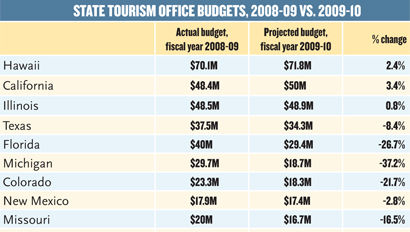
Thus far, of the 26 states that have reported 2010-11 budget figures to U.S. Travel, only 11 saw their funding reduced. (Click on the image to view a complete version of a chart of the budget figures.)
"The rest are telling us that they have either gotten an increase or are flat," Marchand said. "We're not seeing the dramatic decreases of the past."
New private-public partnerships are also helping to keep funding at steady levels, she said.
"Because of the financial crisis the industry is realizing they need more than the old model of being dependent on revenues that are not stable," she said. "They are looking at different ways of funding, and it's often a combination of public and private funding. The most important message is that you need to have consistency when marketing a destination, and you have to find a consistent funding mechanism."
According to U.S. Travel's 2009-10 budget report on state tourism offices, the public sector is the primary source of funding for the majority of state tourism offices and the sole source for 29 of the 49 states that reported their budgets.
Of the 20 states where public funding is combined with private-sector funding, public money represents 71% of the combined budgets. However, the percentage of public sector funds for those states ranges widely: from 99.9% to 1.9% of their total budgets.
In California, whose state Travel and Tourism Commission is often cited as a model for public-private partnerships, only $900,000 of this year’s $55 million tourism promotion budget comes from the state’s general fund. The rest is derived from a car rental tax and assessments of California travel and tourism businesses.
U.S. Travel's budget survey, however, covers last year and not the upcoming fiscal year, which may see states adopt more draconian cuts. Among those state tourism offices that will have to cope with less public sector money is the Hawaii Tourism Authority, whose budget has been capped from fiscal year 2012 through fiscal year 2015 at $69.1 million. The HTA's budget for 2011 was $81.5 million.
Mike McCartney, president and CEO of the HTA, said the decline was not as drastic as it appeared because the legislature had given the HTA a one-time extra boost in funding last year to counter the effects of the economic downturn.
"So the reduction to $69 million is not as dramatic as it may seem," he said. "We're going to be more efficient and more creative and do more with less."
Reprieve for Visit Florida
Meanwhile, the Florida tourism industry received good news after several nail-biting weeks, when the legislature scrapped a proposal to move the state’s public-private funded tourism office, Visit Florida, into a new jobs agency, where its funding would have been pooled with other industries.
After an outcry from the travel and tourism industry, it was decided that Visit Florida would remain relatively autonomous under a new Department of Economic Opportunity. On top of that, it got a pleasant surprise: an extra $8 million.
Combined with its other funding, which is derived from a car rental tax and voluntary industry contributions, the Florida agency's 2011-12 budget will total $90 million.
"We have a governor and legislature that understand the importance of the tourism industry even though we are facing a $4 billion deficit," said Chris Thompson, president and CEO of Visit Florida. "They see that tourism is the foundation of the Florida economy and is the reason the deficit is not worse."
The extra money will be spread among Visit Florida initiatives, including international marketing and the "Your Florida Side" TV ad campaign.
Gary Sain, president of the Orlando/Orange County Convention and Visitors Bureau, said the Florida battle demonstrated the strength of the industry, which generates nearly a quarter of the state's sales tax revenue and employs nearly 1 million state residents.
"It's important for travel and tourism officials to tell a very compelling story, because you are competing with other industries for dollars," Sain said.
"We told that story: that travel and tourism is the No. 1 economic driver for Florida and for every 85 incremental visitors, we create one new job. Tallahassee heard our voices."