The proliferation of third-party online sales entities is causing hotels’ digital-distribution costs to rise far faster than revenue growth, and far faster than previously forecasted, pushing hotel owners to consider paying commissions based on a scale that emphasizes their margins rather than volume, according to a leading industry researcher.
Tying compensation to the margins realized by suppliers is a formula that is already showing up in the cruise industry, in airline frequent flyer rewards programs and in preferred-supplier agreements with consortia and other agency groups.
What could drive hotels to follow that lead is the fact that, according to new research by Kalibri Labs, the cost of acquiring hotel customers through marketing and distribution channels is rising at twice the rate of hotel revenue growth, a trend that is not sustainable, even during the recovery.
Kalibri CEO Cindy Estis Green said that among the options the lodging industry will have to consider to slow that trajectory is adopting a sliding commission scale for agents, a practice known as value-based booking.
“I anticipate a time when commission ranges will flex depending on the day of week, time of year, lead time or other factors that influence the value of the booking,” Green said. “This method will ultimately result in lower acquisition costs for hotels and will create an incentive for business providers to work with hotels on getting them the type of business they need when they need it.”
For example, Green said, one option would be to pay agents commissions that range from 5% to 15% depending on the value of the booking to the hotel.
She and Kalibri Labs are researching acquisition costs for the Hospitality Asset Managers Association, which represents hotel owners.
Green’s data were derived from an ongoing follow-up to her 2012 Distribution Channel Analysis study, which predicted a doubling by 2015 of distribution costs in the form of discounts and commissions.
The research shows that customer acquisition costs are rising at twice the rate of revenue growth.
This is happening, she said, “at a time when the recovery should be bringing efficiencies in acquisition, not cost growth exceeding revenue growth by a 2-to-1 margin.”
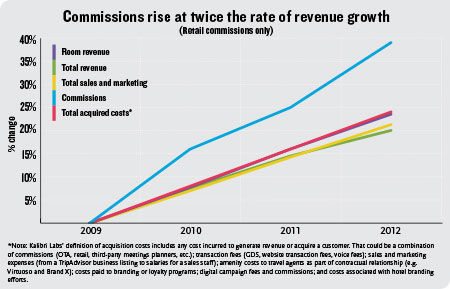 Green’s definition of acquisition costs includes any cost incurred to generate revenue or acquire a customer (see note in chart at left).
While the research suggests that some of these costs, such as OTA and agent commissions, might be going down, Green contends that overall costs are rising too quickly.
While hotels might only have been paying 10% to 20% for OTA/agent commissions in the past, now they are paying out to all types of business. If a downturn comes, this situation could get even worse; as Green noted, “In 2009, hotels were throwing 35%-plus margins at OTAs.”
Hotels have to do a better job, she said, of agreeing to terms with partners that align with business value, and their partners have to understand that they might get paid in line with what they deliver. If evaluated properly, all channel partners will be scrutinized based on profit contribution or net revenue produced, rather than on generic room nights or top-line revenue.
The industry itself has been making efforts to stem the third-party tide, including the launch of RoomKey.com in 2012 by some of the largest hotel companies, including Marriott, InterContinental, Hyatt, Wyndham, Choice and Hilton. Inventory from other chains as well as independent hotels is also available on RoomKey.com, with that list continuing to grow.
Since its introduction, RoomKey.com has expanded. There now is a “Today’s Deals” section that evaluates properties based on pricing plus loyalty. A points system, now in beta, aggregates loyalty points from multiple brands. Also, Room Key said it will adopt a design that delivers a browser-friendly experience for mobile users.
RoomKey.com, whose primary strategy is to capture travelers leaving the brands’ own sites, now offers more than 70,000 hotels representing more than 100 brands in 159 countries.
In 2012, Green estimated that by 2015, digital distribution costs would almost double, to $7.5 billion. Given PhoCusWright’s projection that 2015 U.S. lodging revenue would total about $140 billion, that means hotels are spending about 5.4% of their revenue on digital distribution.
At the time, she also predicted that half of all business would come through third parties.
Both predictions, she said, might have been understated. While hotel brands have made significant efforts to drive customers to their own websites, Green indicated that that objective might be “a dated paradigm.”
The reason, she said, is that although brands’ own bookings are assumed to be relatively low-cost, consumers might be stopping at five or six sites along the way, each one commanding a commission or other transaction cost from the hotel.
However, the landscape is also changing in ways that Green said might benefit both hotels and agents.
“It’s no longer just about OTAs,” she said. “There are dozens, even hundreds of new players entering the space, probably because of the attraction of how much money the OTAs are extracting from hotels. These new players, like Google and TripAdvisor — and possibly Apple, Facebook and Amazon — are mainly offering metasearch and are competing heavily with the OTAs.”
Each of those players, she said, will succeed in carving out some share of the OTAs’ business.
“How much remains to be seen,” she said. “This can be good for hotels, and for consumers, if the hotels protect their margins in these new deals so they don’t leave themselves vulnerable in terms of profit contribution. They can’t afford to pay the high rates to all and sustain another downturn. Operators have gotten very good at managing their operating and labor costs but have not yet started to systematically manage customer-acquisition costs.”
Breaking the 10% standard
In terms of traditional agencies, Green said, there is a lot of opportunity because of the sheer proliferation of booking options.
“We have had such a simplistic view of the way hotels pay incentives to their business providers,” she said. “For retail agents, it’s always been a simple, blanket 10% except for occasional overrides or amenities for clients that push that up, sometimes close to OTA levels.”
Today, she said, “There are so many more choices in channel partners that hotels will be able to decide which ones produce the most valuable business at the lowest cost.”
That plethora of choices, she said, “makes travel agents a more viable alternative to be examined very closely alongside all the digital options.”
Green said her next report will be a major update but also the start of an ongoing reading of what’s going on in the industry in terms of tracking customer acquisition costs and profit contribution.
“We hope to be able to do a snapshot every quarter as a way to keep a finger on the pulse much more closely,” she said, adding that she will be sharing her data with the industry on a regular basis to help with initiatives in the area of managing distribution costs.
The American Hotel & Lodging Association is also looking into those costs, and a number of brand and management companies have joined its effort to deal with this issue, which is front and center for hotel operators.
As Green recently told a roundtable of chief revenue officers organized by the Hospitality Sales & Marketing Association International, among online third-party channels, “there are now booking brands and stay brands. Hotels don’t just pay for transactions but for a presence on these sites. Stay brands have to pay to get the bookings, then have to pay again to compete with each other on the basis of the stay experience. They pay twice — and pay a lot.”
On the other hand, booking brands, she said, “now have much higher market valuations than stay brands. They have grown their market capitalization on the backs of the hotel industry. Three-quarters of their business comes through hotels — not air, car or anything else. Their revenue is the hotel industry’s expense.”
For consumers, Green said, “The payoff is that if hotels can save those distribution costs, they will be able to invest in their product rather than cut back on services and facilities; they will have a more sustainable level of profit that will translate into better hotels.”