Ian Schrager’s accent is pure Big Apple, but the hotelier’s appreciation for the Windy City, from both a personal and business standpoint, is just as unmistakable.
“I’ve grown to really like the city,” said Schrager, who last month opened his first Public brand hotel in his wife’s hometown. “You can’t have a credible hotel company without having a hotel in Chicago.”
 More hotel executives appear to feel the same way, which is why Chicago is emerging as a test market of sorts for new brands.
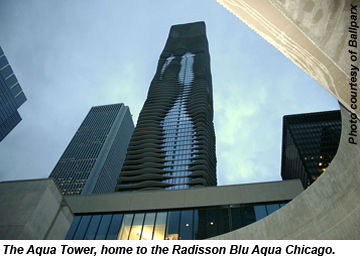
This month, Carlson Hotels opened the first Radisson Blu hotel in North America. The 334-room Radisson Blu Aqua Hotel Chicago takes up the first 18 floors of the 81-story Aqua Tower.
And last month, Virgin Hotels, a brand launched last year by Virgin Group Chairman Richard Branson, announced that it would open its first hotel in Chicago in fall 2013.
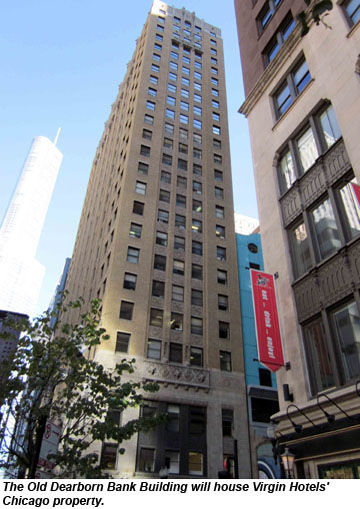
Virgin partnered with John Buck Co., the developer of Chicago’s Palomar Hotel and New York’s Standard Hotel, to acquire the Old Dearborn Bank Building in the city’s Loop.
The 27-story structure, which was built in 1928, will house a 250-room hotel, which will precede other hotels in Los Angeles, New York, Miami, San Francisco, Washington and London that are in the development pipeline.
Virgin made that announcement just as Schrager was opening the 285-room Public in what had been the Ambassador East Hotel. Built in 1926, the Ambassador East was known for its Pump Room restaurant, which hosted celebrities ranging from Humphrey Bogart to Queen Elizabeth. Schrager retained the Pump Room name for the Public Chicago.
Chicago is a natural for hotel companies looking to test a new product. The city attracts more than 40 million people a year and is home to McCormick Place, the largest convention center in the U.S. Add to that Chicago’s museums, tourist attractions and architectural masterpieces, and the Windy City draws myriad business and leisure visitors. 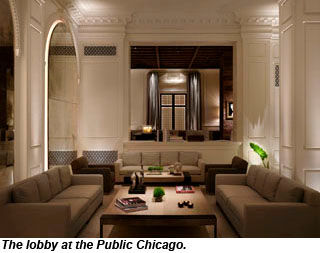
“Chicago is a lot cheaper to get into than New York, and it’s gotten more upscale in recent years as the leisure side of the city has gained traction,” said Bruce Baltin, senior vice president of PKF Consulting.
Baltin noted that Chicago occupancy rates typically run 10% to 15% less than New York’s.
“The economics are different because of the weather patterns, but you build to that specification,” he said. “It doesn’t have as high of a luxury segment, but it’s a very deep market.”
Like the city’s image, Chicago’s performance this year in terms of revenue growth is solid but not flashy. Through the first nine months of the year, Chicago hotels’ revenue per available room rose 8.9% from a year earlier, reflecting a faster growth rate than the U.S. as a whole but slower growth than the 25 largest U.S. markets, according to STR.
Meanwhile, Chicago’s average room rate of $115.59 marked a healthy 4.9% gain from a year earlier but still trailed rates in markets such as Boston, Los Angeles, New Orleans and Seattle.
Still, real estate is cheaper in Chicago than in cities such as New York, Los Angeles and San Francisco.
The W Chicago City Center, the only Chicago hotel to show up on Jones Lang LaSalle Hotels’ list of largest U.S. hotel transactions during the first half of the year, fetched $350,000 a room. That was about $120,000 per room less than what New York’s Radisson Lexington New York and Yotel sold for; it’s about $220,000 per room less than the selling price of the Mondrian Los Angeles.
Meanwhile, the city attracts enough sophisticated tourists to its restaurants, museums and arts and cultural offerings for hotels to be more ambitious with their concepts, Baltin said. That’s likely why Schrager can keep much of the boutique hotel sensibility at the Public Chicago with starting rates less than $200 a night — at least $100 a night less than rates at the boutique hotels he helped popularize.
Granted, the Chicago debuts might have as much to do with luck and happenstance as with any grand plan to launch U.S. operations in the largest city in the Midwest.
For example, Schrager bought what was essentially a distressed property last year, capitalizing on its location, history and bones. Carlson decided on the Aqua Tower site for the first U.S. Radisson Blu when another proposed developer for the hotel couldn’t secure financing, said Thorsten Kirschke, president of Carlson Hotels, Americas.
Still, both Kirschke and Schrager say Chicago’s steady tourist and business clientele will enable them to properly assess what works and doesn’t work for the new brands as they’re rolled out throughout the Midwest for Radisson Blu and in cities like New York and London for Public.
“It is a market that is extremely well-balanced,” Kirschke said, adding that many of the early Radisson-branded hotels were developed in the Midwest. “It’s a market where you can still get enough visibility on launch as opposed to other cities on the coast, which are more frequently hyped.”