 They may not be army combatants or war correspondents, but when high-profile tourism destinations like Egypt and Mexico experience unrest, travel sellers often find themselves on the front lines of global crises as they head to the distressed destinations to determine their suitability for travelers.
"One of a good travel adviser's roles is to provide an exceptional return on a vacation experience for their clients," said Tony Gonchar, CEO of ASTA. "Part of that client valuation is personal safety, along with many other elements of the experience, like on-site experiences, comfort, cuisine, etc.
"There are increasing expectations that travel advisers will have deep product knowledge and experience with the destinations they are recommending to their customers. Firsthand destination experience is important for any travel adviser to help pick the right destination for their clients."
But what if that firsthand destination experience means going to Egypt at a time when the political situation is uncertain and protests can continue to flare up?
Or heading to Japan when there continue to be aftershocks and murky nuclear risks?
Or traveling around Mexico to get a better sense of how well the resort destinations are insulated from drug-cartel violence?
Describing the risks of heading to places where traveler security is questionable, Suzanne Terry of Boca Raton, Fla.-based Blue Sky Excursions, a Travel Experts retailer, said, "Truthfully, when I've been to most of these destinations there are no problems. I'm going to Israel in four days ... and I wouldn't go if it weren't safe."
Terry said that when talking to clients about destinations where there are security concerns, "having been there and experiencing the destination is very important."
Helping clients decide if they would feel safe traveling somewhere is, indeed, part of the overall evaluation of whether that destination is right for a particular client. And for many agents, that means going there themselves.
"Agents' firsthand experience in a destination is what can make or break their ability to send the right customer to the right area at the right time," said Libbie Rice, co-president of Ensemble Travel Group.
 For example, Egypt prior to the revolution was a thriving destination, and many travel agents sent scores of Americans there.
While it's unlikely Egypt's tourism industry will rebound completely this year following the at-times violent revolution and subsequent evacuation of hordes of international tourists, agents who want to get the jump on promoting the destination have already gone there, hoping to instill confidence in traveling to the country.
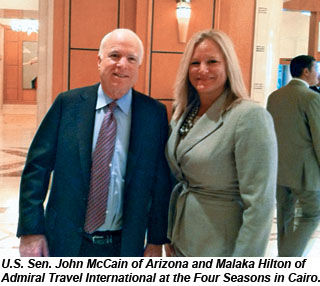
"Egypt is my specialty," said Malaka Hilton, CEO of Sarasota, Fla.-based Admiral Travel International. "I have an Egyptian father, and I've been traveling there ever since I was 4 years old." Last month, Hilton went to Egypt and Jordan with representatives from the travel industry, including executives from the National Tour Association, the U.S. Tour Operators Association and ASTA.
Before that, she had been in Egypt in January and had left the country just four days before the start of the revolution. She said she felt she needed to go back after the uprisings to see the changes the country had undergone and to report those changes back to both prospective clients and travel industry colleagues.
"I needed to do it for the country of Egypt," said Hilton, for whom Egypt represents about 25% of her total business. "With my reputation in this industry, people look to me and ask me, 'What do you think about Egypt?' I know that I can be a big voice for support to bring the tourism back."
Armed to counter negative news
As major tourism destinations such as Egypt and Mexico battle with political and criminal upheavals, and as Japan recovers from massive natural disasters, agents find themselves up against negative news reports, sometimes-confusing U.S. State Department travel warnings and concerned clients. Many are finding first-person reports from the field to be their best line of defense.
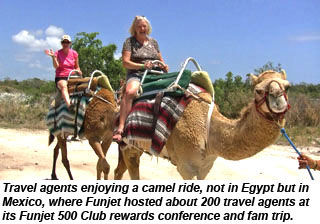
 "You combat emotions and fear with facts," said Mike Going, president of Funjet Vacations, which last month hosted about 200 travel agents at the Funjet 500 Club rewards conference and fam trip in the Riviera Maya. The event was intended to help arm agents with firsthand information and experience that will help them sell Mexico by countering ongoing reports of drug-related violence in parts of the country.
He touted how powerful agent testimonials from the destination can be, giving agents the ability to tell their clients "I was there, and it was wonderful."
Throughout the conference, Funjet had a film crew on hand to shoot on-site agent testimonials, something they could then show clients to instill a very personal level of confidence and security.
Adamarie King, who owns Connoisseur's Travel in Chicago, a Travel Experts agency, now spends most of the year at her home in Mexico. Residing there has helped her work with clients to overcome fears and hesitations about the destination.
There are some clients who call King "because they know that I'm a Mexico specialist. So, that one hurdle is over. Then I get the clients that are looking for the honeymoon, the family trip. In both cases, it's an incredible credibility booster that I live here."
King said that last year she got a lot of inquiries about Mexico, "and I converted many more to sales than if I hadn't lived here." But she admitted that as negative news coverage has continued to flow, "this year has been tougher than last year. ... I have encountered that resistance."
'I don't scare easily'
Not a single travel agent or travel industry executive interviewed for this report admitted to ever being nervous or fearful when traveling to countries that have experienced unrest, either this year or in the past, in order to see for themselves what the destination feels like.
"I don't really scare easily," said Lisa Simon, president of NTA, who also traveled to Egypt and Jordan last month on the same trip as Hilton. Simon said that from what she had heard from ground operators and the Egypt Tourist Authority, she wasn't worried about heading to the country post-revolution.
Simon said that no one in the group was nervous. That might have been because of the intrepid nature of travel sellers and tour operators, but the bottom line, she said, is that agents and operators "don't want to assure that someplace is safe if they're not certain."
While many travel sellers, especially those who are particularly invested or who specialize in certain destinations, won't be satisfied until they see for themselves what the situation on the ground is, others have built up a sophisticated network of trusted contacts on the ground that can serve the same purpose.
Reliable partners on the ground
 "Travel agents need reliable partners that they can trust in the country," said Jeff Aasgaard of Commerce Township, Mich.-based Japan Roads. "Japan Roads has an office in Japan, and we know what is happening. Of course, a personal visit is always best, but with a trusted partner that is not always necessary."
Aasgaard and his family visit Japan every summer, and they are going as scheduled despite the magnitude 9.0 earthquake in March. Aasgaard said he's "not at all" worried about traveling there based on everything he's heard from friends, family and colleagues.
Peggy Mikuni of the Los Angeles-based Yamato Travel Bureau, recalled, "I myself had to leave for Paris the very morning after the earthquake. The media was very strong in their coverage of the damaged area. But in other parts of Japan, we were getting reports that it was safe to go there. ... Clients were reading and hearing what the media was writing, so they were apprehensive about going. But we kept calling our suppliers and friends, who assured us that it was not that bad in other areas."
Mikuni said she felt confident in her knowledge of the situation in Japan even though she had not gone back since the earthquake.
"Because we were in close contact with our friends, ground operators and other suppliers, I have never felt the need to go and see for myself what the situation is," she said.
Organizations such as ASTA, agency consortia and larger agency networks also have numerous programs to help agents share their insight and destination knowledge to alleviate the pressure on individual agents to get to the destinations in question.
A liability issue
Even if and when agents do go do their own reconnaissance in destinations where the situation is uncertain, Ensemble's Rice warns that they should never push clients who are hesitant to go.
"At the end of the day, the client has to make their own decision whether to travel or not," Rice said. "Agents cannot tell them any destination is safe. When dealing with tough destination questions, agents should never try to convince, coerce or argue with the client who has a specific, emotional, physiological or physical fear."
 Agents who have experience working with destinations that can evoke worry on the part of travelers have a good sense of which clients just need a little reassurance and which aren't appropriate to pitch.
"If someone is really afraid to go somewhere, I won't try to sway them," said Terry of Blue Sky Excursions.
ASTA's Gonchar recommends that agents work closely with clients to evaluate the risks of traveling to any destination.
"Great travel advisers speak openly and directly with their client about risk tolerances and comfort levels with the different destinations they are exploring together," Gonchar said.
He noted that agents can provide valuable recommendations for trip-cancellation insurance policies, and "in cases where there are perceived or actual risks, the adviser will make recommendations about mitigating that risk based on their client's comfort level, whether it is choosing a different destination or limiting the geographic area they will visit."