 The rapidly growing China source market presents outsized opportunity, but with a host of new guidelines and parameters, U.S. tour operators and suppliers that aspire to play in this space are going to need patience and perseverance to get a foothold in the marketplace.
In the last year alone, China issued its first law dedicated to the tourism sector, crafted a path for how the tourism industry should be developed in order to create economic stimulus and improve the quality of life in China, and implemented a quality assurance program to certify travel companies that work with the China market based on a number of best-practices criteria.
The law, a 10-chapter document titled “Tourism Law of the People’s Republic of China,” went into effect Oct. 1. It addresses everything from the conduct of tour guides to safety guidelines and shopping arrangements.
For example, the law stipulates that travel agencies cannot offer tours at below-market prices and then force travelers into shopping arrangements for which the agencies receive kickbacks.
The law also notes that travel sellers need to prepare a paper contract for travelers that details the group size; type of transportation, accommodation, catering and other travel services; activity and entertainment times; free-time arrangements; travel costs, payment methods and payment deadlines; liability for breach of contract and dispute resolution methods, among several other stipulations.
“The new law is basically to regulate the industry,” said Haybina Hao, director of international development for the National Tour Association (NTA), which oversees the China Inbound Program. The program was set up to facilitate inbound leisure travel to the U.S. from China through a list of approved U.S. ground operators.
The impact of the law was immediate, Hao said. She noted that with its release in October, the market quickly contracted, as several companies took a step back in order to better understand the law and its implications. Additionally, tour prices for Chinese travelers to the U.S. instantly went up with the law requiring that there essentially be no hidden prices such as forced shopping excursions. (For details about the law, travel companies can contact the NTA.)
More and better travel
The law is part of a larger movement in China to embrace travel and its potential positive economic impact.
Along those lines, on Feb. 18, 2013, the government released “Outlines of Chinese Citizens Travel Initiatives 2013-2020,” a government document that emphasized travel’s role in boosting the nation’s economy as well as citizens’ quality of life.
The government vowed to build and expand airports, highways, hotels and attractions; increase paid leave for workers; increase tax deductions for company incentive-and-conference travel; and let schools expand current student travel opportunities beyond summer and winter breaks.
Here in the U.S., “We finally realized that travel and tourism is a huge economic pillar if we do it right, and the Chinese government realized the same thing,” Hao said.
But the path to creating a more mature inbound leisure China travel market to the U.S. has not been easy.
The floodgates of Chinese leisure travel to the U.S. opened after a 2007 memorandum of understanding between the U.S. and China allowed group leisure travel from China to the U.S. for the first time.
In 2008, the China National Tourism Administration (CNTA) appointed the NTA to assemble a list of U.S. operators approved to work with Chinese touris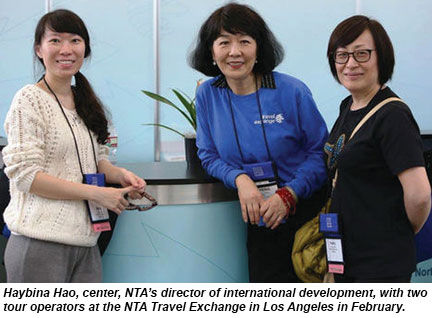 ts. That program became known as the NTA China Inbound Program, which currently has 164 registered members.
Initially, the program ran into challenges, namely in regulating the safety and quality standards of the tour operators on the list. The NTA created stricter criteria for operators on the list, but regulation and enforcement remained a challenge.
In addition to concerns about motorcoach safety — an issue that came to light after a deadly crash in 2009 in which six Chinese tourists and their guide were killed — there were reports that low-cost operators were taking advantage of an inexperienced and cost-conscious Chinese traveling public, luring them in with bargain-basement prices, then shuttling them between substandard hotels and forced shopping situations.
China’s new law attempts to address some of those market challenges head-on, as does the China Outbound Tourism Quality Service Certification (QSC) Program that was implemented in November by the CNTA.
The program is being executed by Ivy Alliance, a tourism consulting firm based in Beijing. A long list of criteria — including the number of years in business, reputation, fair pricing, equal treatment of Chinese travelers, safety standards and a commitment to quality service — are used to qualify tour operators and suppliers who want to be certified for the QSC Program.
Certified suppliers will be issued QSC labels and logos that they can use in their marketing materials and at their place of business, and their company name will appear on the list of certified suppliers on the QSC website (www.qualitytourism.cn). The QSC Program is a way of identifying operators and suppliers that meet a quality standard but is not a requirement in working with the Chinese travel market.
“This market is an evolving market and there are many layers,” said Hao. With all these new initiatives in place, “in the long run [the product] will definitely improve.”
Photo of Great Wall of China courtesy of Shutterstock.com.