Despite the pervasive pessimism washing through the travel industry, not all destinations are expecting a drop in visitors in 2009. Even as leisure travelers hold off or cut back on their vacation plans, a few spots still glow. Chief among them is South America.
"In a year when flat is the new up, South America is actually up," said Melissa Snape, vice president of product at Collette Vacations, whose 2009 bookings for the continent are trending 30% ahead of last year.
South America represents only a small percentage of Collette's business, but as its popularity continues to grow at a time when most other destinations are stalling, it is becoming an increasingly important piece of the travel pie. This year, South America is increasing from under 6% of Collette's overall business to about 7%.
"For people who look for these really long-haul, exotic destinations, South America is sort of this unique in-between," Snape said. "The dollar down there buys a lot. It's a lot less travel time." And at a time when people are nervous about job security and uncomfortable about taking a 21-day vacation, she said, "in a place like Peru, you can get away with 10 days."
According to a January report from the United Nations World Tourism Organization, international leisure arrivals to South America in 2008 increased by 5.9%, to 21.1 million, compared with 2007. That growth is only slightly lower than the 6.4% increase in 2007 over 2006.
Amazingly, South America saw an increase in tourist arrivals last year of 8.3% between July and December, which actually surpassed its January-to-June growth of 4.7%.
Europe, in contrast, was up just 0.1% last year, Asia-Pacific grew 1.6% and Africa grew 4.6%, according to the UNWTO.
The only destinations that saw greater growth than South America were Central America, up 7.9%, to 8.4 million international tourist arrivals, and the Middle East, whose 52.9 million international tourist arrivals represented an 11.3% increase over 2007.
 Tom Armstrong, corporate communications manager for Tauck Worldwide Discovery, also said that demand for South America products remains strong, "which is indeed something positive."
"We've added two new itineraries there recently, one in 2008 and another one this year, so our timing has been good," he said.
The global economic crisis appears to have simply slowed South America's momentum, rather than halted or reversed it.
Travel Bound, a New York-based wholesaler, was seeing double- and even triple-digit increases in South America when the crisis hit.
General Manager Nico Zenner said that bookings for Ecuador were up 140.9% in 2008 over 2007, 58.3% in Brazil and 33.2% in Peru.
"We see some really healthy increases in Argentina, Brazil and Chile" in 2009 bookings, Zenner said.
The bottom line, said Jennifer Halboth, director of marketing for the Globus family of brands, is that South America is "doing a lot better than other destinations."
She added that while "obviously Europe is our big dog," there are several reasons why Globus' South America business was holding this year while other destinations were hurting.
"You're not flying across the ocean," Halboth said. "The lack of jet lag makes it easier for Americans."
She also cited "the value of the dollar, the variety of destinations" as contributing factors.
"In this environment, the people who are continuing to travel are traveling with a purpose," Halboth said. "And an exotic destination, a once-in-a-lifetime destination, is the kind of destination where people are saying, 'I'm doing this trip.' "
The rise of South America
The global recession struck last year at a time when key destinations in Europe, China and Central Africa were already weakened by economic and political upheaval. South America, in contrast, was in the midst of a boom period. Tour operators have been noticing increased interest in and demand for South America since 2003, when many of them started beefing up their South America programs.
Since Abercrombie & Kent opened its first South America office in 2000, "business has increased tenfold," said Mark Wheeler, A&K's regional managing director in South America.
And while Wheeler said that "business for 2009 is coming in more slowly," in December, A&K saw a 43% increase in bookings for Chile and Argentina and a 28% increase in Peru and Ecuador over December 2007.
 Collette has increased its South America portfolio from one itinerary -- Discover South America, which it has offered for two decades -- to eight itineraries, including an additional product this year.
Others have been similarly aggressive in the region.
"Over the last 10 years, people have gone from seeing it as an unsafe destination to a very sought-after destination," Snape said.
During the 1980s and 1990s, while Europe and Asia were developing their tourism industries in relative calm, South American countries were experiencing internal strife and producing headlines about social upheaval.
Drug cartels, military coups, political purges and criminal violence soured U.S. travelers on South America. A decade of attacks by Peru's Maoist rebel group, the Shining Path, and the counter-insurgency campaign took the lives of some 70,000 people.
Brazil was also rife with violent crime, including attacks on tourists, an image it has only recently shed.
As security came under control and negative headlines faded, however, demand increased and the tourism product began developing rapidly.
"We started our business 11 years ago, and every year [South America] has gotten better and better," said Monica Irauzqui, vice president of New York-based Yampu Latin America Tours.
She said that 2007 and 2008 were two of her best years in South America. "Every country has been adding all these nice products. Eleven years ago, most of our travelers were three-star; in the last few years, most of our travelers have been five-star and deluxe."
Many operators tout the improvement in tourism products, namely major hotel development and service enhancements, as a major benefit of working in South America.
Add to that equation perceived value: The dollar has been consistently strong in South America for the last several years, at a time when travelers are watching their pocketbooks more than ever.
"The fall in various South American currencies has hugely benefited U.S. clients with the spending power of the dollar increasing 48% in Chile, 22% in Argentina and 24% in Peru from exchange rate lows in 2008," said A&K's Wheeler, adding that the fact that Ecuador is a dollarized economy with no exchange rate concerns makes it especially attractive for U.S. travelers.
Meanwhile, Europe over the last few years has "gotten really expensive," Snape said. While the dollar is gaining strength in Europe, making it a much better value this year than last year, "it takes a lot of time to change people's perception," she said.
Asia presents perhaps better value than Europe or South America on the ground, but it requires a longer, more expensive flight, meaning that travelers need more time to get to and spend at a destination.
"You can get a direct flight from New York" to South America, Irauzqui said. "And you can [complete the trip] in seven days."
Individual country trends
 Five countries dominate South America's tourism landscape: Brazil, Argentina, Chile, Ecuador and Peru, though Uruguay, Bolivia and Venezuela appear to be on the rise.
In fact, the UNWTO listed Uruguay as one of just a handful of destinations anywhere that "showed very positive results in 2008."
Brazil and Argentina have traditionally been popular destinations because of the bustling European-influenced cities of Rio de Janeiro and Buenos Aires as well as the draw of their natural assets, such as the Iguazu waterfalls in Brazil and the picturesque Patagonia region of Argentina.
Argentina and Chile have benefited from the growing popularity of their wines, which have become the focus of some tour products.
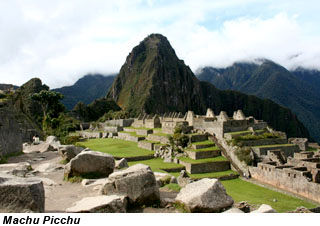
Ecuador's growth is tied tightly to the Galapagos Islands, while Peru owes much of its increase to Machu Picchu, the mountaintop Incan archaeological site that was named one of the New Seven Wonders of the World in 2007.
In fact, among countries that have established tourism industries, operators consistently cite Peru as the big-buzz South American destination of the moment.
The continent is also something of an economic paradox; while the rest of the globe is embroiled in economic turmoil, the United Nations' Economic Commission for Latin America and the Caribbean predicts that South America's economies, which have historically been among the world's most volatile, will actually grow in 2009.
The commission forecasts that Peru's economy will show the greatest growth in the region, with an anticipated 5% increase in gross domestic product in 2009.