Tanzania is offering assurances that a recently approved plan to build a highway across the Serengeti National Park will include consideration of the project’s environmental impact.
"We are all keen to preserve our natural resources. We will never compromise on that," Tanzania’s minister of natural resources and tourism, Shamsa Mwangunga, said in July in response to growing backlash against the highway project. "For this reason, the project will be subject to an environmental impact assessment."
Mwangunga’s statement comes amid harsh criticism from environmental groups and the travel industry following the Tanzanian government’s approval in June of a $480 million commercial highway that would link the cities of Arusha and Musoma, cutting directly across a narrow section of the northern Serengeti, according to the African Wildlife Foundation.
The 300-mile stretch would be completed by 2012, according to reports.
"We are, of course, very much opposed to the proposed highway across the Serengeti as is the whole of the tourist industry in Tanzania," said Aziz Hajee, Tanzania country manager for Big Five Tours & Expeditions. "There is an alternative route to the south of the Serengeti, which will not impact the national park and will, in fact, serve more people and villages and is a more sensible route."
Big Five is among a host of tour operators and travel companies rallying to have the 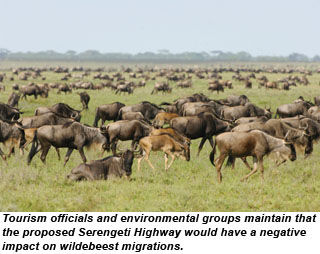 Tanzanian government reconsider the decision, namely due to concerns of severe and possibly permanent disruption of wildlife migrations that attract scores of tourists to the region each year.
"We sincerely believe that the road will have disastrous effects on the entire ecosystem," stated the Frankfurt Zoological Society, a nonprofit conservation organization involved in the Serengeti. According to the organization, the northern Serengeti and the adjacent Masai Mara are crucial to wildebeest and zebra migrations during the dry season as they are home to the only permanent, year-round water source for these herds.
The Frankfurt Zoological Society estimates that if wildebeest were to be cut off from these critical dry-season water supplies, the population could decline from 1.3 million animals to as few as 200,000.
In response to the proposed highway project, a coalition of concerned organizations joined forces to launch a website, SaveTheSerengeti.org, where as of this week more than 2,700 travel companies and tour operators had signed a petition to stop the project.
Additionally, a "Stop the Serengeti Highway" page has been launched on Facebook, with more than 10,000 followers.
"We are very concerned that the proposed road through the northern portion of the park could sever a critical corridor for the annual migration of hundreds of thousands of wildebeest and zebra," Pamela Lassers, director of media relations for Abercrombie & Kent, wrote in an email.
She said that A&K senior regional director, Auni Kanji, has been working closely with local tourism and conservation authorities on alternative routes to achieve similar goals, without threatening the national park.
"This highway project is a horrible idea," said Kent Redding, president of Africa Adventure Consultants. "It will certainly have negative environmental impacts and will negatively impact tourists’ experiences in northern Tanzania. I’m praying that the idea gets shelved."
At issue is balancing the business interests of Tanzania, which rely on new and efficient roads to better connect the country, with the country’s environmental and tourism interests.
"As a native of East Africa and as a tour operator, I ask the Tanzanian government to review this decision," said Mahen Sanghrajka, CEO of Big Five. "We must balance the needs of this vital ecosystem with the need of the people of Tanzania."
There is no indication of when the results of the highway’s environmental impact assessment will be made public by the Tanzanian government.