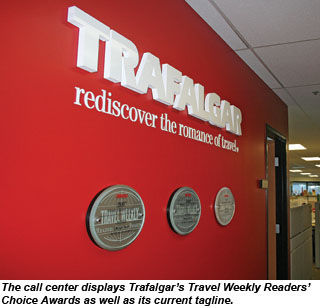
 For one of the country's largest tour operators, the call center presents a distinct challenge. While call center agents are among TravCorp USA's most important employees, on the front lines of assisting agents and making the sale, they tend to be younger people who don't stay longer than a few years.
Consequently, TravCorp is constantly looking at ways to retain talent as well as recruit and train new staff capable of engaging in quality interactions with travel agents, despite being relatively new to the company or industry.
A frequent result is a younger reservations agent answering calls from seasoned, older travel agents. Whether the result is frustrating or satisfying will depend on both the quality of the training and the individual skill sets and personalities of the res agents.
"The hardest job in our company is being a call center or res agent," said Richard Launder, president of TravCorp USA. "It's not what most people get to see. We don't have anything until we have a transaction, and that transaction takes place with our call center."
Last month, I pulled into the parking lot of TravCorp's Anaheim, Calif., headquarters at 8:45 a.m. for a day of shadowing call center employees and sitting in on management meetings to better understand their challenges.
On this day, call center staff fielded inquiries for six TravCorp brands, including Trafalgar Tours, Brendan Vacations, Contiki Vacations and Insight Vacations. They were just emerging from back-to-back crises: the Icelandic volcanic ash cloud and the British Airways strikes.
Signs posted all around reminded the staff what TravCorp's rebooking policies were for each of its brands.
"It's a complicated business only because of what we don't control, such as natural calamities," Launder said. "There's almost not a day that I go to a news channel and not find something that's going to hurt us and something that's not going to help us. You get conditioned to it. You take the good and the bad. We don't control the airlines, the hotels that we use, the weather."
With the BA strikes, for example, TravCorp's air department was working around the clock to communicate schedule changes to travel agents.
"Unfortunately, airlines don't give us a lot of information in advance," said Debora Christensen, the air department manager. "And unfortunately, we're not flying these planes, so it's out of our control." In a situation such as the BA strikes, not only is TravCorp working overtime to rebook clients and accommodate scheduling changes, "a lot of the time, too, we ended up taking the hit."
Call center employees take calls dealing with everything from rebooking clients whose vacations were affected by canceled flights to general information about a tour to converting inquiries into bookings.
There is a science to knowing how long reservations agents should be on the phone in relation to how many calls create actual business.
Call center managers analyze everything from call times to the quality and number of transactions. They use that information to improve training and sales skills, all of which, at the end of the day, is aimed at generating more business for the company.
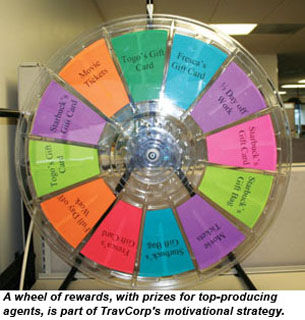 Call center managers also rely on feedback from the reservations agents to improve their strategies.
"They are our ears on the ground," said Madvhi Buch, vice president of call center management.
But despite the crucial role they play, call centers have a tough time retaining talent because of the sheer nature and repetitiveness of the work.
While all the call center agents I shadowed and spoke with expressed satisfaction with their job, most saying they actually love it, TravCorp experiences about 12% to 18% turnover in its call center annually. The industry average is about 25%, Buch said.
On average, TravCorp's call center employees are in their mid-20s and stay with the job for two to three years. In an ongoing struggle to retain well-trained, well-versed call center agents, TravCorp's call center management team is constantly fine-tuning ways to retain and motivate successful staff.
"Our culture here is a motivation-atmosphere culture," Buch said. "You could have the best systems in the world, but it all comes down to people."
An exercise in motivation
The call center is the point of transaction for tour operators, the place where the sale is closed and the revenue realized, which is why one of the company's key goals is "one-call resolution." Res agents must do whatever they can to minimize the possibility that a travel agent will call a competitor or not call back to complete a booking.
But with a job that can often be monotonous, motivating call center employees to remain constantly pleasant and inspiring them to close the sale requires creativity.
 While I was in Anaheim, call center managers met to discuss a mentoring program to identify call center agents with greater potential who might ultimately move into supervisor or management positions themselves.
"We're looking for agents with untapped potential that we want to help develop," explained Espy Petrutis, a call center manager. "A pool of agents available for supervisor or management positions."
The call center managers were building an educational program for those agents whom they identified as having potential. They pitched ideas such as listening in on other agents' calls and critiquing them for quality, accompanying business development managers to observe their interaction with travel agents and proposing solutions to difficult call center scenarios.
"The ultimate goal is always longevity," Buch said. "We want to build a strong pool of potential, definite leaders."
Among the many incentives and motivational activities TravCorp offers its call center employees is an event called Europefest, a week of festivities that coincides with the annual launch of the Europe brochure for the following year, normally in September.
Europefest is a good example of something TravCorp does to both educate call center agents about the destinations they sell with Europe-themed events and to motivate them with fun activities intended to get them amped up to work hard during the peak selling season.
The fest includes competitive events and lots of different Europe-themed food experiences, like a crepe-making station.
"It's an excuse to recharge everyone's sales batteries," Buch said.
The trick is to get the call center agents excited, so that they can get travel agents excited, so they can get their clients excited -- all to make the sale.
In the trenches
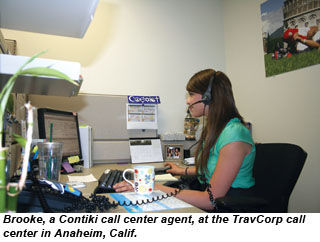 A multitude of scenarios await the call center agent when he or she answers the phone. The person on the other end of the line could be anyone from a very frustrated travel agent trying to get information for a client to someone who is really excited about booking an upcoming vacation.
Listening in on a dozen or so calls with various call center agents, I experienced firsthand the variety of call center communications that take place between travel agent and reservations agent.
At times, neither the problem nor the solution was totally clear-cut. Such was the case as I monitored my very first call.
Sitting with Morgan, a call center agent for Trafalgar Tours, a travel agent named Jane from Long Beach, Calif., called with a question about her client's payment. At issue was whether the booking had been paid in full.
When Morgan looked it up in the reservations system, she showed a balance of $49.28. Upon further investigation, including putting the agent on hold and calling the air department, Morgan discovered the reason: Taxes and fuel surcharges on the clients' airfare had increased since the booking was made.
The agent claimed she called to check the final price and was told the price her client paid was correct. But Morgan's call notes showed that a call center agent had made a call to Jane's agency to let her know that the price had gone up.
"Normally, if we didn't make a call out, we would eat the cost," Morgan said. "But we did make the call."
Other reservations agents were facing different challenges.
In between answering calls, a Brendan agent was contacting travel agents and customers who had been affected by 18 withdrawn tours with rebooking options.
Brooke, a call center agent for Contiki, was dealing with the dilemmas of the more youthful travelers. A travel agent named Cynthia called, asking if a group of three people who had already paid a deposit could swap someone in.
To keep the cost lower, some Contiki tours will allow groups of three to travel and room together for a discounted rate. But, Brooke explained, "We don't do name changes, nor is the deposit transferable."
Not all the calls were difficult. In fact, some were downright simple.
John, a Trafalgar call center employee for two years, received a call from a travel agent named Amanda from Laguna Hills, Calif., who was eager to book clients on an eight-day Canada's Rockies itinerary. She patiently waited as John looked into numerous flight options for her and was thankful for his research.
After several minutes on the call, John didn't close the sale, but the outlook was hopeful.
A team effort
While most of my time at the TravCorp offices was spent in the call center, I did manage to get around to several other departments, from operations to customer service to the mailroom, to get a sense of the different aspects of running a major tour operation.
While the call center employees were taking calls from agents, Janis Boteilho, the manager of client support services, was working with calls and comments from clients who were either on a tour at the moment or had recently returned from a tour.
"The most popular complaint is the hotel room size," Boteilho said. "A lot of passengers go on tours in [Europe] expecting the size of [rooms] here."
 Boteilho said she handles about 45 to 55 correspondences a week.
In the operations department, Deirdre McLeod, supervisor for tour operations, assists tour directors who are out on the road with groups. This is her busy time of year.
"We take care of tour directors," she said. "They really are the face of the tour."
That means helping them deal with everything from deaths on tours to health issues to understanding dietary requirements such as the increasingly popular request for gluten-free items.
Down in the mailroom, TravCorp employees were making sure that tours were getting off to a good start. During the week I was there, TravCorp was sending out some 700 travel documents, which are mailed about two to three weeks prior to departure.
The documents must be checked and double-checked to ensure that the clients are receiving the proper information for their transfers, hotels and itineraries.
While the day was really about the call center, Launder wanted to hammer home the importance of all the different components of TravCorp in producing and selling a successful tour product.
"As a tour director, I thought: This is the most important job in the company," Launder recalled of his early days guiding group tours. In fact, he said, "everybody does" have the most important job in the company "because they're all so interconnected."
This report appeared in the July 12 issue of Travel Weekly.