On May 29, an Oregon-based travel agent hopes to step off a plane in Tokyo with between 50 and 100 Americans, the largest group of travelers to land in Japan since part of the country was devastated by an earthquake in March.
Not surprisingly, the man behind the "Flight of Friendship," as the trip is called, is Sho Dozono, owner of Azumano Travel, No. 47 on the 2010 Travel Weekly Power List.
Dozono is also known for bringing 900 Oregonians to New York shortly after the terrorist attacks of 9/11; a group of 100 travel industry leaders to Phuket, Thailand, after the 2004 tsunami; and another group to New Orleans one year after Hurricane Katrina.
In describing the latest Flight of Friendship, Dozono said the trip has two purposes: to show that Japan is safe for tourism and to let the people of Japan know that they are not forgotten.
 "The tendency is to move on to the next biggest news, whether it's the royal wedding or bin Laden, and people do get forgotten," Dozono said.
The Japan National Tourism Organization doesn’t have hard numbers yet, but anecdotally it has found that hotels in the country have lost about 45% of their business since the quake.
While domestic travel is starting to recover, foreign visitors are still hesitant to return.
"We have had a major decline in travel to Japan," said Noreen Tanamachi-Liu, groups manager for Yamato Travel Bureau in Los Angeles. She said that with spring being such a popular time of year for travel to Japan, due to both moderate weather and cherry blossom season, her agency lost a lot of business.
Tanamachi-Liu said there is also hesitation among her clients to visit Japan because they feel it would be difficult to enjoy themselves, "knowing so many lives were taken and people are still left without homes and jobs."
According to ARC figures, there has been some gradual improvement. Processed air tickets to Japan sold by U.S. travel agents dropped 44% just after the earthquake in March. Since the second week in April, ticket transactions were trending upward, and by the last week in April, transactions were only down 26% from the year before.
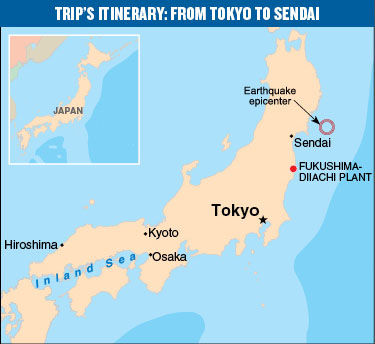
Nori Akashi of the JNTO’s New York office said the organization is trying to promote the return of travel to Japan’s most popular tourist destinations besides Tokyo: Osaka, Kyoto and Hiroshima. These happen to be at the opposite end of the country from Sendai, the city hardest hit by the post-earthquake tsunami, and the Fukushima power plant.
"The western region was not impacted at all," she said. "They didn’t even feel the quake."
Dozono, who will take his group directly to Sendai, said concerns that he is going too close to the nuclear reactor are off-base.
"Japan is about 1,500 miles long, and the restricted area is 27 miles," he said. "Sendai is quite a ways from the restricted zone."
Educating travelers on Japan’s geography is part of the work that both travel agents and the JNTO are trying to do.
Dozono is also trying to make people aware of the fact that, as with Phuket, New Orleans and New York, "lightning isn’t likely to strike twice."
To allay any concerns his group might have, the travelers will meet with personnel at the U.S. Embassy in Tokyo on the first day of the trip.
"If people have questions, they can ask them, and they will do a briefing for us," he said. "We will get the lay of the land from the U.S. government perspective."
Akashi said that the JNTO’s top priority right now is making sure that visitors from the U.S., Japan’s fourth-largest source of tourists and the largest outside of Asia, have the facts about travel to Japan, such as the misconception that radiation affects more than a very small area of the country.
To emphasize this point, the JNTO said that not only is there no dangerous level of radiation in Japan beyond the areas near the nuclear power plants, but that current radiation levels in Tokyo are similar to those of New York.
In addition, Akashi said that the bullet trains are all running on schedule, even to Sendai, and that all stores and restaurants in Tokyo and the western parts of the country are open.
Tanamachi-Liu said that her company is also trying to inform its clientele that Japan is safe, and said the company president will escort a group there this summer.
"We hear hotels saying their properties are fine and unharmed and need the business, and the Japanese government is saying it’s safe to visit Japan, and tourist organizations are back promoting tourism," she said. "We want to help them get back on their feet."
For more information on the Flight of Frienship, visit www.flightoffriendship.com.