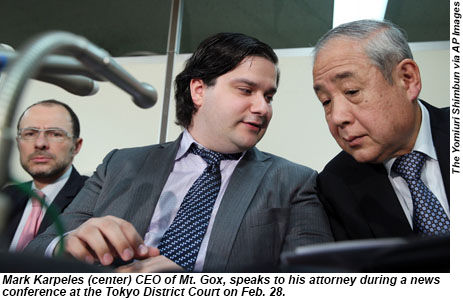
 Just as a few travel companies and major online retailers had begun accepting Bitcoin for payment, a major Japan-based Bitcoin exchange collapsed this week, adding to widespread wariness about the virtual currency.
The Mt. Gox exchange ceased operations after it was discovered that more than $390 million was missing. On Friday, the Associated Press reported that the exchange was filing for bankruptcy protection, saying the money had been stolen in a hacker attack that had wiped out virtually all its clients' accounts.
In many ways, Bitcoin, a form of nonphysical money not tied to any country or its currency, would seem ideal tender for the global travel industry.
But within just weeks of CheapAir.com and a few other travel companies beginning to accept Bitcoin for payment, the Mt. Gox scandal had analysts and other observers predicting that most travel suppliers and retailers would now be either shying away from the virtual currency or at least taking a wait-and-see posture.
In part, that’s because the demise of Mt. Gox was but the latest in a series of Bitcoin scandals and setbacks, coming just weeks after the arrests in New York City of two prominent Bitcoin exchange executives on charges related to laundering money for the drug-dealing website Silk Road.
Silk Road, which was shut down in October, accepted only Bitcoin for payment.
In both the Japanese and New York cases, executives were members of the Bitcoin Foundation, an entity created to standardize, protect and promote a digital currency beloved by its proponents but described by some critics as a Ponzi scheme.
Many of the currency’s proponents argued that the Mt. Gox collapse was a problem specific to a single exchange and was not an indictment of Bitcoin generally.
They compared the Mt. Gox collapse to the economic collapse of the economy in 2008 and 2009, which was caused by mismanagement by banks and not by fundamental problems with the U.S. dollar.
“We have to separate Mt. Gox from Bitcoin,” said Henry Harteveldt, industry analyst with Hudson Crossing.
However, Bitcoin remains an unregulated currency and one that clearly can expose its users to total loss of their funds.
Harteveldt predicted that the Mt. Gox collapse “will cause a lot of companies who were debating whether or not to accept Bitcoin to put it on a back burner until this situation is understood, and I don’t think there’s anything wrong with that.”
The most notable example of the growing interest in using Bitcoin within the travel community is CheapAir.com, a $160 million-a-year company. Ranked No. 48 on the Travel Weekly Power List under the name Amtrav, CheapAir.com accepts Bitcoin payments for both air and hotel bookings.
Virgin Galactic, the suborbital space tourism company being launched by Richard Branson, also accepts Bitcoin, and a number of other major industry players are reportedly considering following suit.
Despite growing interest in the currency, the community of Bitcoin developers and investors clearly recognizes the threat that the Mt. Gox scandal represents.
Jeff Klee, CEO and founder of CheapAir.com, said that Bitcoin was fundamentally sound, but he voiced concern that “perception could become reality.”
Even so, he said, Bitcoin has proved “remarkably resilient” in the past.
Last week, five major exchanges said in a mutual statement that they were working together to “re-establish the trust squandered by [Mt. Gox].”
Among the participants was Coinbase, an exchange that recently received $25 million in a funding round led by Andreessen Horowitz, the venture capital firm founded by Netscape creator Marc Andreessen.
In another attempt to bring stability to Bitcoin, New York-based SecondMarket said it was planning to launch a major new exchange.
“They want to create a trading exchange for institutions, and they’re trying to bring banks into this,” Harteveldt said.
Despite its growing pains and volatility, Bitcoin, the best known of scores of digital currencies that have emerged in the past five years, is a highly attractive payment alternative to retailers for several reasons.
First, exchanges such as Coinbase insulate merchants from Bitcoin’s volatility by immediately converting Bitcoin to dollars. “If it’s a $500 ticket and we get paid in Bitcoin, we get $500, because it’s that instantaneous,” Klee said.
Moreover, Bitcoin significantly reduces retailers’ exposure to fraud, which costs companies millions of dollars in losses and forces them to invest heavily in security resources.
Jonathan Johnson, Overstock.com’s executive chairman, said that the online retailer loses close to 0.2% of revenue to fraud — and that is after it opts not to process from 1% to 1.5% of its orders because they present a fraud risk.
Comparing Bitcoin with credit cards, Johnson said Bitcoin “is much more secure. There’s no chargeback risk.” He added that Bitcoin is also far cheaper than credit cards for merchants to accept.
“The interchange fee goes away — the 2% to 4% that goes to credit cards,” he said, adding that those savings can be passed on to consumers; Overstock.com is planning to offer an across-the-board 1% discount to all customers paying with Bitcoin.
“We’re big fans of it,” Johnson said.
Bitcoin’s global nature enables travel suppliers, retailers and other companies doing business across multiple borders to avoid the costs and complications of dealing with foreign exchange rates.
Several companies also said that it tends to produce new customers, simply because Bitcoin users are passionate about their virtual currency.
Overstock.com has racked up about a million dollars in Bitcoin sales since Jan. 6, and most of those are from new customers, Johnson said.
Klee said that CheapAir.com gets five or 10 Bitcoin bookings a day.
A key aspect of Bitcoin’s security advantage is that it offers consumers anonymity. When buyers use Bitcoin to make a purchase, the merchant is not given any information about them, thus avoiding the kinds of security breaches recently experienced by Target and Neiman Marcus.
Checkout is a simple, two-click process that does not require the consumer to reveal his or her name, address, credit card number and other information.
As for other travel companies using Bitcoin, Coinbase’s Nick Tomaino, who is responsible for business development on the East Coast, said the exchange is in the midst of discussions with “big name” travel companies.
The bottom line, said Harteveldt, is that whatever the fate of Bitcoin, what “we consider to be money is going to change over time. Whether it’s a virtual currency like Bitcoin or something else remains to be seen.”
Follow Kate Rice on Twitter @krtravelweekly.