 In the days, weeks and months after the Sept. 11 terror attacks on the Twin Towers in lower Manhattan, tourism to New York went into a tailspin as the city was placed on high alert and fear gripped the nation.
"I remember walking through the hotels in the city in the days that followed [9/11], and they were empty," recalled Steve Gorga, president and CEO of Farmingdale, N.Y.-based Travel Impressions. "There was nobody in the lobby."
By the end of 2001, New York had welcomed 35.2 million visitors, 1 million fewer than the previous year. In 2002, that number remained basically flat, at 35.3 million visitors. Tourism to New York didn't fully recover to pre-9/11 numbers until the following year, when 37.8 million visitors came to the city.
That number steadily grew until the recession hit. By 2008, New York's visitor numbers had climbed to 47 million, but in 2009 that number dropped to 45.6 million. Last year, New York welcomed 48.8 million visitors, as the city continued to reinvent itself and give visitors new and exciting reasons to come.
There are two parts to the New York recovery story: The first is the rebirth of lower Manhattan in the wake of the devastating attacks, which forever changed the city's skyline and left a gaping hole that came to be known as ground zero. The second is the way the entire city remade itself in the years since the attacks.
"A crucial part of the story of Sept. 11 is how lower Manhattan, an area many people said would turn into a ghost town, has come back in the past 10 years," Mayor Michael Bloomberg said in a statement in May. At the time, he was announcing the Get More NYC: Lower Manhattan campaign, designed to showcase the recovery and revitalization of lower Manhattan in the last decade and encourage visitors to stay in its hotels, eat in its restaurants, shop in its stores and experience the reborn neighborhood.
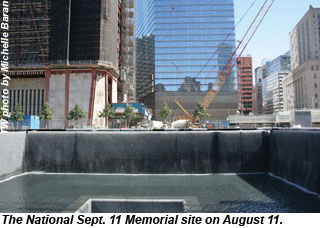 A major component of that rebirth is the National Sept. 11 Memorial, which will be open to victims' family members on the 10th anniversary and will be unveiled to the public Sept. 12. (Click here or on the photo to view a slideshow of the Memorial.)
"In the months and weeks leading up to the 10th anniversary of Sept. 11 and the opening of the 9/11 Memorial, lower Manhattan will be a focal point for the world," George Fertitta, CEO of NYC & Company, the city's tourism marketing arm, said in a statement. "We are prepared and look forward to welcoming visitors and locals to lower Manhattan and encouraging them to experience a neighborhood that has seen a dramatic revitalization in the last decade."
The memorial plaza sits on eight of the 16 acres that comprise the redeveloped World Trade Center site and consists of twin memorial reflecting pools in the footprints of the original twin towers, around which are inscribed the 2,982 names of the people who died in the attacks on 9/11 and on Feb. 26, 1993, when a truck bomb was detonated in a parking garage below the towers.
The remainder of the World Trade Center Redevelopment project consists of the Memorial Museum, which is slated to open in 2012; the Transportation Hub, which connects a PATH commuter rail station with 13 subway lines; and several commercial office buildings. The new buildings include Four World Trade Center, which when completed will be the future headquarters of the Port Authority of New York and New Jersey, which operates the site, and One World Trade Center, which will be the tallest skyscraper in New York at 104 floors and 1,776 feet to the top of the building's spire.
But beyond lower Manhattan, New York as a whole has also reinvented itself in the years since the devastating attacks.
For instance, last year, the city created the Trust for Governors Island, charged with bringing the 172-acre former military base, which sits in New York Harbor, south of lower Manhattan, back to life. Already, Governors Island -- part park space, part exhibition space, part playground -- has become a must-see attraction itself.
Other developments in the city include the High Line, a 1.5-mile-long park on an elevated rail structure on the far west side of Manhattan from Gansevoort Street to West 30th Street. And last summer, Central Amusement International opened the first phase of its new amusement park project, Luna Park at Coney Island at the southern end of Brooklyn, which features 19 rides. And these are just a few examples of new attractions and projects that have helped bring a steadily increasing flow of visitors to New York.
"New York City's quality of life has been greatly enhanced over the last decade," Fertitta said. "The city is now safer, cleaner and greener than ever before."
And New York's tourism industry is "thriving," he added, thanks to an increase tourism promotion funds, an expansion of NYC & Company's network to 18 international offices serving 25 markets and the launch of several communications and marketing programs highlighting all five boroughs.
Consequently, "tourism is now the city's fifth-largest industry, pumping more than $30 billion into the local economy and generating more than 320,000 jobs," Fertitta said.
Share your thoughts on how the travel industry has changed in the 10 years since 9/11.