CONCORD, Calif. -- As I drove toward wine country, on the
same route I had followed countless times before, I was filled with a mix of
emotions and questions.
Exactly one week after savage wildfires began claiming
lives and land throughout Napa and Sonoma counties, I wondered: How smoky would
it be? How much destruction would I find? What would be open and what closed?
How hard would it be to get around?
The road-closure maps provided by CalFire and other entities
comprised a confusing patchwork of reports, and the lists of which businesses
were open and closed were so fluid that I decided to just ignore them and head
toward Napa and Sonoma as if this were just one of my regular jaunts. If I ran
into roadblocks, I'd improvise.
"Model Bakery is closed," my husband texted me. He
knew my first stop would be Oxbow Public Market in the city of Napa, where I
would get a breakfast sandwich at Model and a coffee at Ritual as I planned out
my day. I went anyway, and it's a good thing I did, because Model was open.
That pleasant surprise would be the first of many throughout the day.
The first thing I noticed as I got out of my car at Oxbow
Public Market was that I didn't see or smell any smoke. In fact, it had been
smokier out in Concord, where I'm based, the week prior than it was last Monday
in Napa (though I heard that air quality worsened a bit in Napa the following
day and was expected to improve following a much-anticipated light rainfall
later in the week).
The market and downtown Napa were quiet. But it was also
Monday morning. The city had a very regular workday, low-grade buzz to it. Had
I not known about the fires, or were it not for the countless signs and
placards sending well wishes to the first responders and firefighters -- and
the occasional person wearing a face mask -- I might not have known anything
was awry.
I headed up to Yountville to start checking out some
wineries and tasting rooms to see how they were faring. My first stop was
Ma(i)sonry Napa Valley, which had opened for the first time since the fires.
The stylish tasting room takes reservations and also welcomes walk-ins.
Business, not surprisingly, was slow. But the owners were hopeful, because some
of their customers were rebooking for the low season winter months. Yountville
felt even more subdued and quiet than the city of Napa.
But in Yountville the devastation was much closer. A stone's
throw from downtown, the Atlas Fire had burned more than 50,000 acres of the
hills alongside the Silverado Trail, claiming several wineries in the area,
including Signorello Estate Vineyards, which was destroyed.
Napa Valley wildfires, one week later
As I headed toward the Silverado Trail, I saw what would be
the first of several signs of destruction: the hills charred by the Atlas Fire.
As I drove farther north, just as I turned a bend, I gasped. To the west, the
hills between Napa and Sonoma were still ablaze as firefighters struggled to
contain the Nuns Fire. It finally all started to feel much more real.
As I pulled into the reservation-only Frog's Leap Winery in
Rutherford, I saw that a brave group of wine tasters had gone forward with
their appointment, which took place in the winery's homey but luxurious tasting
room against a backdrop of the Nuns Fire. Bookings here, too, had taken a hit.
The group's driver, Dolly Paez of Allure Limo Wine Tours,
was waiting outside in the parking lot. She said the company had already lost
$20,000 in business in the week since the fires broke out. She was navigating
the patchwork of wineries, finding which were open and which closed, to help
clients who were still coming have an enjoyable experience.
"Nobody's been disappointed," Paez said.
She added that those wineries in Napa Valley that were open,
such as Whitehall Lane, Peju, Prager and Grgich Hills, were really rolling out
the welcome mat for whomever came in. That included one winery owner who opened
a special bottle of 30-year reserve wine for her clients.
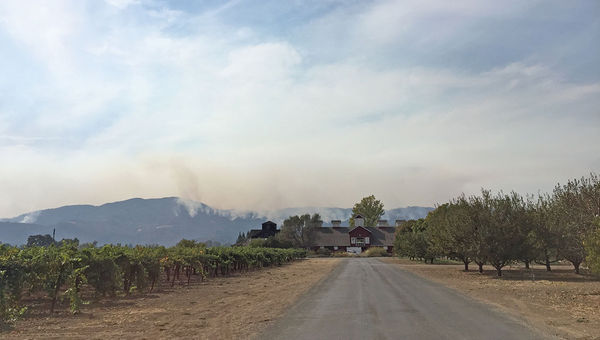
Smoke from the Nuns Fire in eastern Sonoma billowed behind Napa's Frog's Leap Winery. Photo Credit: Michelle Baran
Despite the fires still burning, there were considerably
more Napa wineries that were intact than not. Driving through Yountville and
St. Helena, Napa Valley still very much felt like Napa Valley, with its
picturesque vineyards made all the more lovely by the changing fall colors of
the vine leaves.
I asked Paez how to get across to Sonoma. She pointed to the
fires and told me I wasn't going to get through some of the northern back roads
that cross the range between Napa and Sonoma. I was going to have to go back
south toward the city of Napa and then back up.
As I headed toward Sonoma, the situation definitely felt
more severe. It was smokier out this way, and there were immediately more signs
of fire-related damage as I drove through the Carneros region that bridges both
Napa and Sonoma counties.
I saw a patchwork of burned-down buildings, barns and
wineries. The city of Sonoma was a virtual ghost town. Following an evacuation
order and loss of power, almost every business on the main square remained
closed as of last Monday.
And yet, the spirit of the community was on display. Signs
of gratitude and encouragement were everywhere. As of last week, firefighters
had gotten the upper hand on all the Napa and Sonoma wildfires. Evacuation
orders had been lifted in many areas, including the city of Sonoma, and those
places were being repopulated.
It will take some time, and this disaster will remain with
the people of Napa and Sonoma and its visitors for years to come. But so much
beauty (and great wine!) survived in Northern California's wine country that I
can't imagine visitors will stay away for long.