Coming off a record year in tourist visits, Chicago is continuing to add still more leisure visitors to complement its robust meetings and convention base. Still, at least one local hotel developer recently offered a perspective that lived up to the Windy City's reputation for relative modesty and a bit of bluntness.
"Chicago's not Miami Beach, but it's making meaningfully steady progress in the international tourist trade," said Oxford Capital Group founder and CEO John Rutledge, whose company has developed about a dozen Chicago hotels during the past 15 years. "Business drives this town, but leisure tourism from the region as well as national and international is absolutely a growing percentage."
When it comes to the country's hotel markets, Las Vegas might be bigger, New York might be more lucrative, and cities like Nashville, Denver and San Francisco might show more impressive year-over-year demand-growth numbers.
But when it comes to sheer development activity among burgeoning upper-end brands during the past couple of years, Chicago's hotel sector might just be the most dynamic in the U.S.
Chicago's approximately 110,000 rooms trail only Las Vegas's and Orlando's among U.S. metropolitan areas. It has benefited from a combination of a revamped tourism strategy taken from the pages of New York and a substantial inventory of either under-used architectural gems or under-performing hotels ripe for redevelopment and/or rebranding.
In 2012, looking to build on the appeal of traditional Chicago landmarks such as Navy Pier and Wrigley Field and more recent additions such as the $475 million Millennium Park (whose centerpiece, the Frank Gehry-designed Jay Pritzker Pavilion, was named for the founder of Chicago-based Hyatt Hotels), Chicago Mayor Rahm Emanuel restructured the city's tourism efforts under a single entity called Choose Chicago.
Echoing a strategy developed by former New York mayor and longtime political ally Michael Bloomberg, Emanuel pushed Choose Chicago to look beyond its traditional convention base and market the city as both a leisure destination to regional markets and as an international destination.
That has meant a combination of a bigger push as a weekend destination to residents of Midwestern cities like Minneapolis, Omaha and St. Louis and more marketing dollars targeting Mexico, South America and Asia. This month, Choose Chicago will open its fourth China sales office, in Chengdu, according to Choose Chicago Chief Sales Officer Marc Anderson.
"All of the marketing had been focused toward bringing in conventions," Anderson said, adding that Choose Chicago will launch its first advertising campaigns targeting San Francisco and Denver next month. "When you look at the quality of hotels in the city, the number of restaurants, museums, parks and the Lakefront, it's imperative to keep selling that story of Chicago as an international business and leisure destination.
A successful strategy
Buoyed by the rising tide of global travel spending, Chicago's strategy appears to be working.
Since 2009, when revenue per available room (RevPAR) tumbled 23%, to less than $65 a night, citywide occupancy has jumped to 69% from 56%, representing an increase of more than 5 million room nights a year. Like most other major U.S. markets, Chicago's hotel demand has been on a steady upswing since the recession, showing annual RevPAR increases of between about 4.5% and 10% since 2010, according to PKF Hospitality.
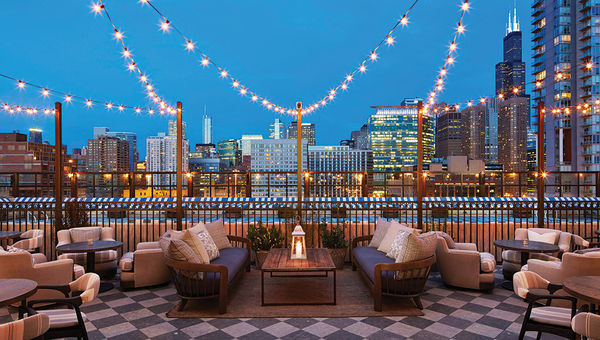
The Soho House Chicago roof deck.
And last year, Chicago boosted its visitor count by 3.5%, to a record 50.2 million visitors, according to Choose Chicago. At the same time, the city has increased visitor numbers by about 20% since 2010 and is shooting for another 10% boost by 2020.
"There's no doubt that San Francisco and Boston are the two most compelling U.S. cities from a supply-constraint standpoint, and Oahu has its own special magic," Rutledge said. "However, there are a number of other big, deep, strong markets in the country, and Chicagoland is one of the three largest."
As a result, during the past four years, those visitor increases have lured hoteliers into either bringing brands with a predominantly overseas presence into Chicago or trying out new concepts altogether.
Trend-setting Ian Schrager was an early example, selecting a location on Chicago's Gold Coast to open the first (and, so far, only) Public-branded hotel. The 285-room property, which inhabits what was formerly the Ambassador East Hotel and includes an update of the city's iconic Pump Room, debuted in October 2011.
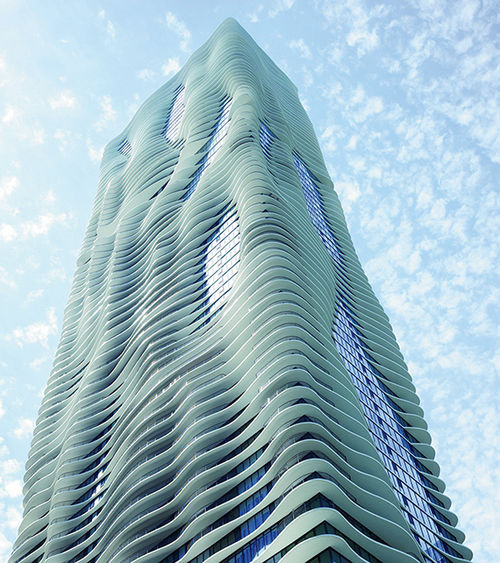
The modernist Radisson Blu Aqua exterior.
The following month, Carlson Rezidor, which had about 275 Radisson Blu properties outside of the U.S., introduced the brand stateside with the opening of the 334-room Radisson Blu Aqua in the city's newer Lakeshore East district. The upper-upscale hotel, one of the downtown's few newbuilds, takes up the first 18 floors of an 81-story, modernist skyscraper that includes undulating terraces, about 80,000 square feet of meetings space and amenities such as an indoor basketball half-court.
Enter the hoteliers
Like Chicago's tourism numbers, development has accelerated since 2013. That June, Langham Hospitality, whose history dates back to 1865 with its namesake London property, debuted Chicago operations on the northern edge of the Chicago River in the Loop's Ludwig Mies van der Rohe-designed architectural landmark previously known as the IBM Tower. The 316-room luxury property, whose rooms exude a posh, modern bachelor-pad vibe, includes a restaurant designed by Rockwell Group, afternoon tea service and a butler staff.
More unusual is the hotel development that opened a month after the Langham and five blocks away, in the heart of Chicago's River North district.
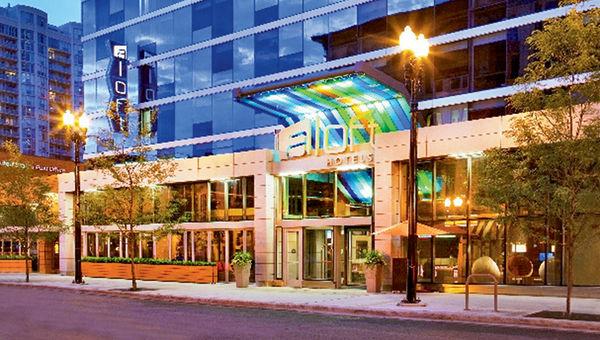
White Lodging's River North "Triplex," which opened in July 2013, includes a 212-room Hyatt Place, a 272-room Aloft (pictured) and a 180-room Fairfield Inn & Suites.
Commonly known as the Triplex, the White Lodging-developed complex includes a 272-room Aloft, a 212-room Hyatt Place and a 180-room Fairfield Inn & Suites, making it the only single property development in the U.S. to include brands from Starwood, Hyatt and Marriott, respectively.
That fall, lifestyle badge Thompson, whose parent, Commune Hotels, is run by Hyatt scion John Pritzker, entered Chicago by taking over the 247-room Sutton Place Chicago on the city's Gold Coast and turning over its food and beverage program to noted Chicago restaurateurs One Off Hospitality Group.
By the following February, Oxford Capital, which redeveloped the Langham Chicago, opened its first upper-upscale, lifestyle property under its Godfrey badge in River North (Oxford will open a second Godfrey in Boston later this year). Boasting the largest rooftop lounge among city hotels, the 221-room Godfrey plays up its credibility among the tech-savvy set via its stark architecture, elliptical lobby, touch-screen concierges and "Discover Your Element" theme; as part of the company's branding effort, the Godfrey includes symbols similar to those on a chemical periodic table to identify certain amenities such as "Sp" for spa, "Tc" for technology and "Zz" for sleep.
And of last August, Soho House, which was founded in London in 1995 as a membership club for people in the arts and media sectors, debuted in Chicago by rehabbing an old belting factory in the rapidly gentrifying Fulton Market district west of the Loop. The 40-room property, which offers accommodations to nonmembers, as well, and has a rooftop pool, is Soho House's largest.
New flags flying in the heartland
With many of the country's largest brands previously represented in Chicago, the recent development trend illustrates an attempt by brands lesser known to Americans to gain domestic exposure by planting themselves in the middle of the country, said Mark Eble, Chicago-based regional vice president at PKF Hospitality.
"Chicago, by any measure, is among the top five markets in the country, so if you want to be in the game, you've got to play there," Eble said. "I don't think we're going to see a Langham in Detroit or a Thompson in Cleveland, and there will never be a Nobu or Soho House in Indianapolis."
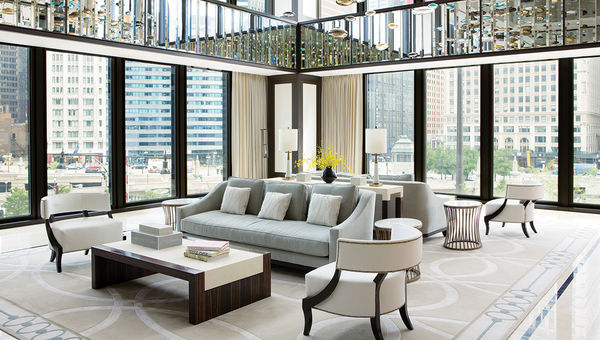
The Langham Chicago lobby.
Oddly, despite the record tourism numbers, Chicago has performed relatively modestly when it comes to room-demand increases, at least compared with the rest of the country.
Last year, Chicago's RevPAR rose 7.1%, lagging the 9.2% growth rate for the U.S., according to STR. Meanwhile, Chicago's 69% occupancy rate was about three percentage points behind that of the top 25 U.S. markets, while its average room rate of about $135 a night trailed that of smaller markets such as New Orleans, San Diego and Seattle.
Even breaking out downtown, which accounts for almost 40% of Chicago's rooms and where most of the development activity is taking place, demand growth has tapered off in recent years, with RevPAR advancing less than 4% in 2013 and about 3% last year, according to STR.
Still, the combination of relatively inexpensive real estate (compared with coastal cities), the presence of McCormick Place (the country's largest convention center) and easy air access makes Chicago a relatively safe bet for hoteliers, said Jan Freitag, STR senior vice president.
"It's the first mainland city after the coasts, even before Atlanta," Freitag said, noting that United Airline's hub is in Chicago's O'Hare Airport, while Southwest Airlines has recently increased its routes through Chicago's Midway Airport. "With Chicago, airlift is always a positive story."
An image correction
Additionally, Choose Chicago's efforts, combined with factors such as the city's well-regarded restaurant scene, has helped alter Chicago's reputation as primarily a convention town and turned the Windy City into more of a regional destination.
"When I started in Chicago in 1981, Saturday and Sunday were terrible, and Tuesday through Thursday were really strong," Eble said. "Nowadays, Friday and Saturday nights are among the busiest of the week."
That means that in addition to the newbloods, some of Chicago's largest and most tried-and-true hotels are making big investments in upgrades.
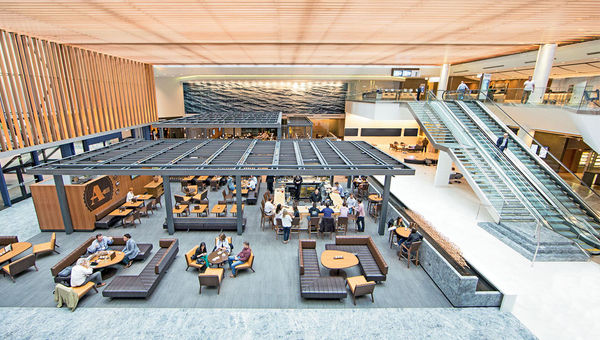
The Hyatt Regency lobby.
In April 2013, the 2,019-room Hyatt Regency Chicago, the city's largest hotel, completed its $170 million renovation, lightening up its airport terminal-size, multilevel lobby and upgrading both its check-in area and its Stetsons Steak & Sushi restaurant in the process.
And last spring, Hilton Worldwide's legendary Palmer House, whose history in the Loop dates back to 1873 (the original Palmer House was built two years prior but was destroyed 13 days after it opened by the Great Chicago Fire), completed its $215 million renovation. Among the parts of the building that were renovated and restored efforts were the hotel's 1,641 rooms, its famed Empire Room nightclub, Lockwood Restaurant and Bar and, most stunningly, the religious-themed murals on the 50-foot-high ceilings in its massive lobby.
Granted, any city's hotel-expansion push involving hundreds of millions of dollars isn't without hiccups. Last month, for example, Crain's Chicago Business reported that Schrager put the Public Chicago property up for sale. While Schrager is expected to make a profit on the sale, at least one analyst said that the property's location on a relatively quiet stretch of State Street might have contributed to less-than-expected demand. (Schrager representatives did not respond to a request for comment.)
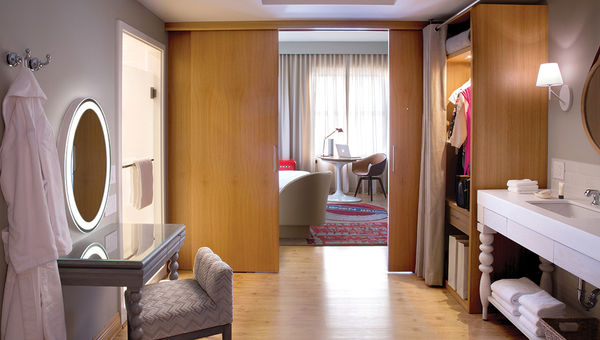
A Virgin Hotel Chicago guestroom.
Still, there is little sign of slowdown in hotel openings. In January, the first Virgin-branded lifestyle hotel opened in downtown's Old Dearborn Building, offering 292 rooms. This month, Loews, which operates Loews Chicago O'Hare in the suburb of Rosemont, Ill., opened its first hotel in Chicago proper. The 400-room, downtown property occupies the first 14 floors of a new 52-story tower and includes a steakhouse run by "Iron Chef" winner Jose Garces.
Just blocks from the Soho Chicago, an Ace Hotels boutique property is under development, according to Crain's Chicago Business (the hotelier has been typically mum about it).
Meanwhile, lifestyle hotelier Viceroy will enter Chicago in 2017 at a redeveloped Gold Coast site about halfway between the Public and Thompson properties.
And last month, Oxford Capital said it was redeveloping Michigan Avenue's London Guarantee Building as well as an adjoining new building into a 452-room hotel to be called LondonHouse, which will be part of Hilton's new Curio collection of independent properties. The hotel, its name a nod to the legendary jazz club once housed in the building, is slated to open next year.
"Chicago has had a large number of well-located, classical buildings that we can buy at deep discounts and convert to beautiful hotels," said Oxford Capital's Rutledge, who added that both the Langham and Godfrey were performing "well above" expectations. "If you look at the course of three to six years, annual deliveries are tracking with relative increases in demand. There's not going to be a bloodbath."