FORT LAUDERDALE -- A new addition to CruiseWorld's programming this year: TW Talks, eight-minute presentations from industry leaders.
The presentations ranged from talks on technology to leadership, touching upon a number of important topics. Several were presented during each general session of CruiseWorld.
Nexion president Jackie Friedman led off the talks with a conversation around "feeling like a little fish in a big pond."
The travel industry is a proverbial big pond with many small fish, but it's not something agents have to face alone, Friedman said. First, she suggested agents affiliate, whether it's with a host agency, consortia, franchise or association, which can provide tools and technology to help grow businesses. Connecting at conferences, FAM trips and even online is also an important thing for agents to do, Friedman said, as is collaboration with fellow agents and suppliers.
"It starts with you, but take advantage of the big pond," Friedman said. "Make it work for you instead of against you and be the best small fish you can be."

Jackie Friedman, president of Nexion, delivers the first of three TW Talks for the day at CruiseWorld. Photo Credit: Creative Focus
Next, Michelle Fee, co-founder and CEO of Cruise Planners, tackled big data and future technology. Technology is evolving at a faster rate than ever before, and while it's hard to keep up with, it's important for agents to do so, she said. "Data is power, and you all have data in your CRMs," she said.
Fee encouraged agents to use data analytics and business intelligence tools to further drive business and predict their customers' wants and needs.
During his TW Talk, Scott Koepf, senior vice president of sales at Avoya Travel, recalled a story from his past. He was 20 years old, in great shape, and looking to play a game of raquetball, which was wildly popular at the time. The only persona available to play one day was an older man in his 50s. Koepf was reluctant, not wanting to embarrass him, but agreed to a game.
He played the best three games of his life, only scoring three points, and was "absolutely destroyed" by the older player. But the man offered three pieces of advice to Koepf, which remain what he considers to be the best business advice he's ever heard.
First was "find your position and stay in it." For agents, that means finding a specialty, a unique niche, to focus on and cultivate. Next was that once you find your position, for the most part, the same things will happen over and over again. In the travel industry, that means focusing on the right kind of business, not the occasional long shots something an agent would never sell but burns themself out trying to do.
Finally, Koepf said, comes practice and doing drills. Drills for agents come in the form of practicing the basics: What they sound like on the phone, what 30 qualifying questions they've asked customers. Like anyone great at something, he said, "you've got to do the drills."
Jenn Lee, vice president of sales and marketing at Travel Planners International, had a simple message in her TW Talk, "Impatience is a Virtue." To excel in business, agents need to push themselves to reach further goals.
"You see, patience is actually the enemy of progress when you're trying to reach a goal," she said.
Leadership was the theme of Debbie Fiorino's talk, "The Soft Stuff is the Hard Stuff (Servant Leadership)."
The senior vice president of Dream Vacations, CruiseOne and Cruises, Inc. said things like transparency, trust, culture and communication are key. Servant leadership sees senior employees putting the needs of others first and sharing power, which helps others develop and perform well in their positions.
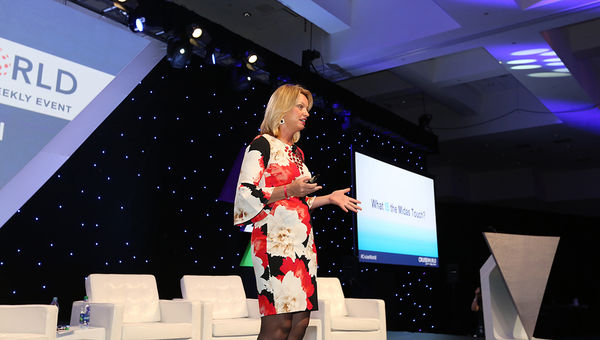
Meredith Hill, founder and president of Gifted Travel Network, presents a short TW Talk on "Activating Your Midas Touch." Photo Credit: Creative Focus
Rounding out Wednesday and Thursday's TW Talks was Meredith Hill, founder and president of Gifted Travel Network. She offered advice on how agents can "Activate Your Midas Touch," or their propensity to grow their business.
"The thing is, we spend a lot of time blocking it," she said with negative thoughts and feelings. She encouraged agents to shift their perspectives, for instance, looking at problems as springboards to achieve greater things.
"Don't jump into action and start practicing these three things for the end result," Hill said. "Do it for the journey. Do it because it's actually fun to feel better."
Legal questions, answered
Do agents have to be registered travel sellers in states where they might only make a few sales a year?
The answer is yes, said Mark Pestronk, the industry attorney and
Legal Briefs columnist, who hosted a TW Talks session: The answers to eight questions he hears
most often from travel retailers.
Civil penalties include a $5 a day fine up to $500 in California, and
a potential $5,000 fine in Florida, where agents can expect to receive a
reminder letter, then a demand letter, before any action.
Another question often posed, Pestronk said, was whether an agency
owner can get out of a contract with a supplier by saying an employee
was not authorized to sign it. The answer is a qualified yes, "if the
person who signed has a title that is not a corporate office title and
you didn't take any steps that indicate you agreed to the contract, such
as making payment."
A very popular question is about the best way to sell a travel
agency. Pestronk said that, in order, the following people are the best
to consult: a fellow hostee of your host agency or the host agency
itself; a fellow member of your consortium or trade association who you
trust; a national consulting firm or broker; and a local experienced
business person in the community, not necessarily in the travel
business. Next on the list is a local business broker, although Pestronk
said they are rarely savvy about travel.
He said although agency owners frequently try to sell to employees,
it rarely works because the employees seldom have the funding to support
a deal. He said an agency owner who does sell to an employee should be
sure to get a lien on the assets of the business so that he or she can
take it back if the employee doesn't pay.