I wasn't in the outback, or even "the bush." I was in the rolling hills of South Australia's Clare Valley wine country, about 75 miles north of Adelaide. But I was determined that, since I was in Australia, I was going to engage with Aboriginal culture, the heritage and way of life of an ancient people I, as an ill-informed foreigner, associated only with this continent's endless, arid inner stretches.
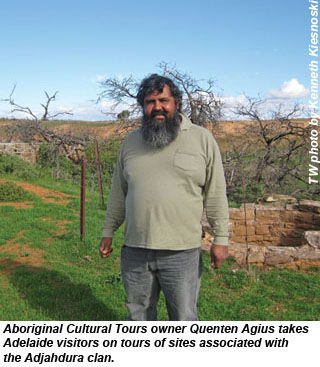
I'd asked about the possibility of Aboriginal tours within striking distance of highly urban Adelaide and was referred to Aboriginal Cultural Tours, run by one Quenten Agius out of Point Pearce, on the Yorke Peninsula.
So there I sat, finishing up breakfast at a posh bed and breakfast nestled up against the vineyards of Seven Hill, when Agius drove up in his dusty pickup. I gulped my cappuccino and we set out for a day in Adjahdura Land, as the peninsula is known to its Aboriginal inhabitants.
Extending like a finger from South Australia and separated from the Adelaide area by Gulf St. Vincent to the east, the Yorke Peninsula has been the Adjahdura clan's homeland for 40 millennia.
 It's also home to wide expanses of plains dotted with isolated, low-slung mountains as well as rolling farmland, old mining towns and the wide, beautiful beaches that figure prominently in South Australia tourism brochures. But it looked nothing as I'd imagined the Australia of the Aborigines would. I'd been thinking desert, blazing sun and Ayers Rock; this landscape was subtler, softer and gentler.
Much like Agius himself. A strong, burly and bearded "fella," as Aussies would put it, he proved soft-spoken and amiable, if, at first, a bit impenetrable. I decided later a better term was "enigmatic," as much of Aboriginal culture can seem to a newly arrived visitor.
In fact, at our first stop I encountered my first Aboriginal enigma. We pulled over at a rest area at the unofficial border of the peninsula, and Agius pulled two boomerangs from behind the driver's seat.
He pointed the curved sticks at two hills in the distance, explaining the roles they play in a complex, key story from the Adjahdura version of the Dreaming, the Aboriginal creation narrative. But he apologetically warned he couldn't reveal the whole story to an outsider. I said I completely understood, given the historically poor treatment of Aborigines at the hands of newer arrivals on their peninsula.
Agius then turned from me, faced the hills and began rhythmically tapping the boomerangs together. Chanting in the Adjahdura language, he asked for leave from local nature spirits and his ancestors to tell me select bits of the Dreaming and take me on a tour of their lands. I assume I was welcomed, as we soon peeled off in the truck.
We pulled over in the seaside town of Ardrossan for a quick lunch before marching down to the town beach. The strand's cliffs and caves, rich in red clay, figure prominently in Adjahdura mythology, and Agius regaled me with an ancient Aboriginal fable, the action set on that very same shore.
We headed back out of town, bound for nearby farmland, stopping here and there along the road when Agius would spot a plant, bush or tree traditionally used by the Adjahdura. He'd pluck the berry, leaf or twig, hand it to me and hold forth.
Reaching a verdant farmstead, we hopped over a small fence or two to visit an abandoned farmhouse where Europeans massacred dozens, if not hundreds, of Aborigines in the early days of white settlement. A bit spooked, I was glad to head out in the pickup, bound for Black Point, a stretch of dunes where Agius plucked genuine artifacts -- stone chisels, knives, arrowheads and the like -- from what looked to me like simple scatterings of stones. On the way back to our pickup, he asked if I'd mind it if he quickly checked for Aboriginal remains in the foundations dug for a nearby holiday home development.
That's when I learned Agius -- protagonist of the 2007 documentary "Sacred Ground" -- has long been an activist fighting for indigenous rights and protection of Aboriginal burial sites. As he put it at the time of the film's release: "Our ancestors are buried all over this country, in the sand hills, along coastal areas and near waterholes.
"Adjahdura Dreaming sites, burial grounds, cultural landscapes and archaeological sites have been desecrated and destroyed," he said. "If something isn't done soon, our heritage ... will be lost forever."
We did find what appeared to be a human finger bone jutting out from a newly dug condo foundation. Agius said he'd report the find. While he did, I spent time chatting with his mother, Irene, at her home in Point Pearce, a struggling town of 150 located in the Australian equivalent of a U.S. Indian reservation.
As we talked about life in Bookyanna, as Point Pearce is called in Adjahdura, I admired a didgeridoo (a wind instrument indigenous to Australia) that had been hand-carved by Agius' younger brother.
The didgeridoo got me thinking. I hadn't seen one as yet that day. Nor had Agius stripped down, painted himself in the bold white stripes and patterns the Aborigines of my mind's eye are always sporting and danced a part of the Dreaming for me. Yet I'd gotten real insights into Adjahdura life of both the past and present.
Agius built his business, completely Aboriginal-owned and -operated, from the ground up and has to date won five South Australian Tourism Awards.
Tours range from a half day to five days. Options include a $65 half-day cultural tour of Point Pearce; a $130 one-day tour with a choice of four itineraries; a $320 two-day tour with a choice of three itineraries; and three- and five-day itineraries priced at $495 and $975 a person, respectively.
An extended tour of all Agius' one-day options, the five-day Ultimate Experience comprises cultural ceremonies, 1.5 days exploring the peninsula's east coast, 2.5 days at Innes National Park and one day in Point Pearce. Aboriginal Cultural Tours also arranges Adjahdura dance performances and overnight accommodations. The minimum for booking tours is two people.
For more, email Aboriginal Cultural Tours at [email protected] or visit www.adjahdura.com.au and www.sacredground.com.au.